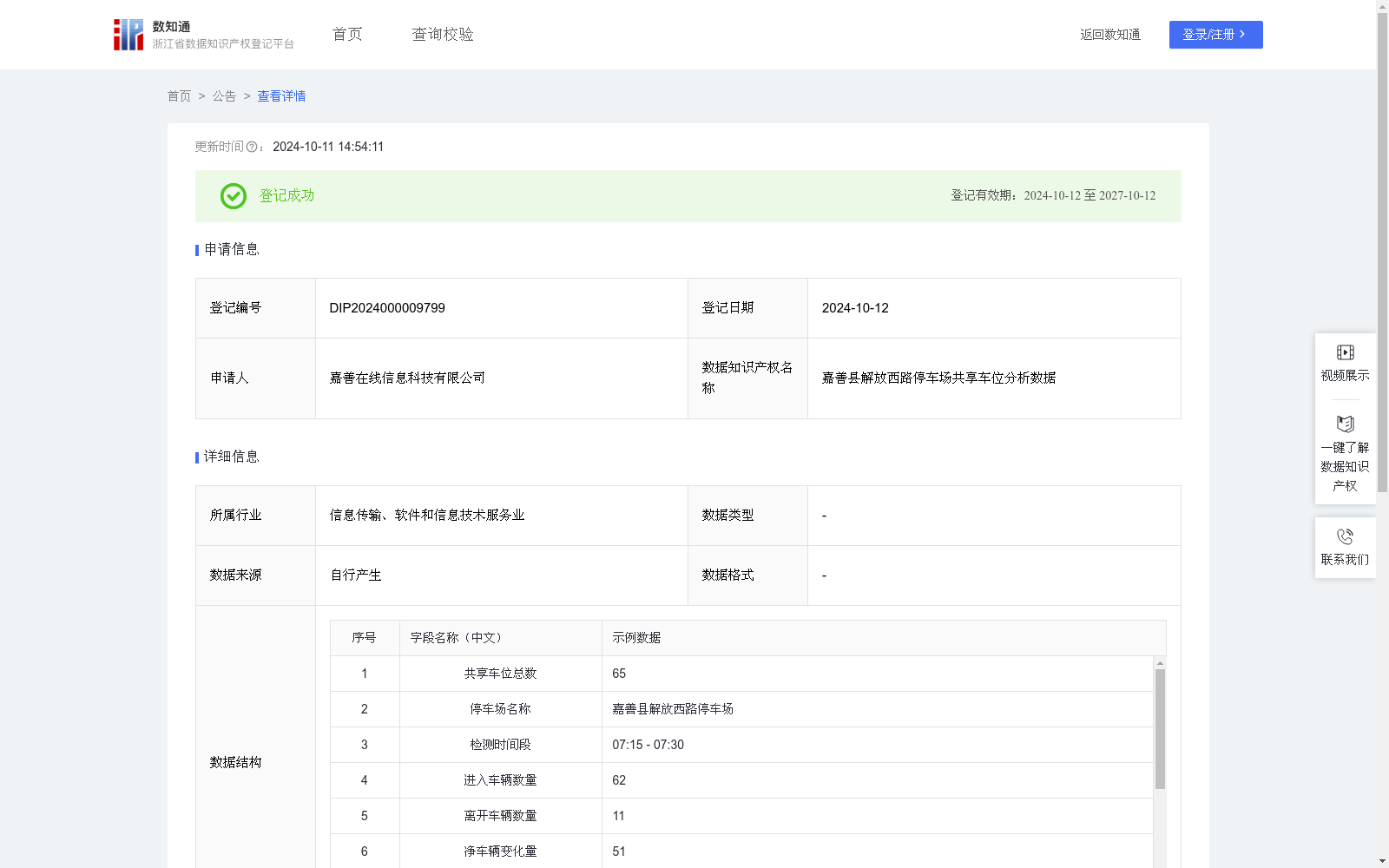
嘉善县解放西路停车场共享车位分析数据
收藏资源简介:
通过数据采集,获取当前停车场使用共享车位车辆的出入信息,分析共享车位的利用率情况,确定共享车位的使用高峰期,方便后续对当前停车场共享车位不同时间段的扩张和缩减提供参考,为市民提供更好的城市停车服务。1.数据采集:车辆驶入或驶出停车位时,安装在此停车位上的红外检测仪器会判断有车还是无车,将判断后的数据上传到平台相应的接口,平台解析数据并根据数据库中存储的设备信息,找到当前车位所在的停车场和车位编号,更新停车场和车位的状态。 2.数据处理:将每天的时间段切片,统计某个时间段里面的进出车辆数据,获取停车场的净车辆变化量,根据每个时间段的净车辆变化量计算四分位数和四分位距,确定高峰期和低峰期阈值,根据与净车辆变化量判断是否为高峰期或低峰期。净车辆变化量大于等于高峰期阈值的,判断为高峰期;净车辆变化量小于等于低峰期阈值的,判断为低峰期;净车辆变化量小于高峰期阈值且大于低峰期阈值的,判断为非高峰/低峰期。净车辆变化量 = 进入车辆数量 - 离开车辆数量;第一四分位数(Q1),第三四分位数(Q3),四分位距(IQR)=Q3 - Q1;高峰期阈值=Q3 + 1.5 * IQR;低峰期阈值=Q1 - 1.5 * IQR。
This dataset collects entry and exit records of vehicles utilizing shared parking spaces in a specific parking lot, to analyze the utilization efficiency of shared parking spaces and pinpoint their peak usage periods. The dataset offers valuable references for subsequent expansion or reduction of shared parking spaces in the parking lot at different time intervals, thereby enabling improved urban parking services for citizens. 1. Data Collection: When a vehicle enters or leaves a parking space, the infrared detection sensor mounted on the corresponding parking space will detect the presence or absence of a vehicle. The sensor uploads the detection result to the corresponding interface of the platform. The platform parses the received data, locates the parking lot and the specific parking space number based on the device information stored in the database, and updates the real-time status of the parking lot and the parking space. 2. Data Processing: The daily time period is divided into discrete time slots. For each time slot, the entry and exit vehicle counts are tallied to calculate the net vehicle change volume, which is defined as the number of entering vehicles minus the number of exiting vehicles. Quartiles (first quartile Q1 and third quartile Q3) and the interquartile range (IQR = Q3 - Q1) are then computed based on the net vehicle change volumes across all time slots. The thresholds for peak and off-peak periods are determined as follows: peak period threshold = Q3 + 1.5 * IQR, off-peak period threshold = Q1 - 1.5 * IQR. A time slot is classified as a peak period if its net vehicle change volume is greater than or equal to the peak threshold, an off-peak period if its net vehicle change volume is less than or equal to the off-peak threshold, and a non-peak/non-off-peak period otherwise.