<b>Effects of Dietary Supplementation with Different Levels of Rose Pomace on Rumen Bacterial Diversity and Fermentation, and Longissimus Dorsi Fatty Acids in Hu Sheep</b>
收藏资源简介:
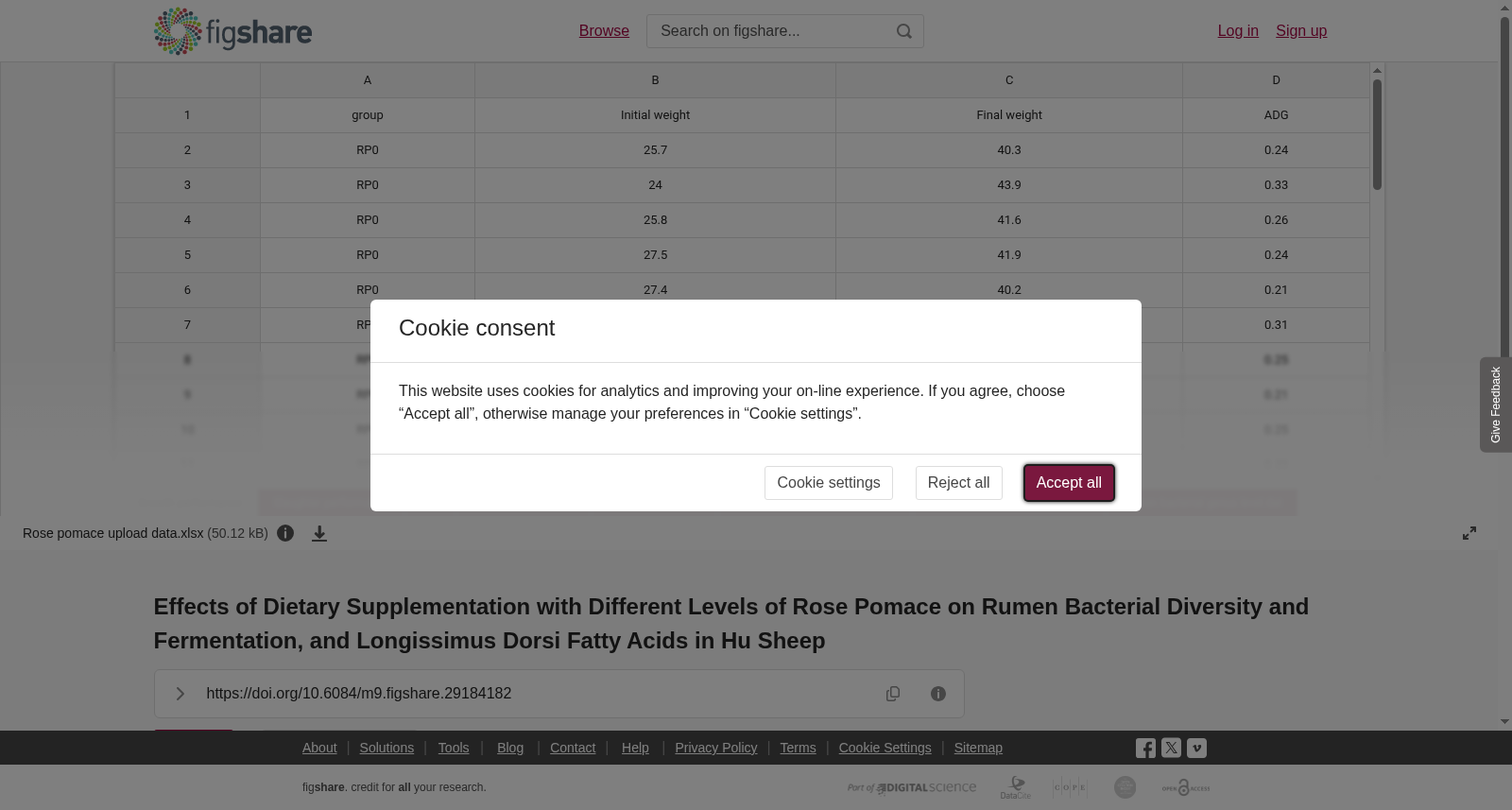
To address the underutilization of rose processing byproducts and meet the demand for antibiotic-free meat production, this study examined the effects of dietary supplementation with rose pomace (RP) on growth performance, rumen fermentation, bacterial diversity, and longissimus dorsi amino acid and fatty acid profiles in Hu sheep. Forty male Hu sheep were randomly assigned to four groups (n=10): a control group (RP0) with a basal diet and three treatment groups supplemented with 2%, 4%, or 8% RP (RP2, RP4, RP8). Results showed that RP8 had significantly higher dry matter intake (DMI) than RP2 (P≤0.05). Rumen fermentation analysis indicated higher acetate in RP4 than RP0 (P≤0.05), while propionate and total volatile fatty acids (TVFA) were lower in RP0 than in all RP groups (P≤0.05). RP8 exhibited significantly elevated isobutyrate (P≤0.05) and isovalerate (P≤0.01), with valerate levels higher in RP4 and RP8 than RP0 (P≤0.05). Microbial analysis revealed increased Bacteroidota and reduced Patescibacteria in RP8 (P≤0.05). RP8 also showed higher Rikenellaceae_RC9_gut_group abundance (P≤0.05). In longissimus dorsi muscle, RP4 had significantly higher C18:3N3, N-3 PUFAs, and C20:2N6 than RP0 and RP8 (P≤0.05). These findings suggest RP modulates rumen microbiota and fermentation, enhancing beneficial fatty acid deposition in lamb meat. An RP supplementation level of 2%-4% yielded optimal results, providing valuable insights for sheep farmers seeking functional feed additives.
为解决玫瑰加工副产物利用不足的问题,并满足无抗生素肉类生产的需求,本研究探究了日粮添加玫瑰果渣(rose pomace, RP)对湖羊生长性能、瘤胃发酵、细菌多样性,以及背最长肌氨基酸与脂肪酸谱的影响。将40只雄性湖羊随机分为4组(每组n=10):对照组(RP0)饲喂基础日粮,另外3个处理组分别添加2%、4%或8%的玫瑰果渣(依次记为RP2、RP4、RP8)。结果显示,RP8组的干物质采食量(dry matter intake, DMI)显著高于RP2组(P≤0.05)。瘤胃发酵分析表明,RP4组的乙酸含量显著高于RP0组(P≤0.05);而RP0组的丙酸与总挥发性脂肪酸(total volatile fatty acids, TVFA)含量均低于所有玫瑰果渣添加组(P≤0.05)。RP8组的异丁酸(isobutyrate)与异戊酸(isovalerate)含量显著升高,且RP4与RP8组的戊酸(valerate)含量均高于RP0组(P≤0.05)。微生物组分析显示,RP8组的拟杆菌门(Bacteroidota)丰度升高,而帕氏杆菌门(Patescibacteria)丰度降低(P≤0.05);同时RP8组的Rikenellaceae_RC9_gut_group丰度显著提升(P≤0.05)。在背最长肌中,RP4组的C18:3N3、N-3多不饱和脂肪酸以及C20:2N6含量均显著高于RP0与RP8组(P≤0.05)。上述研究结果表明,玫瑰果渣可调控瘤胃微生物群与发酵过程,提升羔羊肌肉中有益脂肪酸的沉积。2%~4%的玫瑰果渣添加量可获得最优饲喂效果,可为肉羊养殖户开发功能性饲料添加剂提供有价值的参考依据。