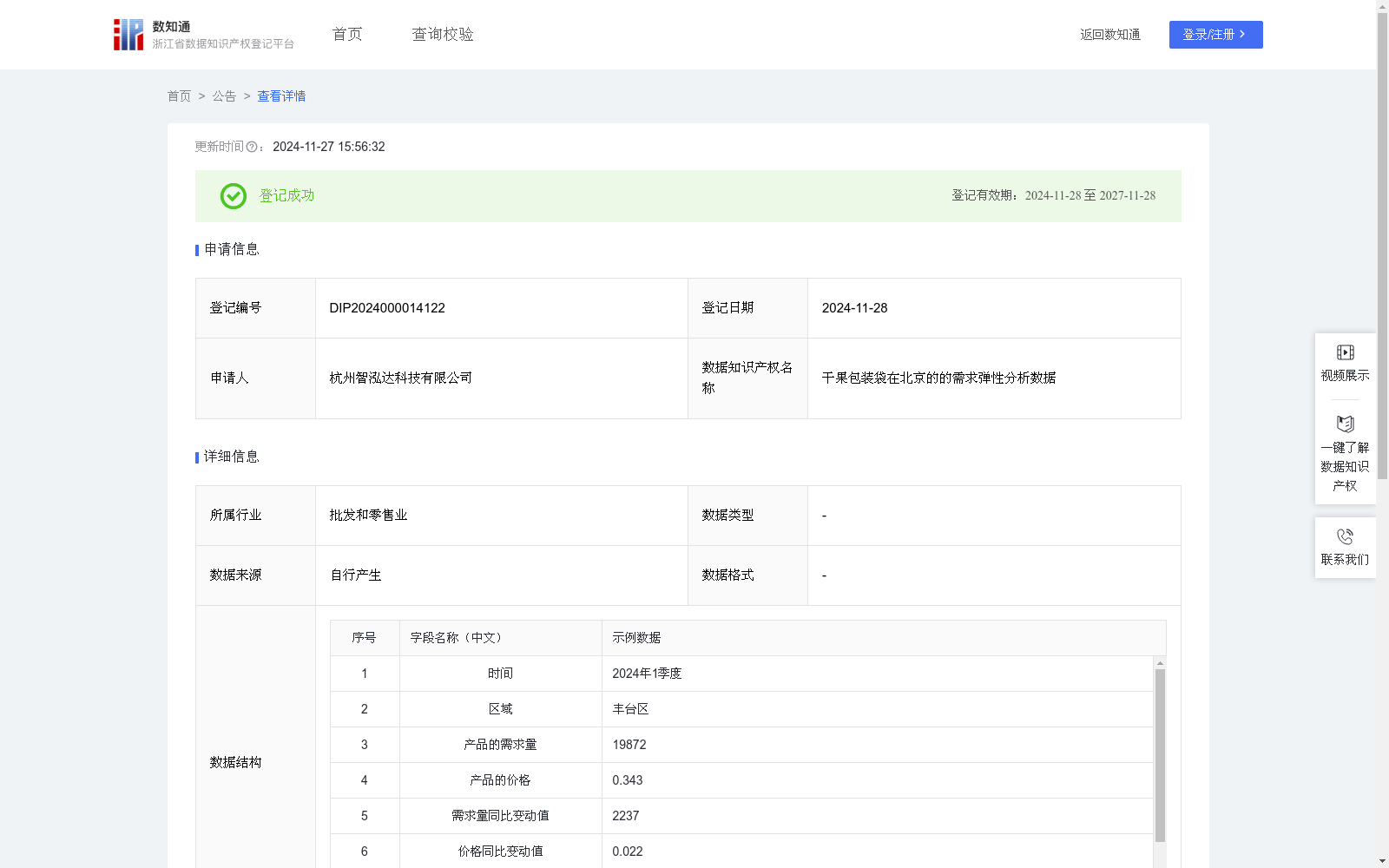
干果包装袋在北京的的需求弹性分析数据
收藏资源简介:
为更好了解北京不同地区对干果包装袋的市场需求情况,需要对产品在不同地区的需求弹性进行数据分析。相关行业的所有企业都可以根据本数据分析的结果制定营销策略。若产品需求富有弹性,可以适当降低产品价格来提高销量、抢占市场;若产品需求缺乏弹性,则可以适当提高产品价格来提高利润率,打造高端品牌效应。该项数据对企业在国内各地区的资源配置及市场布局相关决策具有重要参考价值。1.数据采集:采集产品各季度在北京地区的需求数据和价格数据,在系统内进行同比分析,得到产品的需求量变动数值和价格变化数值。 2.数据运算:根据运算公式需求弹性系数Ed=-(△Q/Q)÷(△P/P),可得到需求弹性系数。式中:Q表示产品的需求量,单位为份;P表示产品的价格,单位为元(按人民币记);△Q表示产品的需求量同比变动值,单位为份;△P表示产品的价格同比变动值,单位为元(按人民币记)。取需求弹性系数的绝对值|Ed|作为分析数据时的参考系数。 3.数据分析:根据|Ed|的数值可分析该产品的需求价格弹性。(1)|Ed|=1(单位需求价格弹性),说明需求量变动幅度与价格变动幅度相同;(2)1<|Ed|<∝(需求富有弹性),说明需求量变动幅度大于价格变动幅度;(3)0<|Ed|<1(需求缺乏弹性),说明需求量变动幅度小于价格变动幅度;(4)|Ed|→0(需求完全无弹性),这表示不管价格怎样变动,需求量总是固定不变;(5)|Ed|→∝(需求完全有弹性),表示在既定价格之下,需求量可以任意变动。
To better understand the market demand for dry fruit packaging bags across different regions of Beijing, it is necessary to conduct data analysis on the demand elasticity of products in various regions. All enterprises in the relevant industries can develop marketing strategies based on the results of this data analysis. If the product demand is price-elastic, the product price can be appropriately reduced to increase sales and seize market share; if the product demand is price-inelastic, the product price can be appropriately increased to improve profit margins and create a high-end brand effect. This data is of important reference value for enterprises' decision-making regarding resource allocation and market layout across domestic regions of China. 1. Data Collection: Collect quarterly demand data and price data of the products in Beijing, and conduct year-on-year analysis within the system to obtain the change in product demand quantity and the change in product price. 2. Data Calculation: The demand elasticity coefficient Ed can be obtained using the calculation formula: Ed = -(ΔQ/Q) ÷ (ΔP/P). In this formula: Q represents the product demand quantity, with the unit of "unit"; P represents the product price, denominated in RMB yuan; ΔQ represents the year-on-year change in product demand quantity, with the unit of "unit"; ΔP represents the year-on-year change in product price, denominated in RMB yuan. The absolute value |Ed| of the demand elasticity coefficient is taken as the reference coefficient for data analysis. 3. Data Analysis: Analyze the price elasticity of demand for the product based on the value of |Ed|: (1) |Ed| = 1 (Unitary Price Elasticity of Demand): This indicates that the magnitude of change in demand is identical to that of price; (2) 1 < |Ed| < ∞ (Elastic Demand): This indicates that the magnitude of change in demand is greater than that of price; (3) 0 < |Ed| < 1 (Inelastic Demand): This indicates that the magnitude of change in demand is smaller than that of price; (4) |Ed| → 0 (Perfectly Inelastic Demand): This means that regardless of price changes, the product demand quantity remains fixed; (5) |Ed| → ∞ (Perfectly Elastic Demand): This means that the product demand quantity can change arbitrarily at a given price.