
Salmon age, sex, and length data from Upper Cook Inlet, Alaska, 1967-2016
收藏Mendeley Data2024-01-31 更新2024-06-27 收录
下载链接:
https://knb.ecoinformatics.org/view/doi:10.5063/513WM9
下载链接
链接失效反馈官方服务:
资源简介:
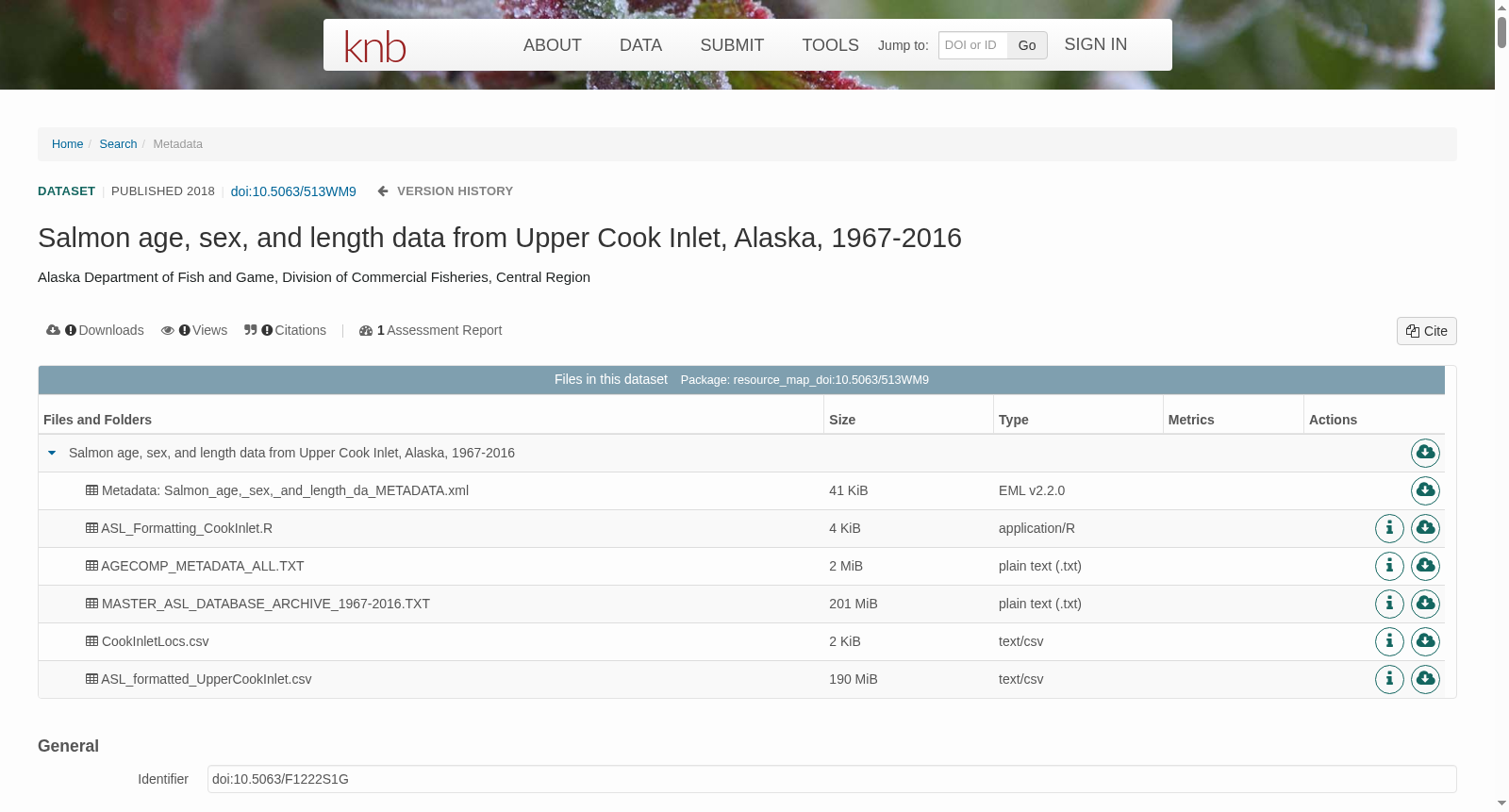
Age, sex and length data provide population dynamics information that can indicate how populations trends occur and may be changing. These data can help researchers estimate population growth rates, age-class distribution and population demographics. Knowing population demographics, growth rates and trends is particularly valuable to fisheries managers who must perform population assessments to inform management decisions. These data are therefore particularly important in valuable fisheries like the salmon fisheries of Alaska. This dataset includes age, sex and length data compiled from annual sampling of commercial and subsistence salmon harvests and research projects in the Upper Cook Inlet. It includes data on five salmon species: chinook, chum, coho, pink and sockeye. Age estimates were made by examining scales or bony structures (e.g. otoliths - ear bones). Scales were removed from the side of the fish; usually the left side above the lateral line. Scales or bony structures were then mounted on gummed cards and pressed on acetate to make an impression. The number of freshwater and saltwater annuli (i.e. rings) was counted to estimate age in years. Age is recorded in European Notation, which is a method of recording both fresh and saltwater annuli. For example, for a fish that spent one year in freshwater and 3 years in saltwater, its age is recorded as 1.3. The total fish age is the sum of the first and second numbers, plus one to account for the time between deposition and emergence. Therefore the fish in this example is 5 years old. Fish sex was determined by either examining external morphology (eg. head and belly shape) or internal sex organ. Length was measured in millimeters, generally from mid-eye to the fork of the tail. This data package includes a .csv of ASL data (ASL_formatted_UpperCookInlet.csv) derived from an original metadata file (AGECOMP_METADATA_ALL.TXT), an original data file (MASTER_ASL_DATABASE_ARCHIVE_1967-2016.TXT), and a file containing location information (CookInletLocs.csv). The reformatting script (ASL_Formatting_CookInlet.R) draws pertinent columns from the data file and combines it with information from the metadata and locations files.
年龄、性别与体长数据可提供种群动态相关信息,用以揭示种群变化趋势及其演变规律。此类数据能够帮助研究人员估算种群增长率、年龄结构分布以及种群统计学特征。明晰种群统计特征、增长率与变化趋势,对于需要开展种群评估以制定管理决策的渔业管理者而言尤为重要。因此,此类数据在阿拉斯加鲑鱼渔业这类高价值渔业中显得尤为关键。
本数据集涵盖了库克湾上游地区商业与自给性鲑鱼捕捞年度采样及相关研究项目所收集的年龄、性别与体长数据。数据集包含5种鲑鱼的数据:大鳞大麻哈鱼(chinook)、狗鲑(chum)、银鲑(coho)、粉鲑(pink)以及红鲑(sockeye)。
年龄估算通过检视鳞片或硬组织结构(例如耳石(otoliths)——内耳骨)完成。鳞片通常取自鱼体侧线以上的左侧区域。随后将鳞片或硬组织结构粘贴在涂胶卡片上,并压印在醋酸纤维膜上以留存印痕。通过计数淡水与海水生长环(即年轮)的数量来估算鱼的年龄(以年为单位)。
年龄采用欧洲记法(European Notation)记录,该方法同时记录淡水与海水生长环数量。例如,若某条鱼在淡水环境中生活1年、海水环境中生活3年,其年龄将记为1.3。鱼类总年龄为前后两个数字之和再加1,以补偿鳞片沉积与鱼体孵化出膜之间的时间差,因此该示例中的鱼年龄为5龄。
鱼类性别通过两种方式判定:一是检视外部形态特征(例如头部与腹部形状),二是解剖观察内部生殖器官。体长以毫米为单位进行测量,通常测量起点为眼部中点,终点为尾鳍分叉处。
本数据包包含一份ASL数据的CSV格式文件(ASL_formatted_UpperCookInlet.csv),该文件源自原始元数据文件AGECOMP_METADATA_ALL.TXT、原始数据文件MASTER_ASL_DATABASE_ARCHIVE_1967-2016.TXT,以及一份包含位置信息的文件CookInletLocs.csv。格式转换脚本ASL_Formatting_CookInlet.R会从原始数据文件中提取相关列,并将其与元数据文件及位置文件中的信息进行整合。
创建时间:
2024-01-31
搜集汇总
数据集介绍
以上内容由遇见数据集搜集并总结生成

暂无相关数据集


