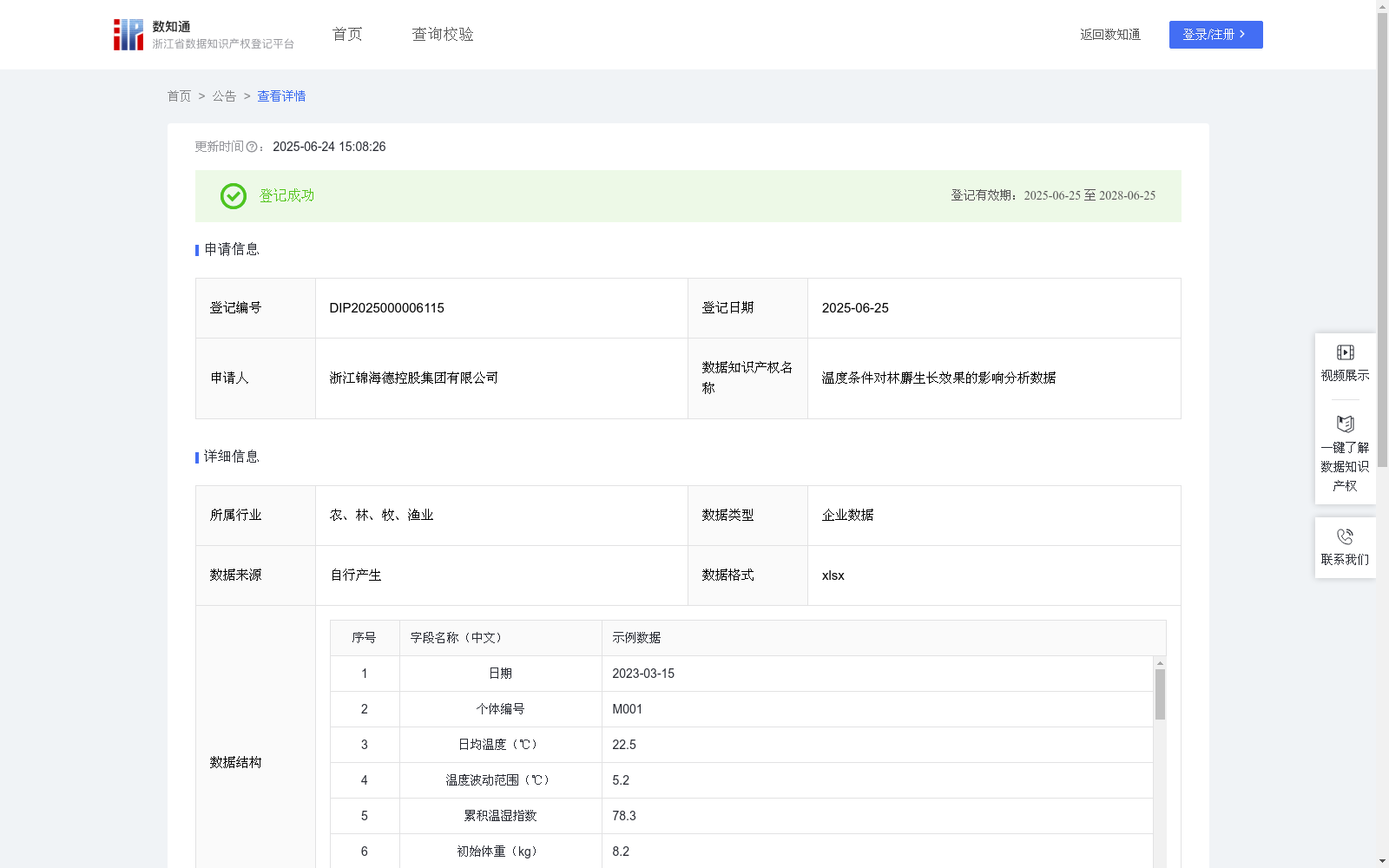
温度条件对林麝生长效果的影响分析数据
收藏资源简介:
本数据集的核心价值在于通过控制变量,量化分析不同温度条件下林麝的生长指数变化,为科学养殖管理提供数据支撑。具体应用场景包括: 1.养殖优化决策:基于拐点区间(最优温度带)动态调节圈舍温度,结合TGI模型优化恒温设备运行,降低应激损耗。另外可依据标准化分数,筛选温变适应力强的个体作为种源,提升种群遗传稳定性。 2.政策制定支持:可为林业部门提供量化数据依据,规范养殖场温控设施建设。 3.教育推广:作为教学案例,帮助从业人员理解温度与生长关系的动态规律,提升养殖技术培训的实践性。1.数据采集自申请人自有林麝养殖基地,采集:日期、个体编号、日均温度AT、温度波动范围TR、累积温湿指数THI、初始体重IW、终末体重FW、初始体长IL、终末体长FL、总进食量FI、饲养周期TC、所属温度组(以1℃间隔划分)。清洗剔除异常值,确保质量。 2.生长效能计算:①基础指标:1)热效增重率TEG=(FW-IW)/(TC×AT)×100% 2)体长温变系数BTC=(FL-IL)/(IL×TR)×100%3)温控饲料效率TFE=FI/(FW-IW)×THI;4)用分组聚合算法计算温度组内指标均值(M_TEG, M_BTC, M_TFE)5)采用滑动窗口标准差计算组内离散度(S_TEG, S_BTC, S_TFE)。 ②综合指数: 1)温度效应标准化(Z-score法):Z_TEG=(TEG-M_TEG)/S_TEG(正向) 2)温变适应标准化:Z_BTC=(M_BTC-BTC)/S_BTC(逆向);3)温控能效标准化:Z_TFE=(M_TFE-TFE)/S_TFE(逆向) 4)温度生长指数(TGI)=0.4×Z_TEG + 0.35×Z_BTC + 0.25×Z_TFE。 3.温度建模:①建立分段回归模型:TGI =β1×AT³+β2×AT²+β3×AT +ε(R²≥0.65)②最优温度带:通过二阶导数求拐点区间[X1,X2] ③效能分区:适宜区:日均温度处于拐点区间±0.5℃;应激区:日均温度超出区间范围。
The core value of this dataset lies in quantifying the changes in growth indices of forest musk deer under different temperature conditions through controlled variables, providing data support for scientific breeding management. Its specific application scenarios include: 1. Breeding optimization decision-making: Dynamically adjust the temperature of breeding pens based on the inflection point interval (optimal temperature zone), and combine with the TGI model to optimize the operation of constant-temperature equipment, reducing stress-induced loss. In addition, individuals with strong temperature change adaptability can be selected as breeding stock based on standardized scores, improving the genetic stability of the population. 2. Policy formulation support: Provide quantitative data basis for forestry departments to standardize the construction of temperature control facilities in breeding farms. 3. Education and promotion: As a teaching case, help practitioners understand the dynamic law of the relationship between temperature and growth, enhancing the practicality of breeding technology training. 1. Data collection: The data were collected from the applicant's own forest musk deer breeding base, including collection date, individual number, average daily temperature (AT), temperature fluctuation range (TR), cumulative temperature and humidity index (THI), initial body weight (IW), final body weight (FW), initial body length (IL), final body length (FL), total food intake (FI), breeding cycle (TC), and temperature group (divided at 1℃ intervals). Outliers were removed during data cleaning to ensure data quality. 2. Growth efficiency calculation: ① Basic indicators: 1) Thermal efficiency weight gain rate (TEG) = (FW - IW) / (TC × AT) × 100% 2) Body length temperature change coefficient (BTC) = (FL - IL) / (IL × TR) × 100% 3) Temperature-controlled feed efficiency (TFE) = FI / (FW - IW) × THI 4) Calculate the mean values of indicators within temperature groups using the grouped aggregation algorithm (M_TEG, M_BTC, M_TFE) 5) Calculate the within-group dispersion using sliding window standard deviation (S_TEG, S_BTC, S_TFE) ② Comprehensive index: 1) Temperature effect standardization (Z-score method): Z_TEG = (TEG - M_TEG) / S_TEG (positive indicator) 2) Temperature change adaptation standardization: Z_BTC = (M_BTC - BTC) / S_BTC (reverse indicator) 3) Temperature control energy efficiency standardization: Z_TFE = (M_TFE - TFE) / S_TFE (reverse indicator) 4) Temperature growth index (TGI) = 0.4 × Z_TEG + 0.35 × Z_BTC + 0.25 × Z_TFE 3. Temperature modeling: ① Establish a piecewise regression model: TGI = β₁×AT³ + β₂×AT² + β₃×AT + ε (R² ≥ 0.65) ② Optimal temperature zone: Determine the inflection point interval [X1, X2] via the second derivative ③ Efficiency zoning: Suitable zone: average daily temperature falls within ±0.5℃ of the inflection point interval; Stress zone: average daily temperature exceeds the interval range.