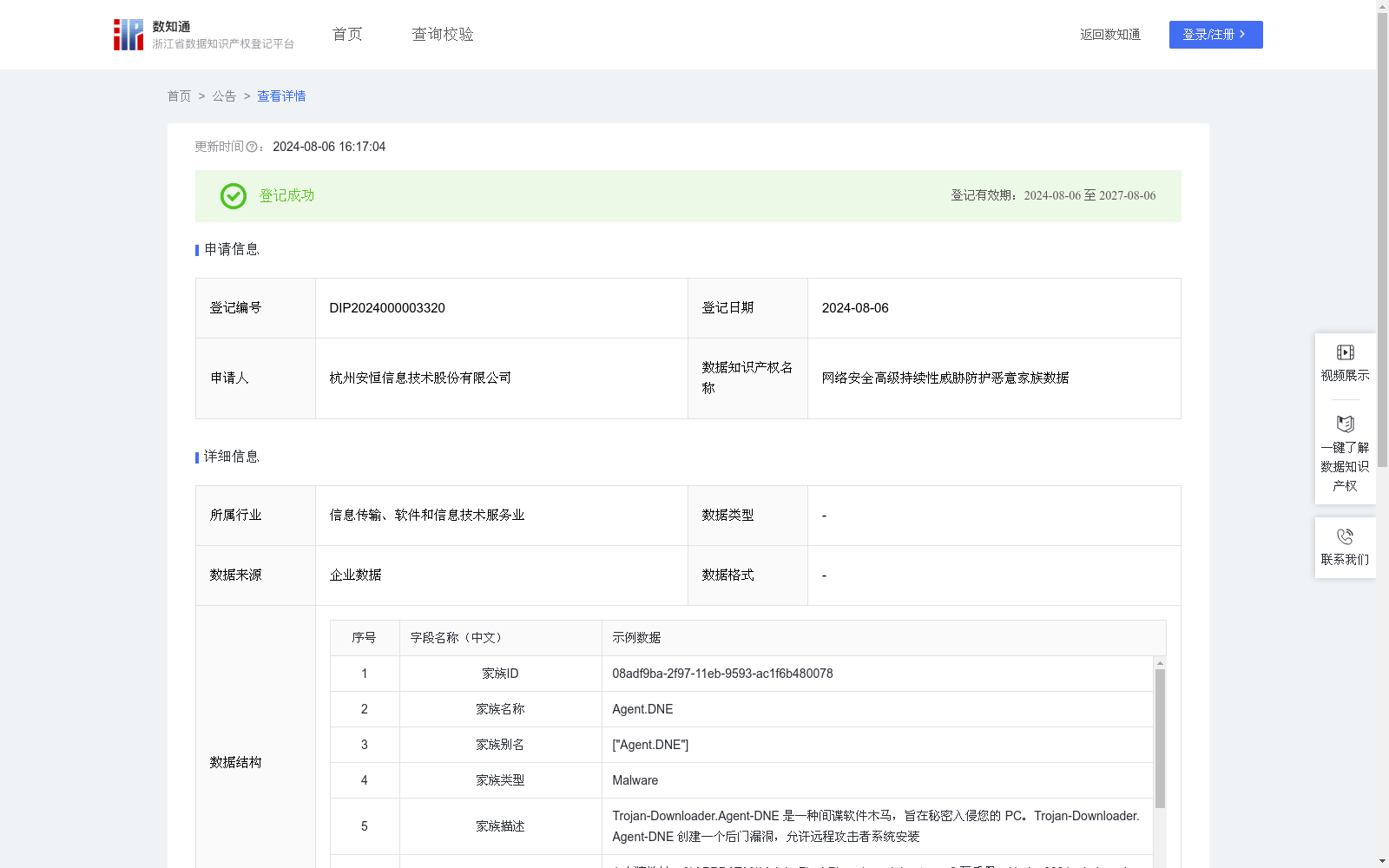
网络安全高级持续性威胁防护恶意家族数据
收藏资源简介:
网络安全高级持续恶意家族数据描述了攻击的使用场景、运行环境、行为、目的等属性,可以针对性的进行预警、防御。可以通过技术细节、相关行为进行取证分析。应用场景有1)安全管理 日志分析与审计:恶意家族库提供了恶意软件的详细信息和行为特征,使得安全团队能够通过分析日志数据,快速识别出恶意软件的攻击行为,从而进行针对性的防御和取证分析。 安全管理平台/态势感知:结合恶意家族库的信息,安全管理平台可以实时感知恶意软件的威胁态势,为安全团队提供预警和防御建议。 安全基线与配置管理:了解恶意家族的攻击行为和目的,有助于安全团队制定更加合理的安全基线配置和策略,降低系统被攻击的风险。 威胁情报(TI):恶意家族库是威胁情报的重要来源之一,通过收集和整理恶意家族的信息,可以为安全团队提供有价值的威胁情报,支持安全决策和响应。 2)安全解决方案 威胁管理/XDR:恶意家族库的信息可以整合到XDR解决方案中,提供对恶意软件威胁的全面检测、分析和响应能力。 3)网络与基础架构安全 高级持续性威胁防护(APT):明确恶意家族的攻击行为、目的和工具链,有助于构建更加有效的APT防护体系,降低APT攻击对组织的影响。步骤1:数据采集,通过事件采集系统获取恶意家族相关事件,内容包括但不限于家族名称、家族类型、家族描述、涉及平台等。 步骤2:数据清洗,对采集到的数据进行结构化转换和标准化处理,清洗不必要的字段,并进行多维信息的聚合。以更好地满足后续对恶意家族进行数据分析和关联的需求。 步骤3: 数据加工,通过沙箱分析恶意文件、AI技术处理文本、狩猎模型关联分析、图谱聚类识别,构建恶意家族画像。 1. 使用公司自主研发的新一代沙箱对恶意文件样本进行动态分析,从中获取恶意家族的攻击行为。 2. 利用AI大模型、LSTM+CRF算法等技术进行自然语言处理和安全文章分析。 3. 采用自主研发的恶意家族特征识别模型,通过识别家族相关事件、情报的静态特征和动态特征,多维度关联分析识别家族。 4. 结合图谱与聚类算法,对恶意家族进行关联和识别,最终通过技术特点、处置建议、参考链接等层面刻画家族画像。
The Cybersecurity Advanced Persistent Malware Family Dataset describes attributes including attack scenarios, operating environments, behaviors, and objectives of attacks, enabling targeted early warning and defense. It also supports forensic analysis via technical details and associated malicious behaviors. Its application scenarios are as follows: 1) Security Management a. Log Analysis and Audit: The malware family library provides detailed information and behavioral characteristics of malicious software, allowing security teams to quickly identify malicious attack behaviors by analyzing log data, enabling targeted defense and forensic analysis. b. Security Management Platform/Cyber Situation Awareness: Combined with the malware family library information, security management platforms can perceive the threat situation of malicious software in real time, providing early warning and defense suggestions for security teams. c. Security Baseline and Configuration Management: Understanding the attack behaviors and objectives of malware families helps security teams develop more reasonable security baseline configurations and strategies, reducing the risk of system attacks. d. Threat Intelligence (TI): The malware family library is one of the important sources of threat intelligence. By collecting and organizing information on malware families, it can provide valuable threat intelligence for security teams to support security decision-making and response. 2) Security Solutions a. Threat Management/XDR: The information from the malware family library can be integrated into XDR solutions, providing comprehensive detection, analysis, and response capabilities for malicious software threats. 3) Network and Infrastructure Security a. Advanced Persistent Threat (APT) Protection: Clarifying the attack behaviors, objectives, and toolchains of malware families helps build a more effective APT protection system, reducing the impact of APT attacks on organizations. The data processing workflow includes the following steps: Step 1: Data Collection. Obtain malware family-related events through an event collection system, including but not limited to family name, family type, family description, involved platforms, etc. Step 2: Data Cleaning. Perform structured conversion and standardization processing on the collected data, remove unnecessary fields, and aggregate multi-dimensional information to better meet the requirements of subsequent data analysis and correlation of malware families. Step 3: Data Enrichment and Profiling. Construct malware family profiles through sandbox analysis of malicious files, AI-powered text processing, threat hunting model correlation analysis, and graph clustering recognition. 1. Use the company's self-developed next-generation sandbox to dynamically analyze malicious file samples and extract the attack behaviors of malware families. 2. Leverage technologies such as AI Large Language Models (LLMs) and LSTM+CRF algorithms for natural language processing and security article analysis. 3. Adopt the self-developed malware family feature recognition model to identify families via multi-dimensional correlation analysis by identifying static and dynamic features of family-related events and intelligence. 4. Combine knowledge graphs and clustering algorithms to correlate and identify malware families, and finally depict comprehensive family profiles from aspects including technical characteristics, remediation suggestions, and reference links.