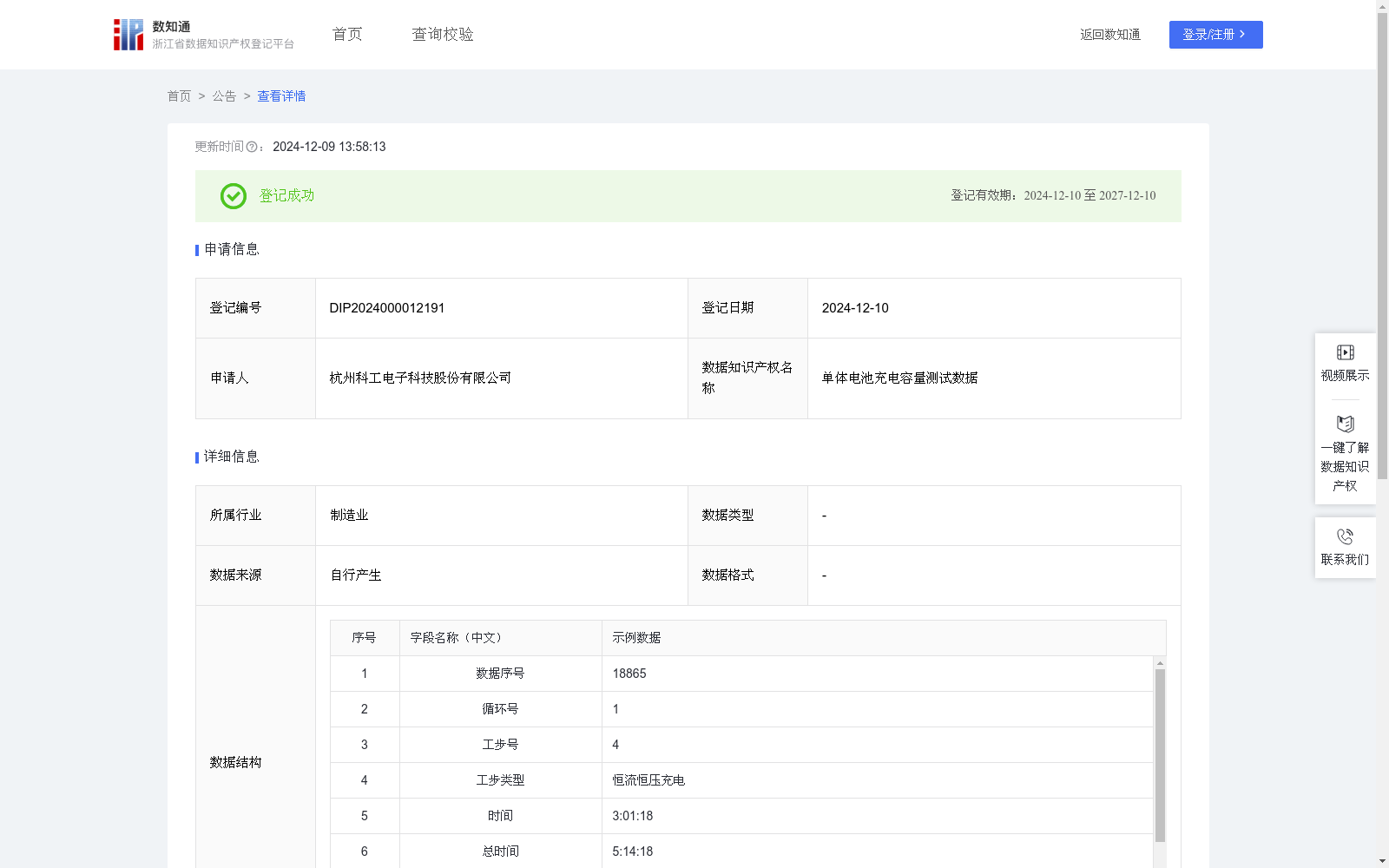
单体电池充电容量测试数据
收藏资源简介:
单体电池充电容量测试数据可以作为产品市场定位和差异化的重要依据。通过比较不同电池的充电容量,制造商可以突出自家产品的优势,如更快的充电速度、更高的充电效率等,从而吸引消费者。同时可以根据测试数据来制定售后服务和保修政策。例如,对于充电容量衰减较快的电池,可以提供更长的保修期限或更频繁的维护服务,以增强客户信任。 基于单体电池管理模块(BMS)对单体电池数据进行采集,包括电池编号,工步类型,工步时间,总时间,瞬时电流,瞬时电压等数据,采样以一天24小时为周期,按时间顺序以1秒为时间间隔进行数据采样;2、数据处理:将数据清洗、去噪,补充完整;3、数据加工:电池是以搁置-充电-搁置-放电进行循环工步动作,循环号表示当前的循环次数,工步号表示现在为第几个工步,当前工步时间表示当前工步已经进行的时间,总时间表示从第一次循环时间开始到现在的绝对时间。瞬时电流、瞬时电压是该时间点传感器采集到的信号。计算充电容量,首先判断当前工步类型,工步类型为充电工步时启动计算,充电容量的计算公式为Q(容量)=I(电流)*T(时间)为基本公式,实践中用瞬时电流乘以时间1s,按当前工步时间进行积分,例如当前工步是恒流恒压充电,当前工步时间是1分15秒,就是对这75秒的电流和时间相乘的结果进行求和。当充电容量达到最大值时,也就是拐点时,即为该电池当前的充电容量。工步类型非充电工步时充电容量统一为0。
Test data of single-cell charging capacity serves as a critical basis for product market positioning and differentiation. By comparing the charging capacities of different battery cells, manufacturers can highlight the advantages of their own products, such as faster charging speed and higher charging efficiency, to attract consumers. Meanwhile, after-sales service and warranty policies can be formulated based on the test data. For example, for battery cells with rapid charging capacity degradation, longer warranty periods or more frequent maintenance services can be provided to enhance customer trust. Data collection is conducted via the Battery Management System (BMS) for single battery cells, covering parameters including battery ID, step type, step time, total time, instantaneous current, instantaneous voltage, etc. The sampling is performed at a 1-second interval in chronological order, with a 24-hour daily sampling cycle. 2. Data processing: Clean, denoise and supplement the collected data to make it complete; 3. Data processing and refinement: Battery cells operate in cyclic steps of rest-charging-rest-discharging. The cycle number represents the current cycle count, the step number indicates the sequence number of the current step, the current step time refers to the elapsed time of the current step, and the total time denotes the absolute time from the start of the first cycle to the present moment. Instantaneous current and instantaneous voltage are signals collected by sensors at the corresponding time point. For charging capacity calculation, first determine the current step type. The calculation is initiated only when the step type is a charging step. The basic formula for charging capacity is Q (capacity) = I (current) * T (time). In practice, the calculation is performed by integrating the product of instantaneous current and 1-second time interval over the duration of the current step. For example, if the current step is constant-current constant-voltage (CCCV) charging and the current step time is 1 minute and 15 seconds, the sum of the products of current and time over these 75 seconds is calculated. When the charging capacity reaches its maximum value, i.e., at the inflection point, this value is the current charging capacity of the battery. For non-charging steps, the charging capacity is uniformly set to 0.