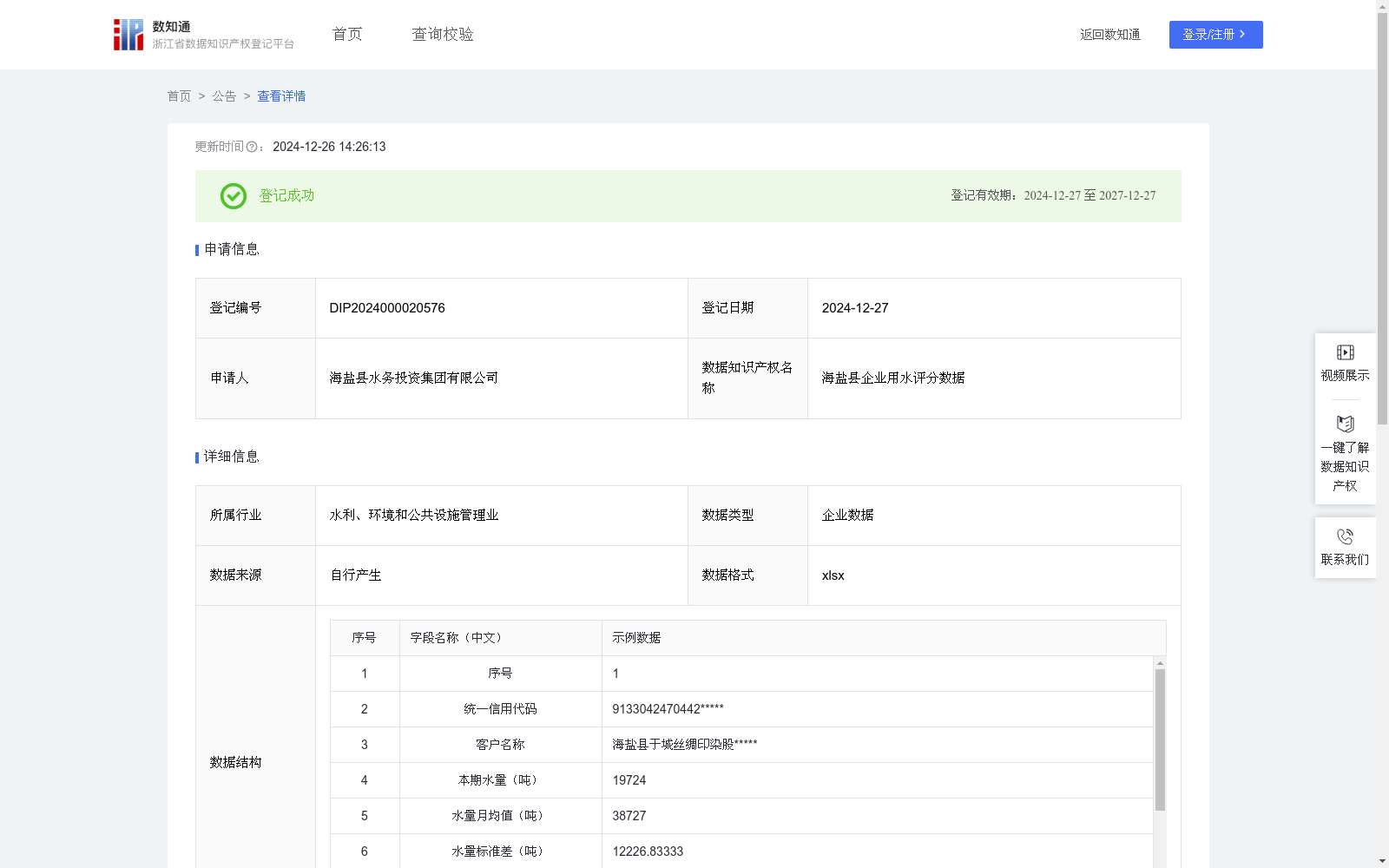
海盐县企业用水评分数据
收藏资源简介:
可以为金融机构信贷业务提供信息支持,通过对企业用水、排水在线智能监测,实现企业异常用水波动预警提醒信息。在信贷反欺诈、贷前审批、额度管理和贷后监测等业务环节,金融机构可以从用水视角评估企业经营健康状况,消减金融机构与企业间的信息不对称,进一步完善金融机构对企业信用评价的指标体系。1.数据采集:人工采集和自动采集。 2.数据处理:对采集到的原始数据进行清洗、分析、整理等方式,获取所需要的数据:统一信用代码、客户名称、本期水量(吨)、水量月均值(吨)、水量标准差(吨)、本期污水量(吨)、污水量月均值(吨)、污水量标准差(吨)、企业用水评分、评分时间。 3.算法 1)本期水量:当期月企业用水量; 2)水量月均值:一年的企业用水量数据,除以12个月,得到月均用水量; 3)水量标准差:每月用水量减去其月均值的平方和,所得结果除以12,再把所得值开根号; 4)本期污水量:当月企业污水量。 5)污水量月均值:一年的企业污水量数据,除以12个月,得到月均污水量; 6)污水量标准差:每月污水量减去其月均值的平方和,所得结果除以12,再把所得值开根号; 7)建立0-10的企业用水评分机制。对大水量用户(月用水量≥1000吨)、一般用水户(100≤月用水量<1000吨)、小水量用户(月用水量<100吨)进行打分,以直观反映企业用水量的情况。 大水量用户,本期用水高于其月均值且污水量小于其月均值,计10分; 大水量用户,本期用水、污水量同步高于其月均值,计9分; 大水量用户,本期用水、污水量均高于其月均值,计8分; 大水量用户,本期用水、污水量均低于其月均值且小于2倍水量标准差,计7分; 一般用水户,本期用水、污水量均高于其月均值,计6分; 一般用水户,本期用水、污水量均高于其月均值且小于2倍标差,计5分; 一般用水户,本期用水、污水量均低于其月均值且大于2倍标差,计4分; 小水量用水户,本期用水、污水量均高于其月均值,计3分; 小水量用水户,本期用水、污水量均低于其月均值,计2分; 本期有用水,计1分; 本期无用水不评分,计0分;
This dataset provides information support for the credit business of financial institutions. Through online intelligent monitoring of enterprise water use and drainage, it enables early warning and reminder of abnormal water use fluctuations for enterprises. In business links such as credit anti-fraud, pre-loan approval, quota management and post-loan monitoring, financial institutions can evaluate the operational health of enterprises from the perspective of water use, reduce information asymmetry between financial institutions and enterprises, and further improve the index system for financial institutions' credit evaluation of enterprises. 1. Data Collection: Manual collection and automatic collection. 2. Data Processing: Clean, analyze and organize the collected raw data to obtain the required data: Unified Social Credit Code, customer name, current period water consumption (tons), monthly average water consumption (tons), standard deviation of water consumption (tons), current period sewage discharge (tons), monthly average sewage discharge (tons), standard deviation of sewage discharge (tons), enterprise water use score, scoring time. 3. Algorithms 1) Current Period Water Consumption: Monthly water consumption of the enterprise in the current period; 2) Monthly Average Water Consumption: Calculate the monthly average water consumption by dividing the annual enterprise water consumption data by 12 months; 3) Standard Deviation of Water Consumption: Calculate the sum of squared differences between each month's water consumption and its monthly average, divide the result by 12, then take the square root of the obtained value; 4) Current Period Sewage Discharge: Sewage discharge of the enterprise in the current month; 5) Monthly Average Sewage Discharge: Calculate the monthly average sewage discharge by dividing the annual enterprise sewage discharge data by 12 months; 6) Standard Deviation of Sewage Discharge: Calculate the sum of squared differences between each month's sewage discharge and its monthly average, divide the result by 12, then take the square root of the obtained value; 7) Establish a 0-10 enterprise water use scoring mechanism. Score users in three categories: large water users (monthly water consumption ≥ 1000 tons), general water users (100 ≤ monthly water consumption < 1000 tons), and small water users (monthly water consumption < 100 tons), to intuitively reflect the enterprise's water use status. For large water users: If current period water consumption is higher than its monthly average and sewage discharge is lower than its monthly average, score 10 points; For large water users: If both current period water consumption and sewage discharge are higher than their respective monthly averages, score 9 points; For large water users: If both current period water consumption and sewage discharge are higher than their respective monthly averages, score 8 points; For large water users: If both current period water consumption and sewage discharge are lower than their respective monthly averages and less than twice the standard deviation of water consumption, score 7 points; For general water users: If both current period water consumption and sewage discharge are higher than their respective monthly averages, score 6 points; For general water users: If both current period water consumption and sewage discharge are higher than their respective monthly averages and less than twice the standard deviation of water consumption, score 5 points; For general water users: If both current period water consumption and sewage discharge are lower than their respective monthly averages and greater than twice the standard deviation of water consumption, score 4 points; For small water users: If both current period water consumption and sewage discharge are higher than their respective monthly averages, score 3 points; For small water users: If both current period water consumption and sewage discharge are lower than their respective monthly averages, score 2 points; If the enterprise has water consumption in the current period, score 1 point; If the enterprise has no water consumption in the current period, no score will be given, and 0 points will be recorded;