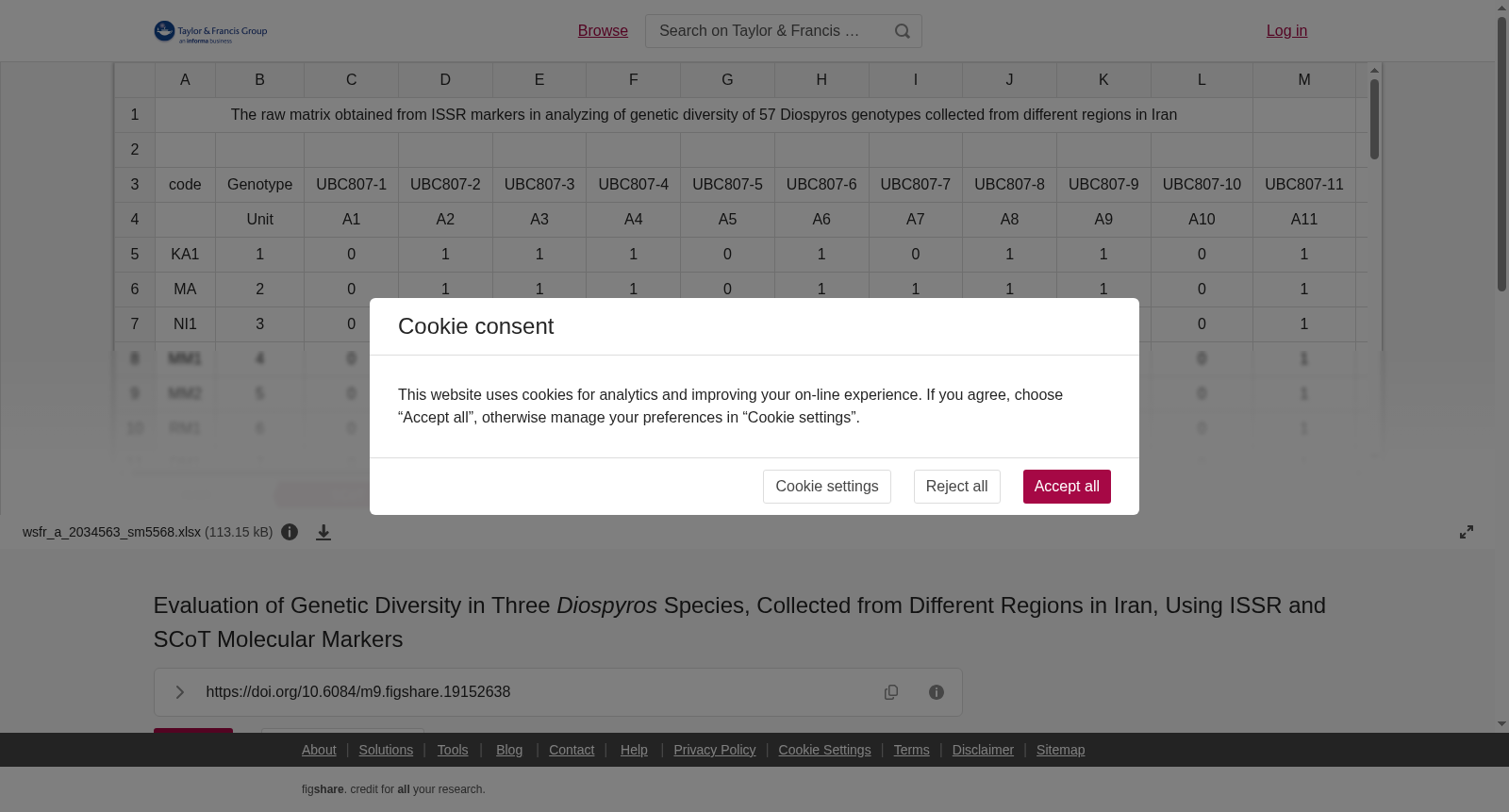
Evaluation of Genetic Diversity in Three <i>Diospyros</i> Species, Collected from Different Regions in Iran, Using ISSR and SCoT Molecular Markers
收藏资源简介:
The <i>Diospyros</i> genus contains approximately 400 to 500 species, among which <i>D. kaki</i> is cultivated as the edible persimmon. Knowledge about the genetic diversity of <i>Diospyros</i> genotypes is of high significance for breeding programs. In this research, the genetic diversity of 57 <i>Diospyros</i> genotypes collected from different regions of Iran was evaluated using inter simple sequence repeats (ISSR) and start codon targeted (SCoT) markers. Seven ISSR and 10 SCoT markers produced a total of 42 and 75 fragments with the averages of 6 and 7.5 fragments per primer, respectively. The average polymorphism information content (PIC) for ISSR markers was 0.3 and for SCoT markers was 0.36. The average marker index (MI) for ISSR and SCoT markers were 1.81 and 1.79, respectively. Cluster analysis based on Jaccard’s genetic similarity coefficient and UPGMA method classified 57 <i>Diospyros</i> genotypes into four main groups based on ISSR and SCoT markers. However, the clustering pattern based on the combination of ISSR and SCoT markers data separated the species genotypes better than each marker alone. Accordingly, groups 1 and 2 contained all <i>D. kaki</i> genotypes, both encompassing various subgroups, group 3 included <i>D. lotus</i> and group 4 included <i>D. virginiana</i> genotypes. Genotype distribution visualized with principal coordinate analysis (PCoA) was in accordance with the cluster analysis. Based on our results Iran is a rich source of <i>Diospyrus</i> germplasm, and a combination of ISSR and SCoT markers can be used as an accurate technique for evaluating genetic diversity among the <i>Diospyros</i> genotypes.
柿属(Diospyros)包含约400至500个物种,其中柿(Diospyros kaki)作为食用柿被广泛栽培。柿属基因型的遗传多样性研究对育种项目具有重要意义。本研究采用简单序列重复区间扩增多态性(inter simple sequence repeats, ISSR)与起始密码子靶标扩增多态性(start codon targeted, SCoT)标记技术,对从伊朗不同地区采集的57份柿属基因型材料的遗传多样性进行了评价。7个ISSR引物与10个SCoT引物共扩增得到42条ISSR条带与75条SCoT条带,平均每对引物分别扩增出6条与7.5条条带。ISSR标记的平均多态性信息含量(polymorphism information content, PIC)为0.3,SCoT标记的平均PIC为0.36。ISSR与SCoT标记的平均标记指数(marker index, MI)分别为1.81和1.79。基于雅卡尔遗传相似系数与非加权配对算术平均法(UPGMA)的聚类分析结果显示,利用ISSR和SCoT标记可将57份柿属基因型划分为4个主要类群。不过,结合ISSR与SCoT标记数据的聚类模式,相较于单独使用单一标记,能够更有效地区分不同物种的基因型。具体来看,类群1与类群2涵盖了所有柿(Diospyros kaki)基因型,二者均包含多个亚组;类群3包含君迁子(Diospyros lotus)基因型,类群4则包含美洲柿(Diospyros virginiana)基因型。通过主坐标分析(principal coordinate analysis, PCoA)可视化的基因型分布结果,与聚类分析结果完全一致。本研究结果证实,伊朗是柿属(Diospyros)种质资源的丰富宝库;同时,ISSR与SCoT标记的组合可作为一种精准可靠的技术手段,用于评价柿属基因型间的遗传多样性。