Localized Critical Peak Rebates (LCPR) Dataset
收藏资源简介:
Localized Critical Peak Rebates (LCPR) Dataset是由蒙特利尔综合理工学院和Hydro-Québec合作创建的,旨在展示在北方气候下的本地化关键峰值回扣需求响应机制。该数据集包含197名匿名LCPR测试者的每小时能耗数据,以及额外的每小时天气数据和LCPR信息。数据集的创建过程包括对智能电表和遥测数据的聚合,以及对异常值的处理。该数据集主要用于训练和验证机器学习模型,特别是在能源需求响应和智能电网管理领域,旨在解决冬季高峰期电力需求预测和优化问题。
The Localized Critical Peak Rebates (LCPR) Dataset was co-developed by École Polytechnique de Montréal and Hydro-Québec, aiming to demonstrate the localized critical peak rebate demand response mechanism under northern climatic conditions. This dataset contains hourly energy consumption data from 197 anonymized LCPR test participants, along with additional hourly weather data and LCPR-related information. The dataset creation process includes the aggregation of smart meter and telemetry data as well as outlier handling. This dataset is primarily used for training and validating machine learning models, especially in the fields of energy demand response and smart grid management, with the goal of addressing winter peak electricity demand forecasting and optimization issues.
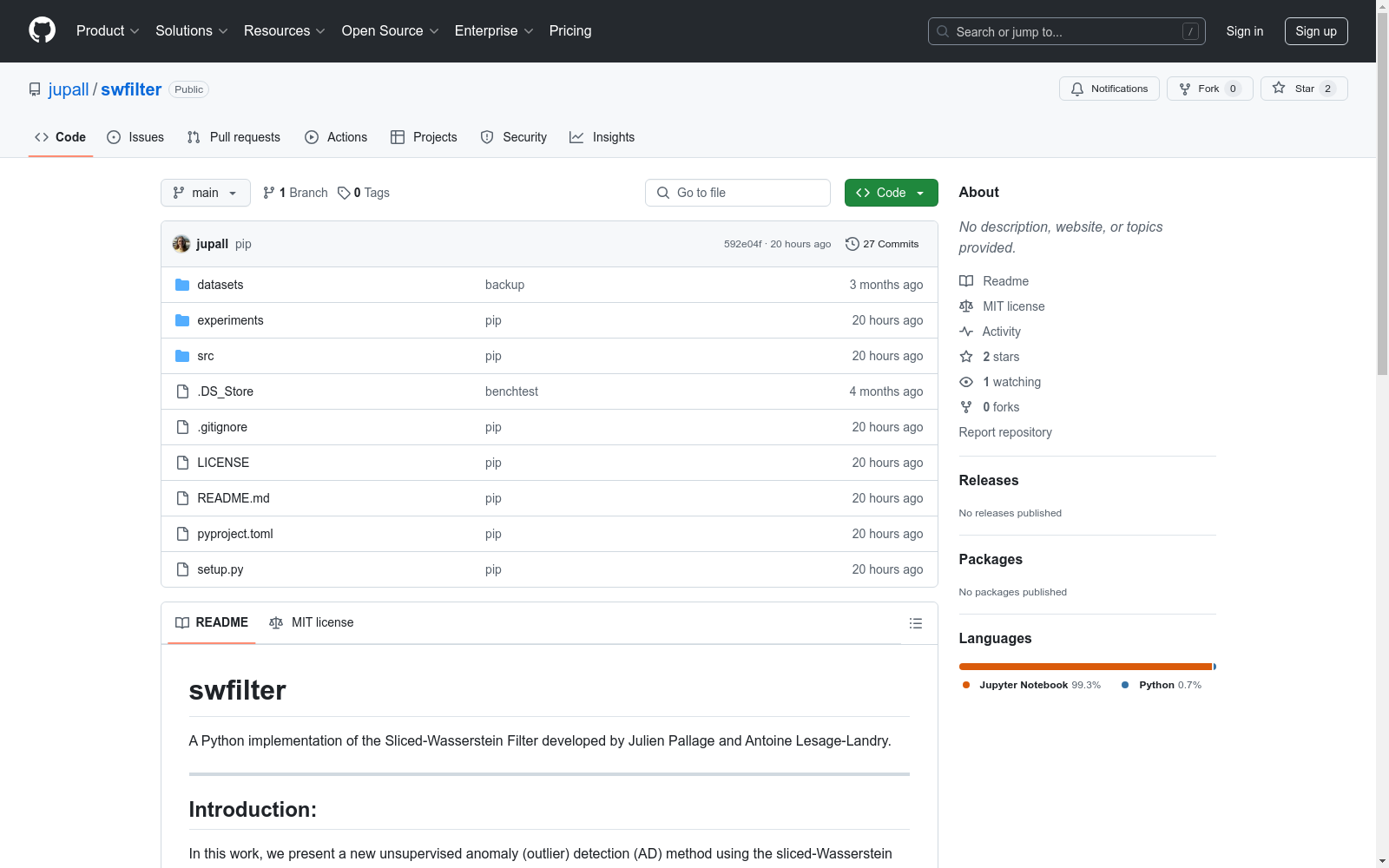
swfilter
简介
本项目提出了一种使用切片Wasserstein度量(Sliced-Wasserstein Metric)的新型无监督异常检测(AD)方法。该过滤技术在能源等关键领域的MLOps管道中部署可信机器学习模型方面具有概念上的吸引力。此外,还提出了一种使用快速欧几里得变体的近似方法。代码遵循scikit-learn的API,可以像其他scikit-learn AD方法(如Isolation Forest、Local Outlier Factor)一样调用。
实现方式
使用POT库中的切片Wasserstein距离的Python实现,并通过投票系统将候选样本标记为异常值或正常值,使用joblib并行化处理过程。
使用方法
python from swfilter import SlicedWassersteinFilter eps = 0.01 # SW距离的阈值 n = 30 # 投票者数量 n_projections = 50 # SW计算中使用的投影数量 p = 0.6 # 标记为异常值所需的投票者百分比阈值 n_jobs = -1 # 并行化中调用的工作者数量(-1 = 最大值)
model = SlicedWassersteinFilter(eps=eps, n=n, n_projections=n_projections, p=p, n_jobs=n_jobs, swtype=original) preds, vote = model.fit_predict(dataset)
mask = preds == 1 filtered_dataset = dataset[mask]
安装
即将推出!
教程
查看我们的教程页面!
引用与论文
即将推出!