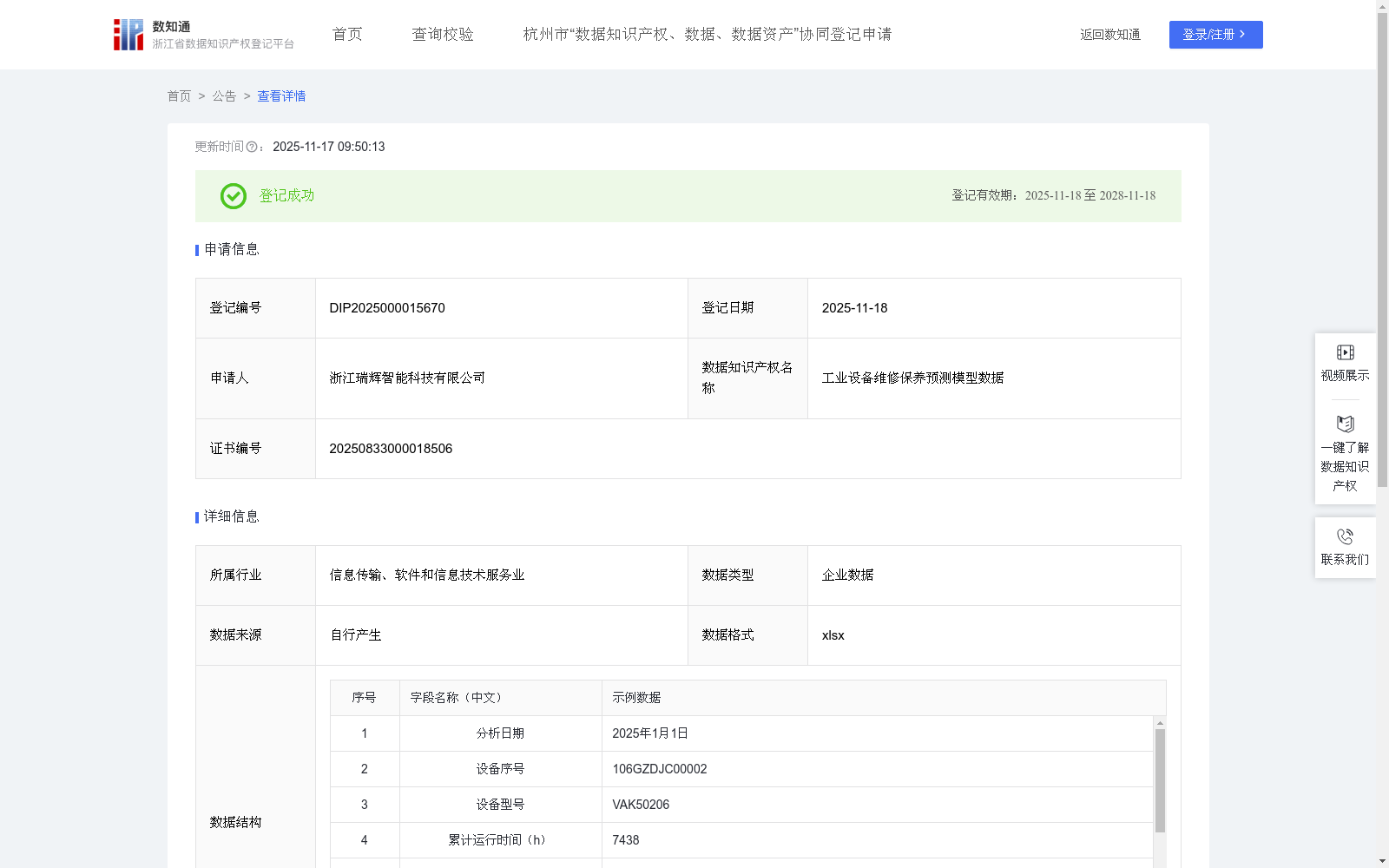
工业设备维修保养预测模型数据
收藏资源简介:
工业设备维修保养预测模型数据具有广泛的用途和应用场景,通过计算得出下次保养建议日期,可以为各个领域带来显著的效益,如汽车制造、电子制造、化工、半导体等行业,这些行业中的设备通常价值高昂且对生产至关重要,因此预测性维护具有重要的经济价值,通过制定科学的维修保养计划,合理安排保养时间和资源,避免非计划性停机和生产中断,提高设备利用率和生产效率,实现降本增效、提升竞争力;同时有助于推动工业互联网和智能制造的发展,通过将传统维护转变为预测性维护,可以减少设备故障率和维修成本,提高生产安全性和环保性,从而促进社会的可持续发展;并且此类数据也可应用于我司的各类工业系统产品中,提高我司产品质量,为客户带来更为优质的产品与服务,推动可持续的业务增长。 数据采集:本项数据主要来源于对我司生产基地、我司技术研究部门的相关设备进行定期监测和维护所产生,存储在我司数据存储和处理系统; 数据处理:对数据实施数据清洗和去重,确保数据的质量和一致性,剔除异常项目,包括但不限于设备型号、累计运行时间、累计待机时间、累计维修停机时间、累计保养停机时间、上次维保结束日期、上次维保类型、累计保养次数、累计维修次数、设备常规保养周期; 系数计算:负载强度系数=累计运行时间/(累计运行时间+累计待机时间+累计维修停机时间+累计保养停机时间),故障系数=(累计维修停机时间/(累计维修停机时间+累计保养停机时间)+累计维修次数/(累计保养次数+累计维修次数))/2。 日期预测:下次保养建议日期=上次维保结束日期+设备常规保养周期/(负载强度系数+故障系数)
The data for industrial equipment maintenance prediction models has a wide range of applications and scenarios. By calculating the recommended next maintenance date, it can bring significant benefits to various sectors including automotive manufacturing, electronic manufacturing, chemical industry, semiconductor industry and other industries. Equipment in these industries is usually highly valuable and critical to production, so predictive maintenance holds considerable economic value. Formulating scientific maintenance plans to rationally arrange maintenance time and resources can avoid unplanned downtime and production disruptions, improve equipment utilization rate and production efficiency, thereby achieving cost reduction and efficiency improvement, and enhancing competitiveness. Meanwhile, it helps promote the development of industrial internet and intelligent manufacturing: transforming traditional maintenance into predictive maintenance can reduce equipment failure rate and maintenance costs, improve production safety and environmental friendliness, thus advancing sustainable social development. Moreover, such data can also be applied to various industrial system products of our company, improving the quality of our products, providing customers with higher-quality products and services, and promoting sustainable business growth. Data Collection: This dataset is primarily generated from regular monitoring and maintenance of relevant equipment in our company's production bases and technical research departments, and is stored in our company's data storage and processing systems. Data Processing: Data cleaning and deduplication are performed on the dataset to ensure data quality and consistency, with abnormal entries removed, including but not limited to equipment model, cumulative operating time, cumulative standby time, cumulative unplanned maintenance downtime, cumulative scheduled maintenance downtime, date of the last maintenance completion, type of the last maintenance, cumulative maintenance times, cumulative repair times, and the equipment's routine maintenance cycle. Coefficient Calculation: Load intensity coefficient = cumulative operating time / (cumulative operating time + cumulative standby time + cumulative unplanned maintenance downtime + cumulative scheduled maintenance downtime); Failure coefficient = [cumulative unplanned maintenance downtime / (cumulative unplanned maintenance downtime + cumulative scheduled maintenance downtime) + cumulative repair times / (cumulative maintenance times + cumulative repair times)] / 2. Date Prediction: Recommended next maintenance date = date of the last maintenance completion + equipment routine maintenance cycle / (load intensity coefficient + failure coefficient)