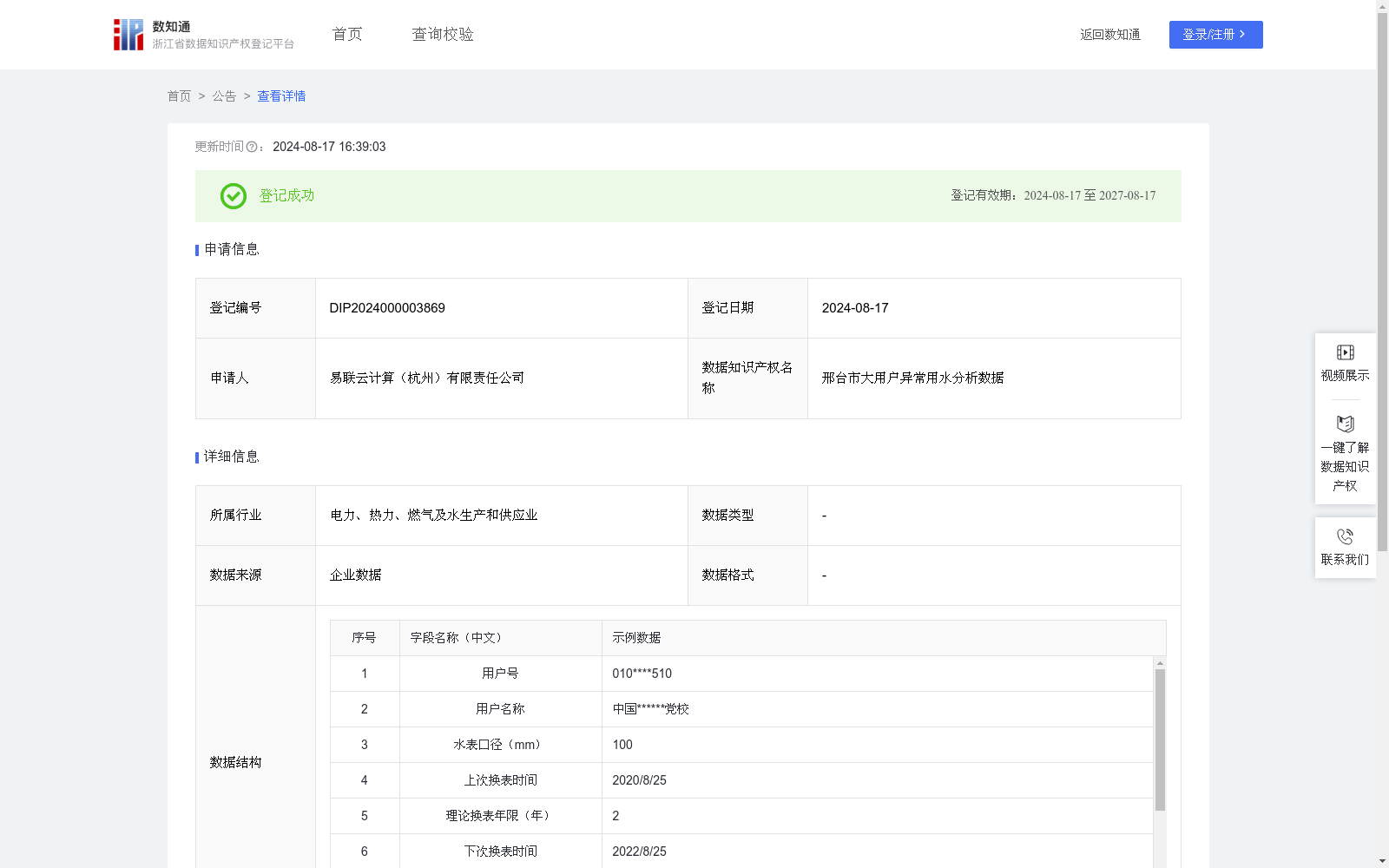
邢台市大用户异常用水分析数据
收藏资源简介:
通过大用户水表营收抄表数据集,分析用水变化规律,并根据不同水量区间,设定异常判断标准,筛选水量异常下降的大用户,判断水量下降原因,供水务公司管理决策。1、数据获取 获取用户号、用户名称、水表口径(mm)、上次换表时间、下次换表时间、日期 2、规则设定 ①根据水表口径(mm),设定不同口径水表的理论换表年限(年)。 ②设定结论判断条件,根据去年年度水量区间,超期服役,月均用水变化(m³/月)及历年水量变化(m³/年)设置判断条件。 3、结果输出 使用ARIMA模型,每月执行计算,用当月数据对比设定的判断条件,生成分析结论。
This dataset comprises revenue meter reading data for large-volume water users. It is utilized to analyze water consumption variation patterns, establish abnormality judgment criteria based on different water consumption intervals, screen out large water users with abnormally decreased water consumption, identify the causes of such consumption decline, and provide support for management decision-making of water supply companies. 1. Data Acquisition: Collect user number, user name, water meter caliber (mm), last meter replacement time, next scheduled meter replacement time, and meter reading date. 2. Rule Setting: ① Specify the theoretical service lifespan (in years) for water meters of various calibers based on their caliber (mm). ② Establish conclusion judgment criteria by incorporating factors including last year's annual water consumption intervals, overdue meter service status, monthly average water consumption variation (m³/month), and multi-year water consumption variation (m³/year). 3. Result Output: Implement the ARIMA model for monthly calculations, compare the current month's data with the pre-established judgment criteria, and generate analysis conclusions.