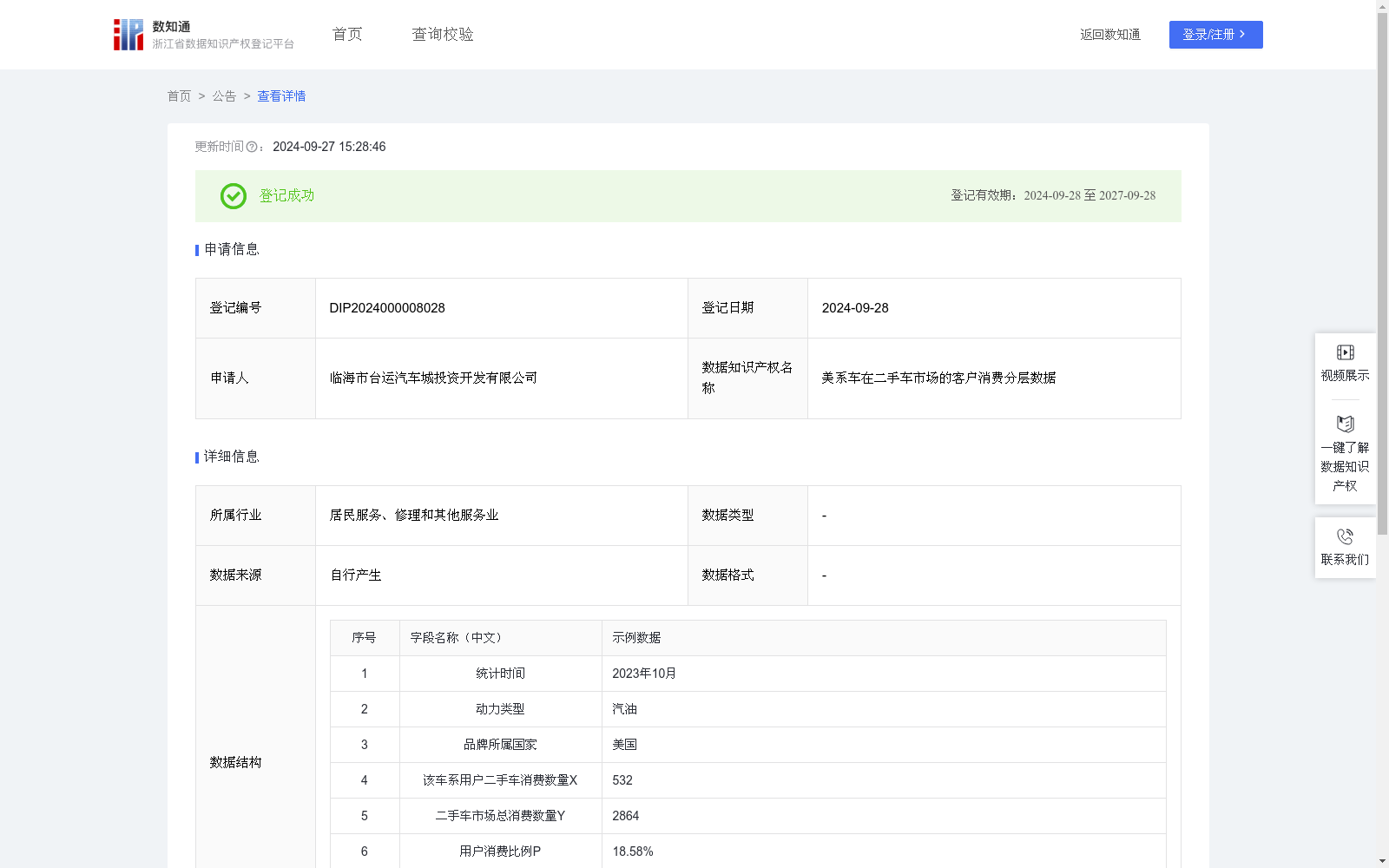
美系车在二手车市场的客户消费分层数据
收藏资源简介:
通过统计分析不同车系品牌的汽车在二手车市场的客户消费数据,定位二手车客户的消费级别,为二手车销售企业的品牌选取、营销方案制定、定价决策等提供数据支持。该项数据分析对二手车销售企业有非常重要的意义,对整个二手车市场都有巨大推广价值。1、数据采集:收集二手车市场的客户消费数据并统计。2、用户消费比例P = 该车系用户二手车消费数量X ÷ 二手车市场总消费数量Y × 100%,用户消费占总消费的比例按从大到小进行排名;3、消费分层运用ABCDEF分类法,若P≥50%,则划分为“A类消费”分层;若40%≤P<50%,则划分为“B类消费”分层;若30%≤P<40%,则划分为“C类消费”分层;若20%≤P<30%,则划分为“D类消费”分层;若10%≤P<20%,则划分为“E类消费”分层;若P<10%,则划分为“F类消费”分层。
This dataset performs statistical analysis on customer consumption data of vehicles from different series and brands in the used car market, aiming to classify the consumption tiers of used car customers and provide data support for used car sales enterprises in brand selection, marketing plan formulation, pricing decision-making and other aspects. This data analysis is of great significance to used car sales enterprises and has tremendous promotional value for the entire used car market. 1. Data Collection: Collect and count customer consumption data in the used car market. 2. User Consumption Proportion Calculation: The user consumption proportion P is calculated as (Number of used car consumption transactions of users of a specific vehicle series X) ÷ (Total used car consumption transactions in the market Y) × 100%. Rank the user consumption proportions in descending order. 3. Consumption Stratification: Adopt the ABCDEF classification method for consumption stratification. If P ≥ 50%, it is classified as "Class A Consumption"; if 40% ≤ P < 50%, it is classified as "Class B Consumption"; if 30% ≤ P < 40%, it is classified as "Class C Consumption"; if 20% ≤ P < 30%, it is classified as "Class D Consumption"; if 10% ≤ P < 20%, it is classified as "Class E Consumption"; if P < 10%, it is classified as "Class F Consumption".