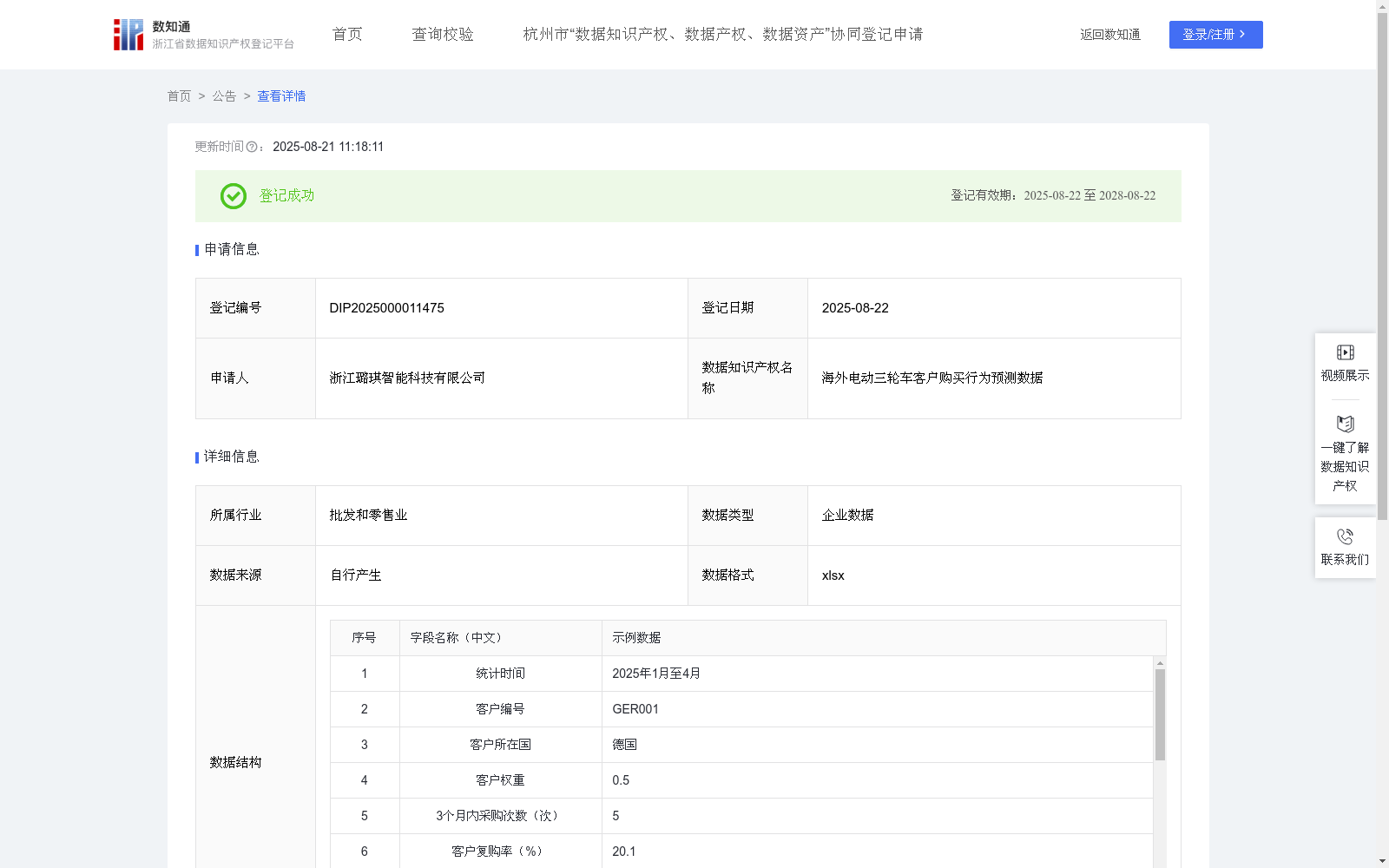
海外电动三轮车客户购买行为预测数据
收藏资源简介:
客户购买行为指电动三轮车采购方在客户复购、价格敏感度、营销响应等环节中表现出的心理倾向与行动模式,涵盖产品匹配、价格敏感度及品牌忠诚度等维度。该模型通过解析客户行为逻辑,可显著提升电动车企业的市场响应效率,降低客户流失率,同时提高高附加值车型销售占比。本预测数据还具有以下应用场景:基于分级定向向客户推送不同的优惠券,高价值客户转化率可提升;量化客户价值与需求特征,可帮助本行业所有的电动车企业从“粗放销售”转向“精准运营”,提升客户生命周期价值。采集各个客户对电动三轮车购买的各个数据,客户行为预测公式:客户行为预测值=客户权重*客户复购率+价格权重*价格敏感度+产品权重*产品需求匹配度+营销权重*营销响应率,客户复购率基于各个客户在3个月内重复采购比例,价格敏感度基于客户对促销活动的响应弹性系数,产品需求匹配度基于客户调研中设备功能与生产场景的契合评分,营销响应率基于客户点击广告的行为增幅。通过计算得出各个客户行为预测值,根据客户行为预测值对各个客户进行分级,如客户行为预测值大于等于10,则该客户为高价值客户,如客户行为预测值小于等于8,则该客户为低效客户,如客户行为预测值在8到10之间,则该客户为潜力客户。
Customer purchasing behavior refers to the psychological tendencies and behavioral patterns exhibited by electric three-wheeled vehicle buyers in aspects such as customer repurchase, price sensitivity, and marketing response, covering dimensions including product matching, price sensitivity, and brand loyalty. This model, by analyzing the logic of customer behavior, can significantly improve the market response efficiency of electric vehicle enterprises, reduce customer churn rate, and increase the sales proportion of high-value-added vehicle models. This prediction data also has the following application scenarios: 1. Delivering different coupons to customers in a graded and targeted manner can improve the conversion rate of high-value customers; 2. Quantifying customer value and demand characteristics can help all electric vehicle enterprises in this industry shift from "extensive sales" to "precision operation" and increase customer lifetime value. When collecting various data related to electric three-wheeled vehicle purchases from each customer, the customer behavior prediction formula is as follows: Customer Behavior Prediction Value = Customer Weight * Customer Repurchase Rate + Price Weight * Price Sensitivity + Product Weight * Product Demand Matching Degree + Marketing Weight * Marketing Response Rate. The customer repurchase rate is based on the proportion of repeat purchases by each customer within 3 months; price sensitivity is based on the response elasticity coefficient of customers to promotional activities; product demand matching degree is based on the fit score between equipment functions and production scenarios in customer surveys; marketing response rate is based on the behavioral growth rate of customers clicking advertisements. By calculating the customer behavior prediction value for each customer, customers are classified based on this value: customers with a prediction value greater than or equal to 10 are categorized as high-value customers; those with a prediction value less than or equal to 8 are inefficient customers; and those with a prediction value between 8 and 10 are potential customers.