
The Treatment of CISG Article 79 in German Courts: Halting the Homeward Trend
收藏DataCite Commons2021-10-15 更新2024-07-03 收录
下载链接:
https://journals.aau.dk/index.php/NJCL/article/view/3010
下载链接
链接失效反馈官方服务:
资源简介:
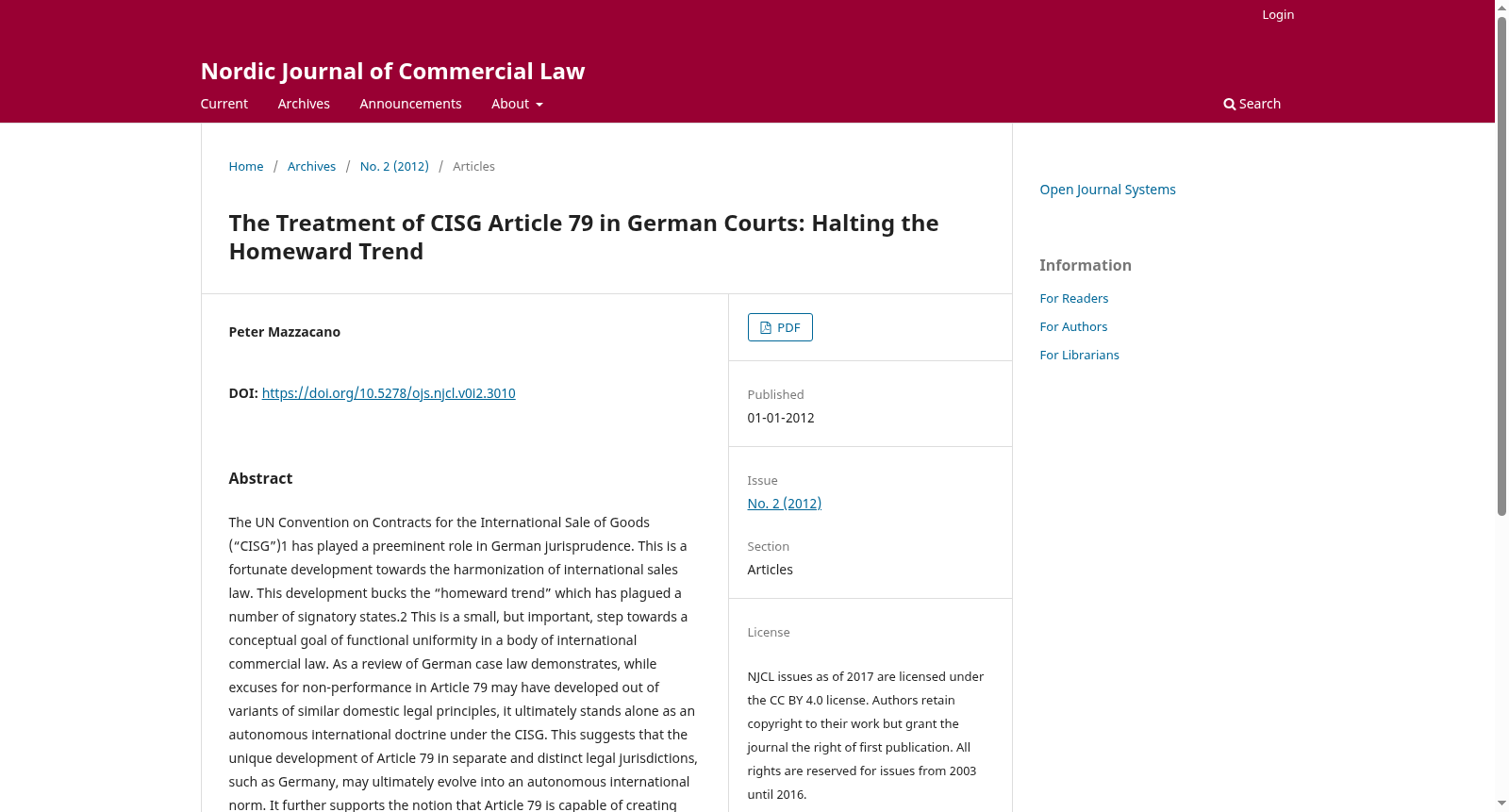
The UN Convention on Contracts for the International Sale of Goods (“CISG”)1 has played a preeminent role in German jurisprudence. This is a fortunate development towards the harmonization of international sales law. This development bucks the “homeward trend” which has plagued a number of signatory states.2 This is a small, but important, step towards a conceptual goal of functional uniformity in a body of international commercial law. As a review of German case law demonstrates, while excuses for non-performance in Article 79 may have developed out of variants of similar domestic legal principles, it ultimately stands alone as an autonomous international doctrine under the CISG. This suggests that the unique development of Article 79 in separate and distinct legal jurisdictions, such as Germany, may ultimately evolve into an autonomous international norm. It further supports the notion that Article 79 is capable of creating relative uniformity within the context of the CISG’s goal for a sales law that is transnational in design.
《联合国国际货物销售合同公约》(United Nations Convention on Contracts for the International Sale of Goods,缩写CISG)1在德国法学实践中占据卓越地位,此举对国际销售法的统一化进程而言堪称颇具裨益的发展。这一发展扭转了长期困扰诸多缔约国的“回归本土趋势”2。这是朝着国际商事法律体系实现功能统一这一概念性目标迈出的微小却至关重要的一步。正如对德国判例法的梳理考察所证实的那样,尽管第七十九条(Article 79)规定的非履行免责事由或许脱胎于同类国内法律原则的不同变体,但在CISG框架下,其最终作为一项自主的国际法律原则独立存在。这表明,在德国等彼此独立且各具特色的法域中,第七十九条的独特发展或许终将演变为一项自主的国际规范。这进一步佐证了如下观点:鉴于CISG旨在构建具有跨国属性的销售法,第七十九条足以在该公约的目标框架内实现相对统一。
创建时间:
2021-10-15
搜集汇总
数据集介绍
背景与挑战
背景概述
该数据集是一篇学术论文,聚焦于CISG第79条在德国司法实践中的应用,旨在分析该条款如何作为独立国际法律原则,减少本土法律影响,推动国际销售法的统一和协调。文章发表于2012年,强调德国案例法在促进跨国商业法功能一致性方面的作用。
以上内容由遇见数据集搜集并总结生成


