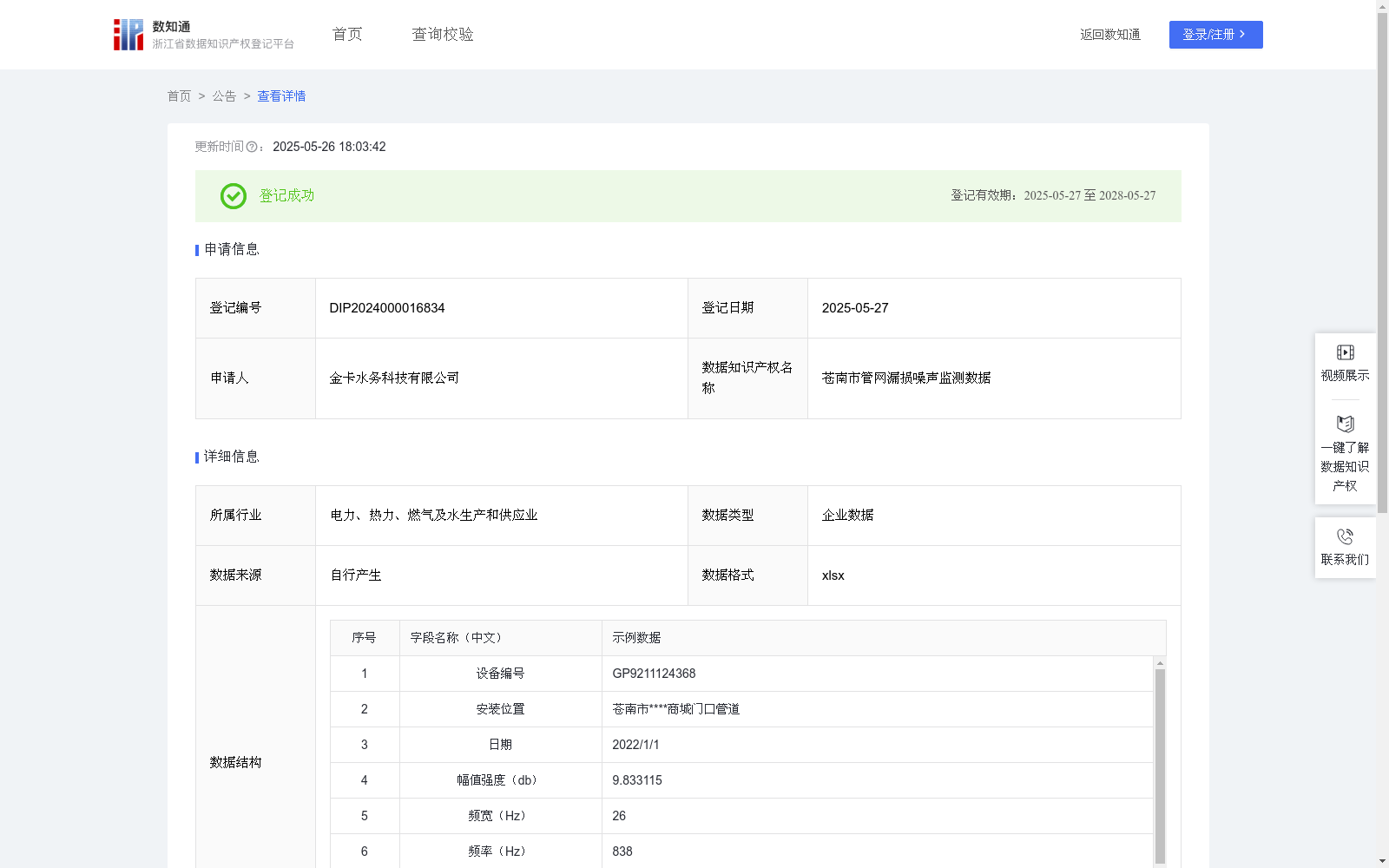
苍南市管网漏损噪声监测数据
收藏资源简介:
通过将噪声监测设备吸附在管网上,监测管网2:00~4:00时段内某段时间内的供水音频,分析音频频谱频率,计算漏损可能性,生成特征值,帮助检漏人员快速确定漏损位置,提高检漏效率,为城市供水公司提供低成本、高效率的管网漏损检测解决方案,协助优化管网运行,降低漏损率,节约水资源。1、数据获取 通过金卡物联网平台及漏损管控平台获取噪声监测设备的设备编号、安装位置、日期、幅值强度(db)、频宽(Hz)、频率(Hz)。 2、规则设定 将音频数据的幅值强度(db)、频宽(Hz)、频率(Hz)按照傅里叶变换(FFT)进行标准处理提取,计算特征值,根据特征值结果,输出报警状态,如特征值>20,报警状态输出为漏损,其余为正常。 计算公式如下: ①如果 幅值强度(db)<15,则特征值为1 ②如果 幅值强度(db)≥15,则 特征值=幅值强度(db)*频宽(Hz)/频率(Hz)*10 3、结果输出 输出特征值、报警状态,筛选出存在报警的设备编号和日期,进一步判断是否存在漏损,并根据安装位置信息,委派人员现场核实。
By attaching noise monitoring devices to water supply pipeline networks, this solution collects water supply audio data within the 2:00–4:00 time window, analyzes the audio spectral frequencies, calculates leakage risk probabilities, and generates feature values. It helps leak detection personnel quickly pinpoint leak locations, improves detection efficiency, and provides low-cost, high-efficiency pipeline leakage detection solutions for urban water supply companies, assisting in optimizing pipeline network operations, reducing leakage rates, and conserving water resources. 1. Data Acquisition Obtain the device ID, installation location, collection date, amplitude intensity (decibels, dB), frequency bandwidth (Hz), and signal frequency (Hz) of the noise monitoring devices via the Jinka IoT Platform and Leakage Control Platform. 2. Rule Setting Standardly process and extract the amplitude intensity (dB), frequency bandwidth (Hz), and signal frequency (Hz) of the audio data using Fast Fourier Transform (FFT), then calculate the feature values. Output the alarm status based on the feature values: if the feature value > 20, the alarm status is set to "leakage detected"; otherwise, it is set to "normal". The calculation formulas are as follows: ① If the amplitude intensity (dB) < 15, the feature value = 1; ② If the amplitude intensity (dB) ≥ 15, the feature value = (amplitude intensity (dB) × frequency bandwidth (Hz) / signal frequency (Hz)) × 10. 3. Result Output Output the calculated feature values and alarm status, filter out the device IDs and collection dates with active alarms, further verify whether actual leakage exists, and dispatch on-site inspection personnel based on the device installation locations.