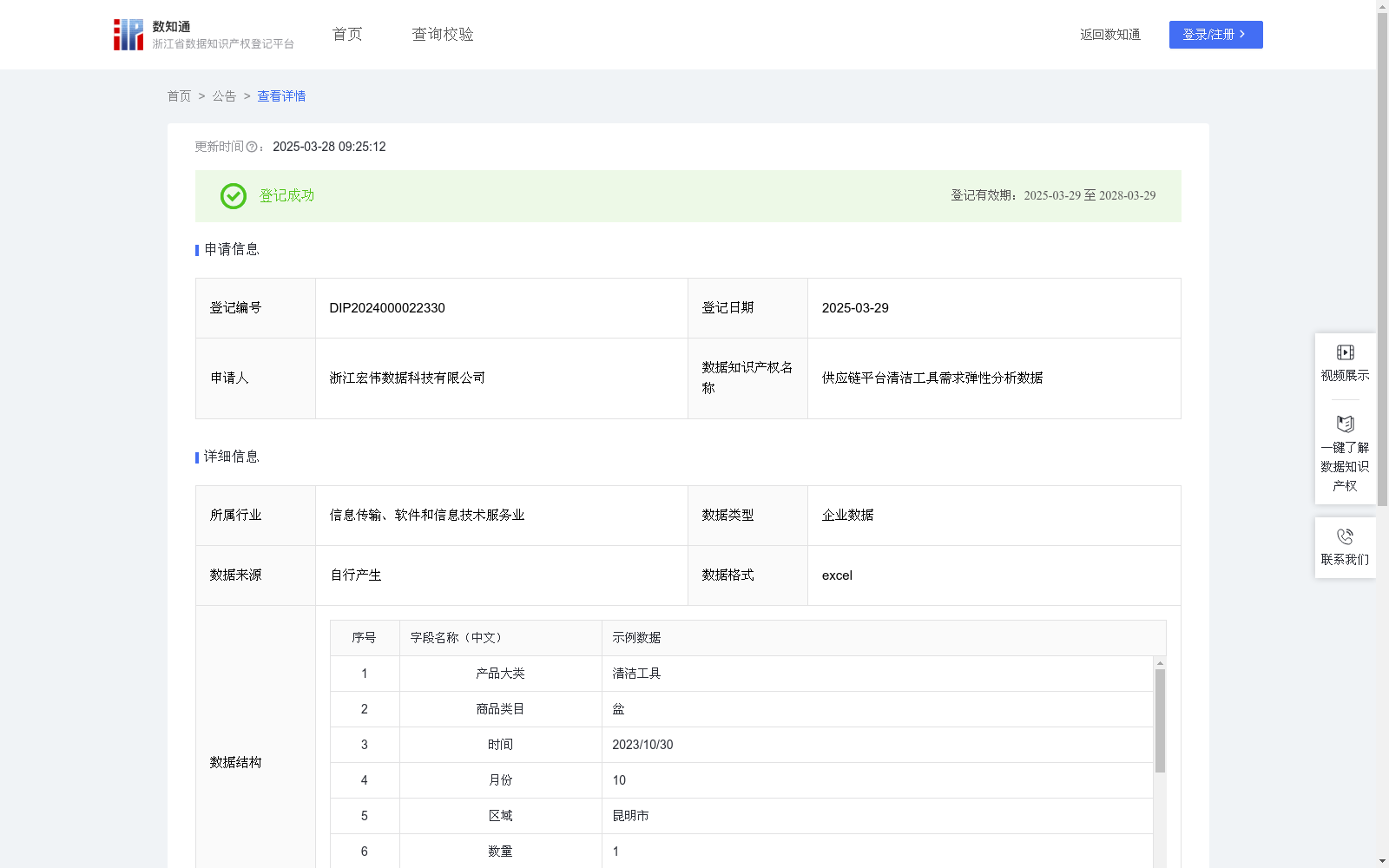
供应链平台清洁工具需求弹性分析数据
收藏资源简介:
通过对特定时间段内不同地区清洁工具的需求及价格数据进行搜集与分析,可以计算出清洁工具的需求价格弹性。当清洁工具的需求量变化率超过其价格变化率时,表明该商品具有较高的需求价格弹性,即消费者对清洁工具价格变动的反应较为敏感。需求价格弹性越大,意味着需求对价格变动的响应程度越高。 基于需求价格弹性的分析结果,供应商能够更加科学地调整清洁工具的库存和采购计划,进一步优化库存管理和销售策略,从而有效应对市场波动,确保收入的稳定性。这种做法不仅有助于减少不必要的库存成本,还能提高市场竞争力,为企业的长期发展奠定坚实的基础。1.数据采集:采集供应链平台相关清洁工具在某一时间段的需求数据和价格数据。 2.算法规则:对采集得到的数据按照如下公式进行计算:需求弹性系数Ed=-(△Q/Q)÷(△P/P),得到需求弹性系数。 式中:Q表示产品的需求量,单位为件;P表示产品的价格,单位为元;△Q表示需求量同比变动值,单位为件;△P表示价格同比变动值,单位为元。 取需求弹性系数的绝对值|Ed|作为分析数据时的参考系数。 3.数据分析:根据|Ed|的数值可分析各类商品的需求价格弹性。 (1)|Ed|=1(单位需求价格弹性),说明需求量变动幅度与价格变动幅度相同; (2)1<|Ed|<∝(需求富有弹性),说明需求量变动幅度大于价格变动幅度;(3)0<|Ed|<1(需求缺乏弹性),说明需求量变动幅度小于价格变动幅度。
By collecting and analyzing demand and price data of cleaning tools across different regions over a specific time period, the price elasticity of demand (PED) for cleaning tools can be calculated. When the rate of change in the quantity demanded of cleaning tools exceeds the rate of change in their prices, the commodity exhibits relatively high price elasticity of demand, meaning consumers are highly sensitive to price fluctuations of cleaning tools. The greater the price elasticity of demand, the higher the responsiveness of demand to price changes. Based on the analysis results of price elasticity of demand, suppliers can scientifically adjust the inventory and procurement plans for cleaning tools, further optimize inventory management and sales strategies, effectively cope with market fluctuations, and ensure revenue stability. This approach not only helps reduce unnecessary inventory costs but also enhances market competitiveness, laying a solid foundation for the long-term development of enterprises. 1. Data Collection: Collect demand and price data of relevant cleaning tools on the supply chain platform over a certain period of time. 2. Algorithm Rules: Calculate the demand elasticity coefficient using the following formula based on the collected data: $$E_d = -frac{Delta Q / Q}{Delta P / P}$$ Where: Q represents the quantity demanded of the product, with the unit of piece; P represents the price of the product, with the unit of yuan; ΔQ represents the year-on-year change in quantity demanded, with the unit of piece; ΔP represents the year-on-year change in price, with the unit of yuan. Take the absolute value of the demand elasticity coefficient $|E_d|$ as the reference coefficient for data analysis. 3. Data Analysis: Analyze the price elasticity of demand for various commodities based on the value of $|E_d|$. (1) $|E_d|=1$ "unitary price elasticity of demand": indicates that the magnitude of change in quantity demanded is the same as that of price change; (2) $1 < |E_d| < infty$ "demand is elastic": indicates that the magnitude of change in quantity demanded is greater than that of price change; (3) $0 < |E_d| < 1$ "demand is inelastic": indicates that the magnitude of change in quantity demanded is smaller than that of price change.