
MMS 3 Flux Gate Magnetometer (FGM) DC Magnetic Field, Level 2 (L2), Burst Mode, 128 Sample/s, v4/5 Data
收藏DataCite Commons2025-12-22 更新2025-04-16 收录
下载链接:
https://spase-metadata.org/NASA/NumericalData/MMS/3/FIELDS/FGM/Burst/Level2/PT0.0078125S
下载链接
链接失效反馈官方服务:
资源简介:
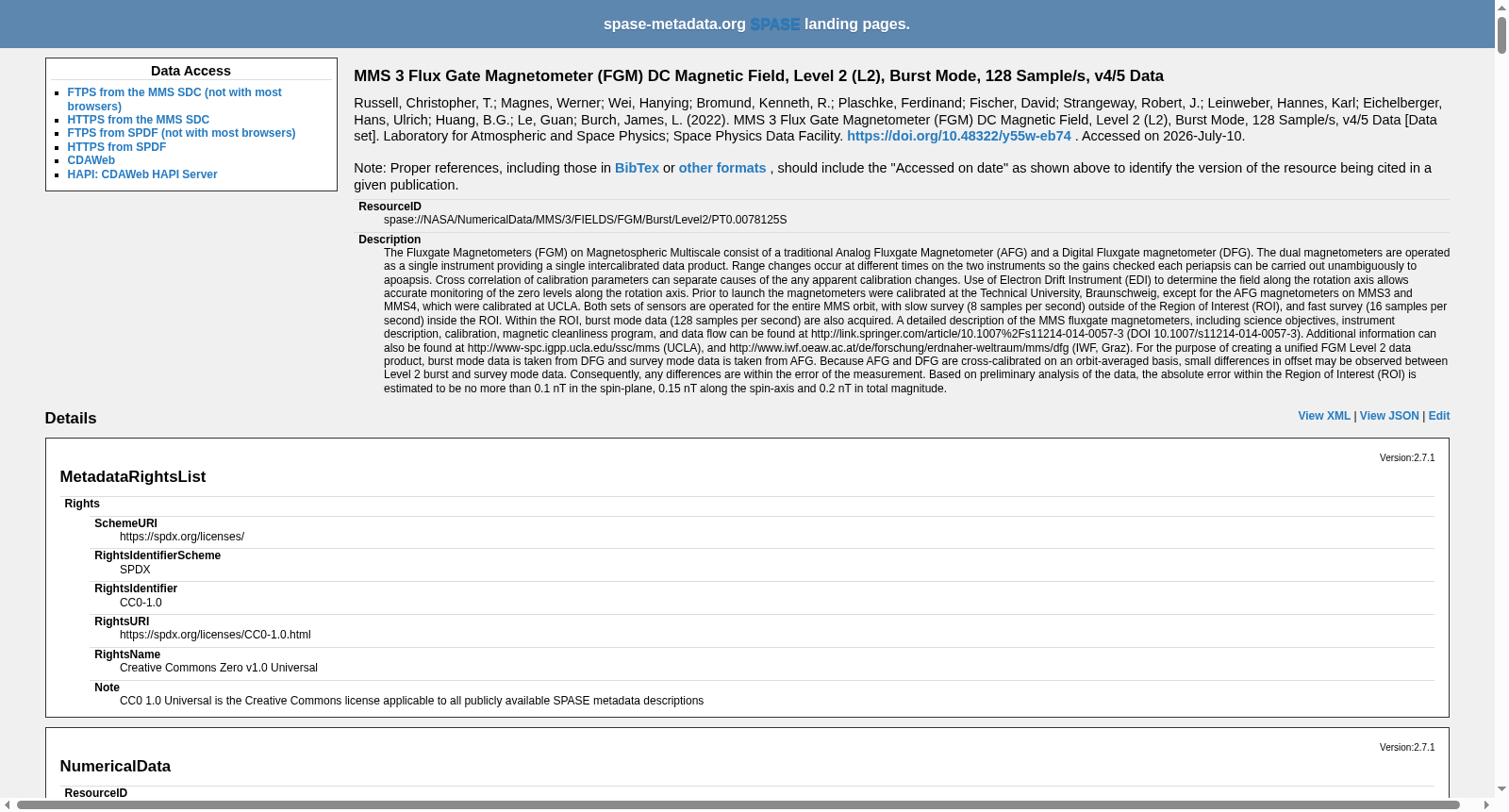
The Fluxgate Magnetometers (FGM) on Magnetospheric Multiscale consist of a traditional Analog Fluxgate Magnetometer (AFG) and a Digital Fluxgate magnetometer (DFG). The dual magnetometers are operated as a single instrument providing a single intercalibrated data product. Range changes occur at different times on the two instruments so the gains checked each periapsis can be carried out unambiguously to apoapsis. Cross correlation of calibration parameters can separate causes of the any apparent calibration changes. Use of Electron Drift Instrument (EDI) to determine the field along the rotation axis allows accurate monitoring of the zero levels along the rotation axis. Prior to launch the magnetometers were calibrated at the Technical University, Braunschweig, except for the AFG magnetometers on MMS3 and MMS4, which were calibrated at UCLA. Both sets of sensors are operated for the entire MMS orbit, with slow survey (8 samples per second) outside of the Region of Interest (ROI), and fast survey (16 samples per second) inside the ROI. Within the ROI, burst mode data (128 samples per second) are also acquired. A detailed description of the MMS fluxgate magnetometers, including science objectives, instrument description, calibration, magnetic cleanliness program, and data flow can be found at http://link.springer.com/article/10.1007%2Fs11214-014-0057-3 (DOI 10.1007/s11214-014-0057-3). Additional information can also be found at http://www-spc.igpp.ucla.edu/ssc/mms (UCLA), and http://www.iwf.oeaw.ac.at/de/forschung/erdnaher-weltraum/mms/dfg (IWF, Graz). For the purpose of creating a unified FGM Level 2 data product, burst mode data is taken from DFG and survey mode data is taken from AFG. Because AFG and DFG are cross-calibrated on an orbit-averaged basis, small differences in offset may be observed between Level 2 burst and survey mode data. Consequently, any differences are within the error of the measurement. Based on preliminary analysis of the data, the absolute error within the Region of Interest (ROI) is estimated to be no more than 0.1 nT in the spin-plane, 0.15 nT along the spin-axis and 0.2 nT in total magnitude.
磁层多尺度(Magnetospheric Multiscale, MMS)卫星搭载的磁通门磁力计(Fluxgate Magnetometer, FGM)包含传统模拟式磁通门磁力计(Analog Fluxgate Magnetometer, AFG)与数字式磁通门磁力计(Digital Fluxgate Magnetometer, DFG)。这套双磁力计作为单一集成仪器运行,产出经过统一交叉校准的单一组数据产品。两台仪器的量程调整节点存在差异,因此每次近拱点(periapsis)开展的增益校验可明确延伸至远拱点(apoapsis)阶段。通过校准参数的互相关分析,可精准区分各类表观校准偏差的成因。借助电子漂移仪(Electron Drift Instrument, EDI)测定旋转轴方向的磁场,能够实现旋转轴方向零电平的高精度监测。发射前,除MMS3与MMS4搭载的AFG磁力计由加州大学洛杉矶分校(UCLA)完成校准外,其余磁力计均在不伦瑞克工业大学(Technical University, Braunschweig)完成校准。整套传感器在MMS的全轨道周期内持续运行:在感兴趣区域(Region of Interest, ROI)外采用慢速勘测模式(采样率8次/秒),在ROI内则切换为快速勘测模式(采样率16次/秒);在ROI内还会同步采集爆发模式数据(采样率128次/秒)。关于MMS磁通门磁力计的详细说明,包括科学目标、仪器架构、校准流程、磁洁净方案以及数据流,可参阅http://link.springer.com/article/10.1007%2Fs11214-014-0057-3(DOI: 10.1007/s11214-014-0057-3)。更多相关信息可分别访问UCLA官方资源页面http://www-spc.igpp.ucla.edu/ssc/mms,以及奥地利格拉茨空间物理研究所(IWF, Graz)的MMS-DFG专题页面http://www.iwf.oeaw.ac.at/de/forschung/erdnaher-weltraum/mms/dfg。为构建统一的FGM二级数据产品,爆发模式数据取自DFG,而勘测模式数据则取自AFG。由于AFG与DFG基于轨道平均基准进行交叉校准,二级数据产品中爆发模式与勘测模式数据之间可能存在微小的偏移量差异,但此类差异均处于测量误差的允许范围之内。基于初步数据分析,ROI内的绝对误差估算结果为:自旋平面内不超过0.1纳特(nT),自旋轴方向不超过0.15纳特,总场强度不超过0.2纳特。
创建时间:
2022-08-02
搜集汇总
数据集介绍
背景与挑战
背景概述
该数据集来自NASA磁层多尺度任务(MMS)中MMS 3号卫星的磁通门磁力仪,提供Level 2级别的直流磁场突发模式数据,采样率为128样本/秒,适用于高时间分辨率的磁层物理研究。数据覆盖地球磁层、磁鞘、磁尾等多个区域,包括磁场矢量、卫星位置和温度等参数,经过校准处理,精度在0.1-0.2 nT范围内,并以CDF格式开放访问。
以上内容由遇见数据集搜集并总结生成


