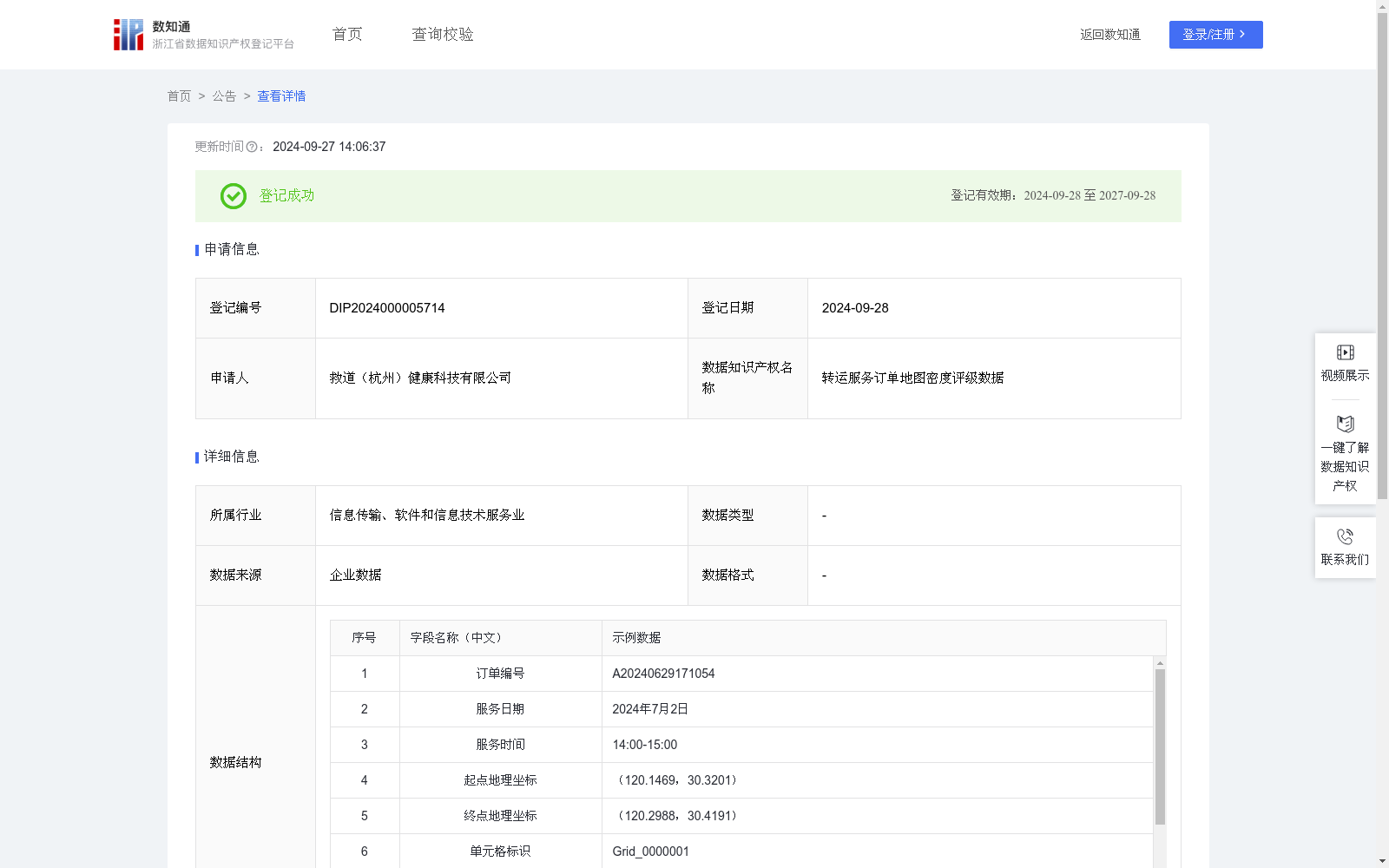
转运服务订单地图密度评级数据
收藏资源简介:
(1)本数据有助于本公司进行资源优化,依据订单密度数据对热点区域进行服务规划和资源部署,如车辆和人员,以提高服务效率。 (2)本数据有助于其他转运服务商进一步统计分析订单密度,识别市场趋势和潜在的增长区域,针对性开展营销。 (3)本数据有助于政府或监管机构利用订单密度数据为城市规划、交通优化和公共服务开展等提供数据支撑。 (4)本数据有助于医疗服务机构根据订单密度数据选择合作伙伴,优化服务网络。(1)数据收集和预处理: 从公司内部订单管理系统中收订单数据,包括订单编号、服务日期、服务时间、起点地理坐标、终点地理坐标。通过数据清洗去除无效或错误记录,确保数据质量。 (2)空间划分: 根据行业经验,将服务区域划分为若干个网格单元,每个网格单元具有固定的大小(100m*100m,0.01平方公里)和唯一的标识。 (3)订单聚合: 根据订单的地理坐标,将每个订单分配到相应的网格单元中。 (4)密度计算: 对每个网格单元内的订单数量进行计数,计算订单密度。订单密度可通过以下公式计算: 订单密度=网格单元内的订单数量÷网格单元面积(以平方公里计) (5)密度等级划分: 根据订单密度的数值,经内部专家研讨将网格单元划分为不同的密度等级:低密度:100以下;中密度:100-200;高密度:200以上。并进行结果输出。
1. This dataset enables the company to optimize its operational resources by formulating service plans and deploying resources (e.g., vehicles and personnel) for hotspots based on order density data, thereby improving service efficiency. 2. This dataset assists other transfer service providers to conduct statistical analysis of order density, identify market trends and potential growth areas, and launch targeted marketing campaigns. 3. This dataset helps governments or regulatory agencies provide data support for urban planning, traffic optimization, public service development and other work by leveraging order density data. 4. This dataset enables medical service institutions to select partners and optimize their service networks based on order density data. (1) Data Collection and Preprocessing: Order data including order number, service date, service time, origin geographic coordinates and destination geographic coordinates is collected from the company's internal order management system. Invalid or erroneous records are removed through data cleaning to ensure data quality. (2) Spatial Division: Based on industry experience, the service area is divided into several grid units, each with a fixed size (100m × 100m, 0.01 square kilometers) and a unique identifier. (3) Order Aggregation: Each order is assigned to the corresponding grid unit based on its geographic coordinates. (4) Density Calculation: The number of orders in each grid unit is counted to calculate the order density. The order density can be calculated using the following formula: Order Density = Number of Orders in the Grid Unit ÷ Area of the Grid Unit (in square kilometers) (5) Density Level Division: Based on the numerical values of order density, grid units are divided into different density levels through internal expert discussions: Low Density: below 100; Medium Density: 100–200; High Density: above 200. The results are then output.