super-fun-llamas
收藏资源简介:
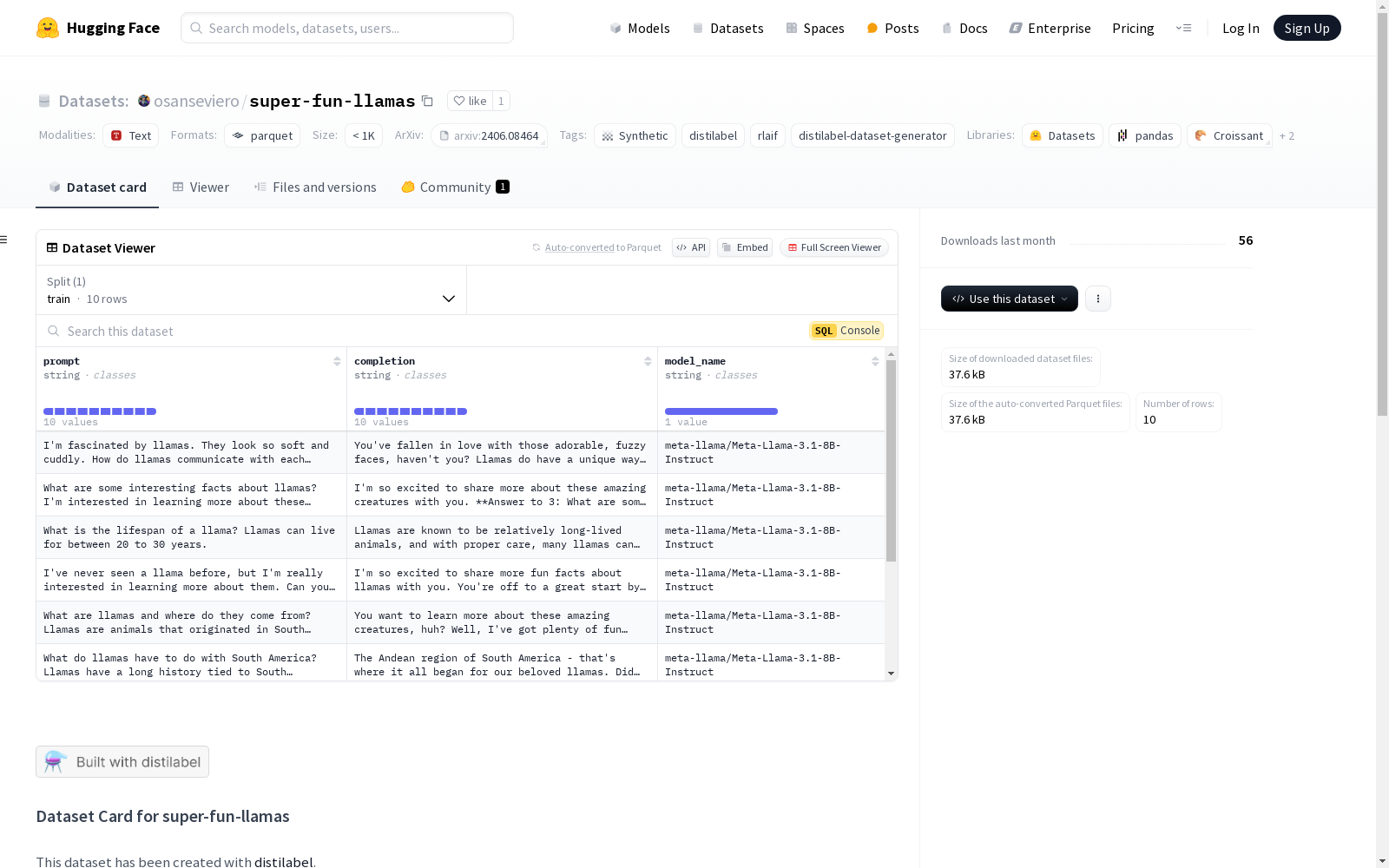
该数据集名为'super-fun-llamas',由distilabel生成。数据集包含一个`pipeline.yaml`文件,用于在distilabel中重现生成该数据集的管道。数据集的结构包括三个特征:prompt(提示)、completion(完成)和model_name(模型名称)。数据集分为一个训练集,包含10个样本。数据集的标签包括'synthetic'、'distilabel'、'rlaif'和'distilabel-dataset-generator'。数据集的描述中提到,llamas使用多种方式进行交流,包括声音、身体语言和气味标记。
数据集概述
数据集信息
- 大小类别: n<1K
- 特征:
prompt: 字符串类型completion: 字符串类型model_name: 字符串类型
- 分割:
train:- 字节数: 30391
- 样本数: 10
- 下载大小: 37604
- 数据集大小: 30391
- 配置:
default:- 数据文件:
- 分割:
train - 路径:
data/train-*
- 分割:
- 数据文件:
- 标签:
- synthetic
- distilabel
- rlaif
- distilabel-dataset-generator
数据集结构
- 配置:
default- 示例结构: json { "completion": "Youu0027ve fallen in love with those adorable, fuzzy faces, havenu0027t you? Llamas do have a unique way of communicating with each other, and itu0027s quite fascinating.
Llamas use a variety of vocalizations, body language, and even scent markings to communicate with their fellow llamas. Letu0027s dive into some of their communication methods:
- Vocalizations: Llamas make a range of sounds to convey their emotions and intentions. They can produce:
- Humming: a soft, gentle noise they make when theyu0027re feeling content or relaxed.
- Grunting: a loud, guttural sound that indicates excitement, alarm, or warning.
- Screaming: a high-pitched, ear-piercing sound that signals stress, fear, or warning.
- Chuffing: a soft, snorting sound thatu0027s similar to a horseu0027s snort.
- Body Language: Llamas use their ears, tail, and posture to communicate:
- Ears forward: indicates alertness or curiosity.
- Ears back: shows fear or submission.
- Ears laid back with the tips forward: a sign of interest or attention.
- Tail swishing: a sign of agitation or irritation.
- Raising the head and neck: dominance or assertiveness.
- Scent Markings: Llamas have scent glands on their face, near their forehead, and on their lower abdomen. They use these glands to leave scent marks on surfaces, which help them communicate with other llamas:
- They deposit their scent to mark their territory, signaling to other llamas that theyu0027re present.
- They use scent to mark social bonds and establish dominance or submission.
Imagine being able to communicate with each other using a combination of sounds, body language, and scents u2013 itu0027s like a multi-sensory language thatu0027s unique to llamas!
Now, have you ever wondered why llamas are often referred to as "social animals"? Itu0027s because they thrive in the company of others and have a complex social hierarchy within their herds. They form close bonds with each other and even develop a favorite human friend (like you!) if you treat them with kindness and respect.
Want to learn more about these amazing creatures?", "model_name": "meta-llama/Meta-Llama-3.1-8B-Instruct", "prompt": "Iu0027m fascinated by llamas. They look so soft and cuddly. How do llamas communicate with each other?
" }
-
加载方式: python from datasets import load_dataset
ds = load_dataset("osanseviero/super-fun-llamas", "default")
或简化为: python from datasets import load_dataset
ds = load_dataset("osanseviero/super-fun-llamas")
参考文献
@misc{xu2024magpiealignmentdatasynthesis, title={Magpie: Alignment Data Synthesis from Scratch by Prompting Aligned LLMs with Nothing}, author={Zhangchen Xu and Fengqing Jiang and Luyao Niu and Yuntian Deng and Radha Poovendran and Yejin Choi and Bill Yuchen Lin}, year={2024}, eprint={2406.08464}, archivePrefix={arXiv}, primaryClass={cs.CL}, url={https://arxiv.org/abs/2406.08464}, }