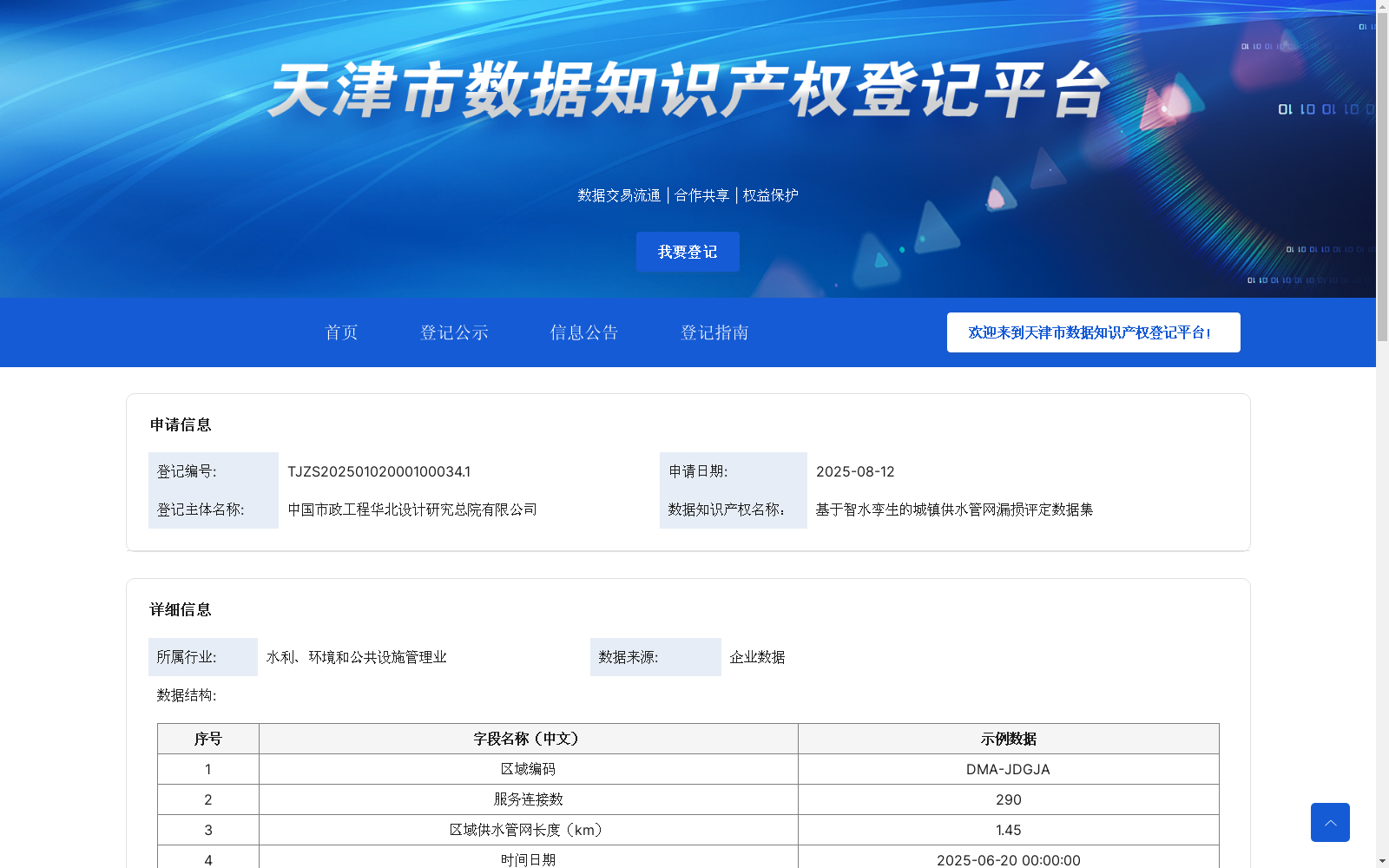
基于智水孪生的城镇供水管网漏损评定数据集
收藏资源简介:
一、针对连续7日原始流量数据、原始压力数据、区域供水管网长度数据及服务连接数,通过多种算法识别无效数据,针对有效数据采用均值计算方法,获取压力均值数据及日平均流量数据。 二、基于上述基础数据,核算时间波定性指标、空间密度性指标、用户端粒度指标和管理潜力指标等管网漏损绩效指标,计算逻辑包括: 夜间最小流量均值为所选区域连续7日夜间如2点到5点的夜间流量数据的平均值。夜间净流量为夜间最小流量均值与夜间合法用水量差值,其中夜间合法用水量为历史未发生漏损或爆管事故时的夜间最小流量。计算前,针对DMA分区流量计或噪声记录仪漏失监测记录仪报警、或节假日、极端天气等异常值进行数据清洗与预处理。实际漏失水量是由夜间净流量推算的年度实际漏失水量。不可避免漏失水量依据参考《城镇供水管网漏损控制及评定标准 CJJ 92-2016》计算。 时间波动性指标即夜间最小流量均值/日平均流量,反映昼夜用水差异;空间密度性指标即单位管长夜间净流量,识别管网物理缺陷密度;用户端粒度指标即单位服务连接夜间净流量,定位用户端异常;管理潜力指标即管网漏失指数,为实际漏失水量与不可避免漏失水量比值,评定控漏空间。 三、通过预设阈值矩阵将核心绩效指标组合映射至A-D四级漏损等级:当所有指标均达到优秀级,评估结果为A类,表明漏控卓越,接近技术极限,应维持监测,优化压力管理;当主要指标时间波动性指标、管理潜力指标在良好级,评估结果为B类,表明漏损可控,局部存在优化空间,应着重修复高漏损管段,升级老旧水表;当任意一指标达到需改进,评估结果为C类,表明漏损显著,管理存在漏洞,应重点开展DMA分区检漏;当任意一指标达严重漏损,评估结果为D级,表明漏损失控,经济/技术风险高,应紧急全面排查,申请管网改造资金,更换超期管道;通过漏损等级判断驱动检漏资源定向投放与管网改造决策,形成监测-评级-处置-验证管理闭环。
1. For seven consecutive days of raw flow data, raw pressure data, regional water distribution network length data and service connection counts, invalid data is identified via multiple algorithms, and valid data is processed using mean calculation to derive mean pressure data and daily average flow data. 2. Based on the above basic data, water distribution network leakage performance indicators including temporal volatility indicator, spatial density indicator, customer-side granularity indicator and management potential indicator are calculated. The calculation logic is as follows: The mean nighttime minimum flow refers to the average value of nighttime flow data from 2:00 to 5:00 AM for seven consecutive days in the selected area. Nighttime net flow is the difference between the mean nighttime minimum flow and nighttime legal water consumption, where nighttime legal water consumption is the nighttime minimum flow recorded during periods with no historical leakage or pipe burst incidents. Prior to calculation, data cleaning and preprocessing are conducted for outliers caused by alarms of District Metering Area (DMA) flow meters or noise logger leakage monitoring recorders, holidays, extreme weather and other factors. Actual water loss is the annual actual water loss estimated from nighttime net flow. Inevitable water loss is calculated in accordance with the Standard for Leakage Control and Evaluation of Urban Water Distribution Networks (CJJ 92-2016). The temporal volatility indicator, defined as mean nighttime minimum flow / daily average flow, reflects the diurnal water use disparity; the spatial density indicator, defined as nighttime net flow per unit pipe length, is used to identify the density of physical defects in the water distribution network; the customer-side granularity indicator, defined as nighttime net flow per service connection, is used to locate customer-side anomalies; the management potential indicator, namely the pipe network leakage index which is the ratio of actual water loss to inevitable water loss, is used to evaluate the potential for leakage control improvement. 3. Core performance indicators are combined and mapped to four-level leakage ratings (Level A to D) via a preset threshold matrix: - Level A: All indicators reach the excellent grade, indicating excellent leakage control close to the technical limit. Sustained monitoring and pressure management optimization should be maintained. - Level B: The core indicators (temporal volatility indicator and management potential indicator) reach the good grade, indicating that leakage is controllable with localized optimization potential. Priority should be given to repairing high-leakage pipe sections and upgrading outdated water meters. - Level C: At least one indicator falls into the "needs improvement" grade, indicating significant leakage and existing management loopholes. Focused DMA district leakage detection should be carried out. - Level D: At least one indicator reaches the "severe leakage" grade, indicating loss of leakage control with high economic and technical risks. Emergency comprehensive inspections should be launched, funds for water distribution network renovation should be applied for, and expired pipelines should be replaced. The leakage rating judgment drives the targeted deployment of leakage detection resources and water distribution network renovation decisions, forming a closed-loop management cycle of monitoring, rating, disposal and verification.