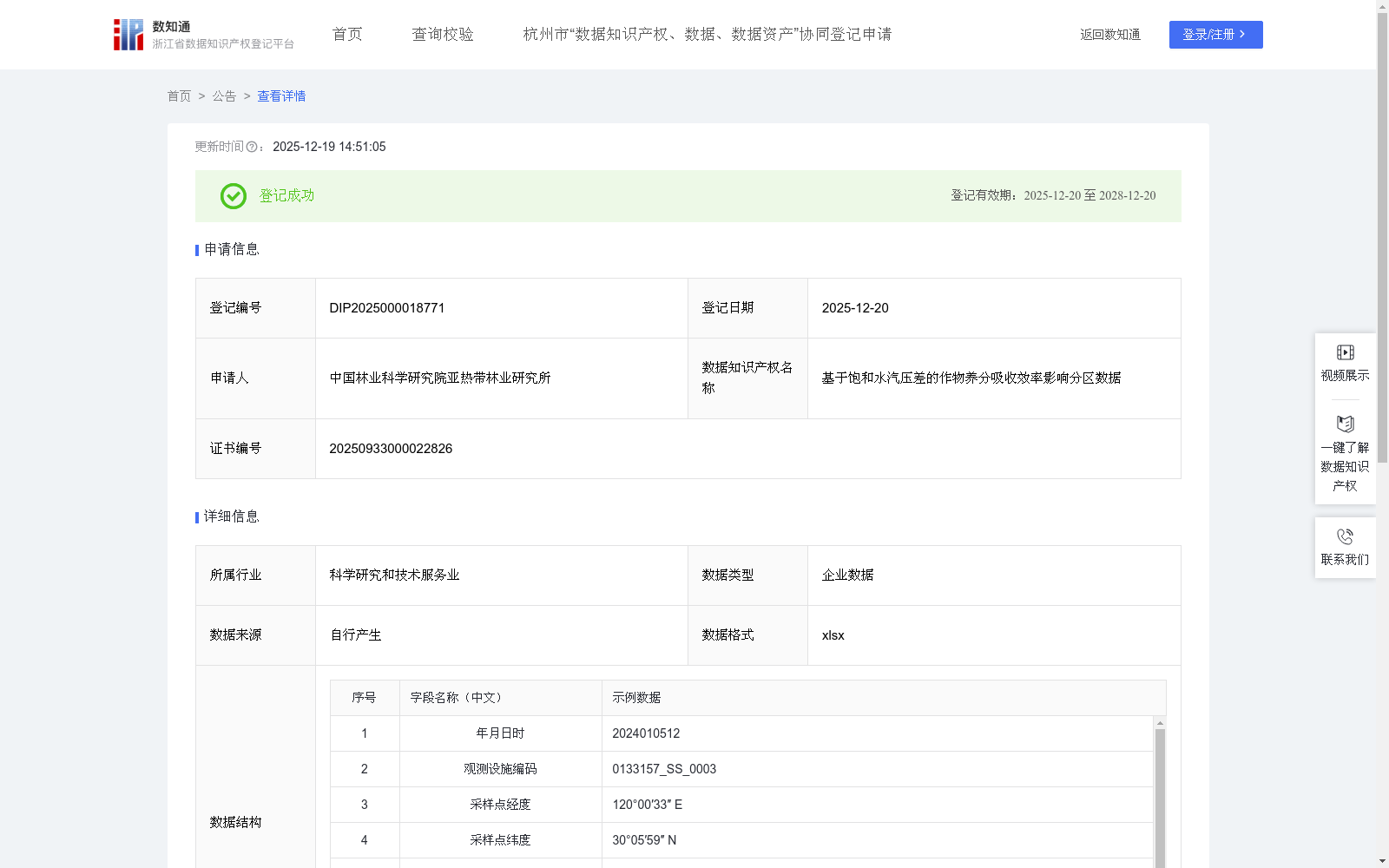
基于饱和水汽压差的作物养分吸收效率影响分区数据
收藏资源简介:
在农业生产中,饱和水汽压差(VPD)是衡量大气干湿程度并直接影响作物水分和养分吸收的关键指标。将全年VPD数据与作物需水模型结合,可以制定出按需灌溉的精确时刻表。系统可以在VPD达到临界值时自动触发灌溉,而不是基于固定的时间或经验,从而实现最大化节水。作物在低VPD(高湿)环境下对养分的吸收效率会降低。通过避开高湿时段(高风险区、警戒区)进行施肥,可以提高肥料利用率。1.数据采集:根据气象学标准,设置专业气象采集点(120°00′33″ E,30°05′59″N),采集实时空气温度、空气湿度数据,时间做到以每小时为间隔,全年不间断采集; 2.数据处理:将数据去噪、优化、补全; 3.数据加工:①饱和水汽压es = 0.61121 * exp( (18.678 - T/234.5) * (T / (257.14 + T)) )。T是空气温度(单位:℃),es的单位是kPa。②实际水汽压ea = es * (RH / 100)。RH是相对湿度(单位:%)。③饱和水汽压差VPD = es - ea。计算结果保留小数点后三位。 4.根据VPD大小可将其划分为五个影响区间:当VPD低于0.3 kPa时,环境极度潮湿,蒸腾作用受到严重抑制,为高风险区;VPD处于0.3至0.5 kPa范围内为潮湿环境,蒸腾作用明显减弱,开始影响吸收效率,为养分吸收的警戒区;VPD在0.5到0.8 kPa之间时,对于夜间或幼苗期是安全区,蒸腾平稳,养分运输正常;0.8至1.2 kPa是白天大多数果菜和叶菜的最佳区间,能有效促进蒸腾、光合和养分吸收;而当VPD高于1.2 kPa时,大气干燥进入胁迫区,植物可能部分关闭气孔以避免失水,从而影响光合作用和养分吸收。
In agricultural production, vapor pressure deficit (VPD) is a critical indicator for measuring atmospheric dry-wet conditions and directly influencing crop water and nutrient uptake. Combining year-round VPD datasets with crop water requirement models allows for the development of precise, demand-based irrigation schedules. The system can automatically initiate irrigation once VPD reaches a critical threshold, rather than relying on fixed time schedules or empirical rules, thereby maximizing water conservation. Crop nutrient uptake efficiency declines in low VPD (high humidity) environments. Applying fertilizers while avoiding high-humidity periods (high-risk and warning zones) can enhance fertilizer use efficiency. 1. Data Collection: In accordance with meteorological standards, a professional meteorological monitoring station is deployed at (120°00′33″ E, 30°05′59″N) to collect real-time air temperature and relative humidity data at hourly intervals, with non-stop, year-round data acquisition; 2. Data Processing: Denoise, optimize, and perform data imputation on the collected datasets; 3. Data Calculation: ① Saturation vapor pressure (e_s = 0.61121 imes expleft( (18.678 - T/234.5) imes (T / (257.14 + T)) ight)). Here, (T) represents air temperature (unit: ℃), and the unit of (e_s) is kPa. ② Actual vapor pressure (e_a = e_s imes (RH / 100)). RH is relative humidity (unit: %). ③ Vapor pressure deficit (VPD = e_s - e_a). All calculation results are rounded to three decimal places. 4. VPD Impact Zones: VPD can be categorized into five impact zones based on its magnitude: - Below 0.3 kPa: The environment is extremely humid, transpiration is severely inhibited, and this zone is classified as a high-risk zone; - 0.3–0.5 kPa: This is a humid environment, where transpiration is significantly reduced and nutrient uptake efficiency begins to be impaired, making it a warning zone for nutrient absorption; - 0.5–0.8 kPa: This is a safe zone for nighttime or seedling stages, with stable transpiration and normal nutrient transport; - 0.8–1.2 kPa: This is the optimal zone for most fruit and leafy vegetables during the daytime, effectively promoting transpiration, photosynthesis, and nutrient absorption; - Above 1.2 kPa: The atmosphere becomes dry and enters a stress zone, where plants may partially close their stomata to prevent water loss, thereby affecting photosynthesis and nutrient absorption.