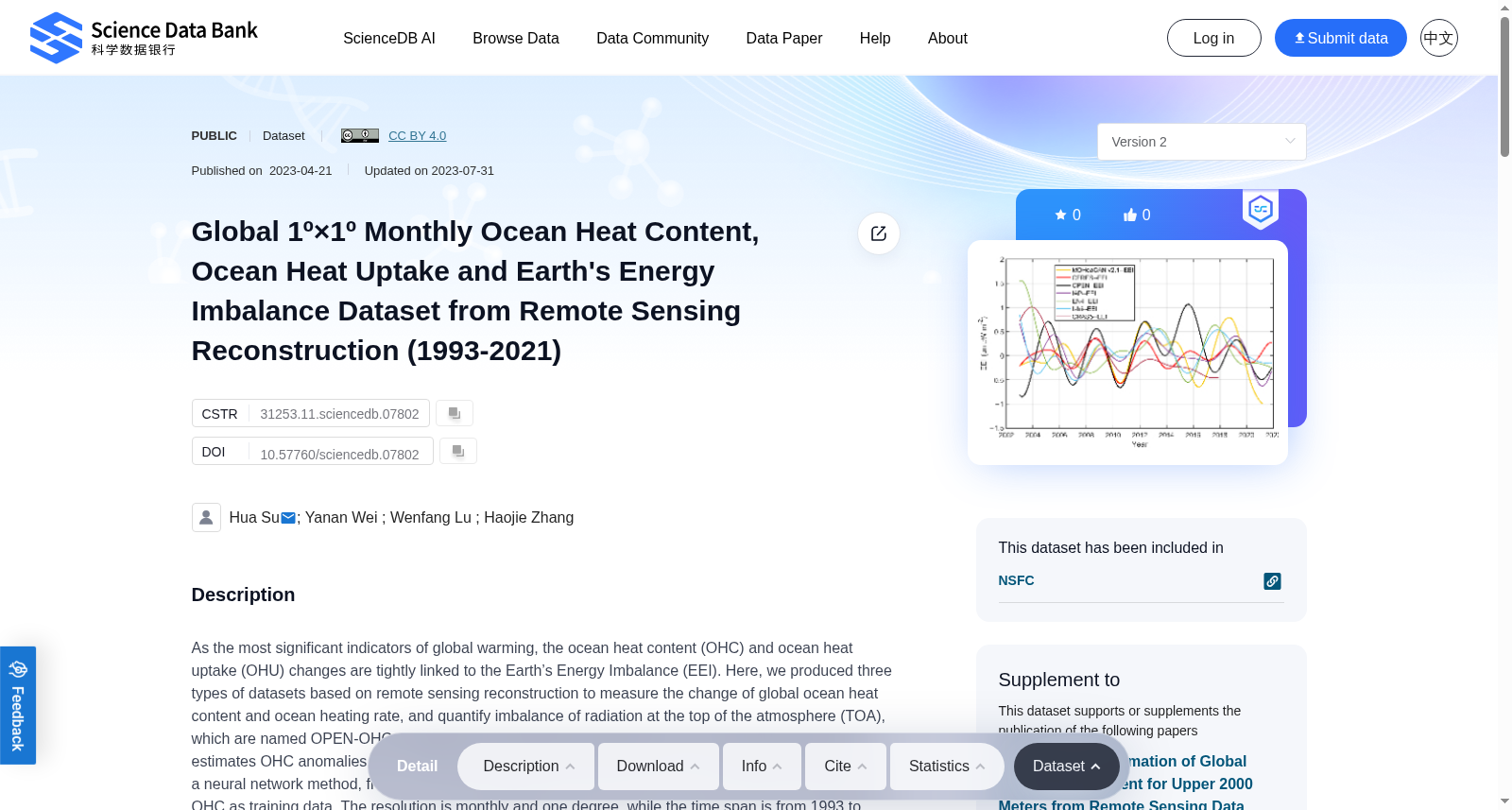
Global 1º×1º Monthly Ocean Heat Content, Ocean Heat Uptake and Earth's Energy Imbalance Dataset from Remote Sensing Reconstruction (1993-2021)
收藏资源简介:
As the most significant indicators of global warming, the ocean heat content (OHC) and ocean heat uptake (OHU) changes are tightly linked to the Earth’s Energy Imbalance (EEI). Here, we produced three types of datasets based on remote sensing reconstruction to measure the change of global ocean heat content and ocean heating rate, and quantify imbalance of radiation at the top of the atmosphere (TOA), which are named OPEN-OHC, OPEN-OHU and OPEN-EEI respectively. 1) The OPEN-OHC dataset estimates OHC anomalies over 26 different depths down to 2000 m covering the near-global ocean, with a neural network method, from remote sensing-based products (SSH, SST, and Winds) to Argo-gridded OHC as training data. The resolution is monthly and one degree, while the time span is from 1993 to 2021. The work was published in Remote Sensing (https://www.mdpi.com/2072-4292/12/14/2294). It was cited by IPCC's Sixth Assessment Report (AR6), among the direct estimations of global OHC. 2) To further analyze the change of OHC over time, the OHU is applied to quantify the heating rate of the ocean. The OPEN-OHU was calculated by the first-order time derivative of the global OHC. The work was published in Remote Sensing (https://www.mdpi.com/2072-4292/15/3/566). The resolution is monthly and one degree, while the time span is from 1993 to 2021. 3) Over the past few decades, emissions of greenhouse gases (GHG) have led to a radiation imbalance at the top of the atmosphere. The EEI leads to heat accumulation in the climate system, making it a major cause of climate change. Since the ocean sequesters the vast majority of excess energy (~90%) in the form of heat, it has been proved that global OHU is a good representative of EEI changes. Thus, OPEN-EEI can be estimated by OHU derived from the derivative of the global OHC. The time span is from 1993 to 2021.
作为全球变暖最关键的表征指标,海洋热含量(Ocean Heat Content, OHC)与海洋热吸收(Ocean Heat Uptake, OHU)的变化与地球能量失衡(Earth’s Energy Imbalance, EEI)紧密关联。本研究基于遥感反演方法构建了三类数据集,用于监测全球海洋热含量与海洋升温速率的变化,并量化大气层顶(Top of the Atmosphere, TOA)的辐射失衡情况,三类数据集分别命名为OPEN-OHC、OPEN-OHU与OPEN-EEI。 1) OPEN-OHC数据集采用神经网络方法,以遥感衍生产品(海平面高度(Sea Surface Height, SSH)、海表温度(Sea Surface Temperature, SST)与海面风场)为输入,以网格化Argo海洋热含量数据作为训练样本,估算了覆盖近全球海域、深度达2000米的26个不同层位的海洋热含量距平。该数据集时空分辨率为月尺度、1°,时间跨度为1993年至2021年。相关成果发表于《Remote Sensing》期刊(https://www.mdpi.com/2072-4292/12/14/2294),并被IPCC第六次评估报告(AR6)在全球海洋热含量直接估算相关内容中引用。 2) 为进一步分析海洋热含量的时序变化,本研究采用海洋热吸收来量化海洋升温速率。OPEN-OHU数据集通过对全球海洋热含量进行一阶时间求导计算得到,相关成果发表于《Remote Sensing》期刊(https://www.mdpi.com/2072-4292/15/3/566),时空分辨率为月尺度、1°,时间跨度为1993年至2021年。 3) 近数十年来,温室气体(Greenhouse Gas, GHG)排放导致大气层顶出现辐射失衡。地球能量失衡会引发气候系统的热量累积,是气候变化的核心诱因之一。由于海洋以热能形式封存了绝大多数过剩能量(约90%),已有研究证实全球海洋热吸收可很好地表征地球能量失衡的变化。因此,OPEN-EEI数据集可通过对全球海洋热含量求导得到的海洋热吸收进行估算,其时间跨度为1993年至2021年。