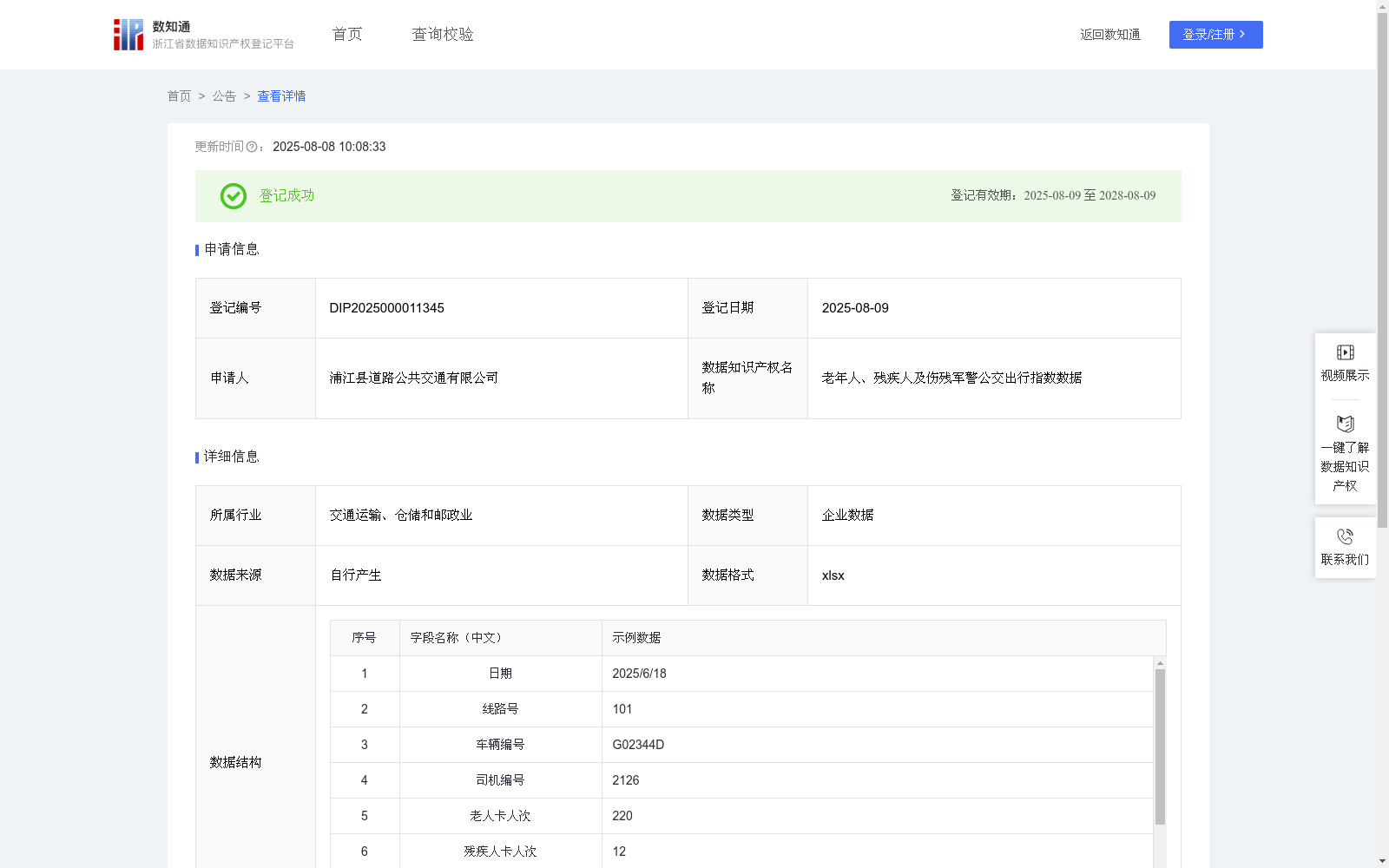
老年人、残疾人及伤残军警公交出行指数数据
收藏资源简介:
公交出行中,老年人、残疾人、伤残军警是公交公司重点优服对象。公交公司通过量化三类人员的出行特征,基于综合评估三类人员在总乘坐人次的占比数据,可针对性优化服务细节,提升老年人和残疾人、伤残军警的出行体验。1、合理配置车辆与站点设施 对超 0.35 的线路,优先配置低地板公交车(方便轮椅 / 步行辅助器上下)、车内增设爱心专座提示牌,并强化语音报站(重复播报站点名称)。 2、 保障出行安全。对指数超过0.35的路线车辆,提高驾驶稳定性。延长上、下车停留时间。 3、 结合三类人员出行指数,可针对性调整运力资源:构建适配社会公交运营体系。1、数据采集自本企业内部,对数据进行归类,清洗;去除异常值。2、三类人员综合评估人次=W1*老人卡人次+W2*残疾人卡人次+W3*伤残军警卡人次, W1,W2,W3是各类人员系数,根据以往经验赋予系数值:WI=0.6,W2=1,W3=1.2 三类人员出行指数=三类人员综合评估人次/总人次 3、对三类人员出行指数超过0.35的路线,优先配置低地板公交车(方便轮椅 / 步行辅助器上下)、车内增设爱心专座提示牌,并强化语音报站(重复播报站点名称)。提高驾驶稳定性。延长上、下车停留时间。
In bus transit, the elderly, persons with disabilities, and injured and disabled military and police personnel are key priority service targets for bus companies. By quantifying the travel characteristics of these three groups and comprehensively evaluating their proportion in total passenger trips, bus companies can optimize service details in a targeted manner and improve the travel experience of the aforementioned groups. 1. Rational allocation of vehicles and station facilities: For routes with a travel index of the three groups exceeding 0.35, prioritize equipping low-floor buses (to facilitate boarding and alighting of wheelchairs and walking aids), adding reminder signs for priority seats inside the vehicles, and enhancing audio station announcements (by repeating station names). 2. Ensuring travel safety: For route vehicles with an index exceeding 0.35, improve driving stability and extend the dwell time for boarding and alighting. 3. Targeted adjustment of transportation capacity resources based on the travel index of the three groups: Build a social bus operation system that fits the actual needs. 1. Data is collected from the company's internal systems, then categorized, cleaned, and outliers are removed. 2. The comprehensive evaluated passenger trips of the three groups = W1 * elderly card passenger trips + W2 * disability card passenger trips + W3 * injured and disabled military and police card passenger trips. W1, W2, and W3 are coefficients for each group, assigned based on past experience: W1=0.6, W2=1, W3=1.2. The travel index of the three groups = comprehensive evaluated passenger trips of the three groups / total passenger trips. 3. For routes with a travel index of the three groups exceeding 0.35, prioritize equipping low-floor buses (to facilitate boarding and alighting of wheelchairs and walking aids), adding reminder signs for priority seats inside the vehicles, enhancing audio station announcements (by repeating station names), improving driving stability, and extending the dwell time for boarding and alighting.