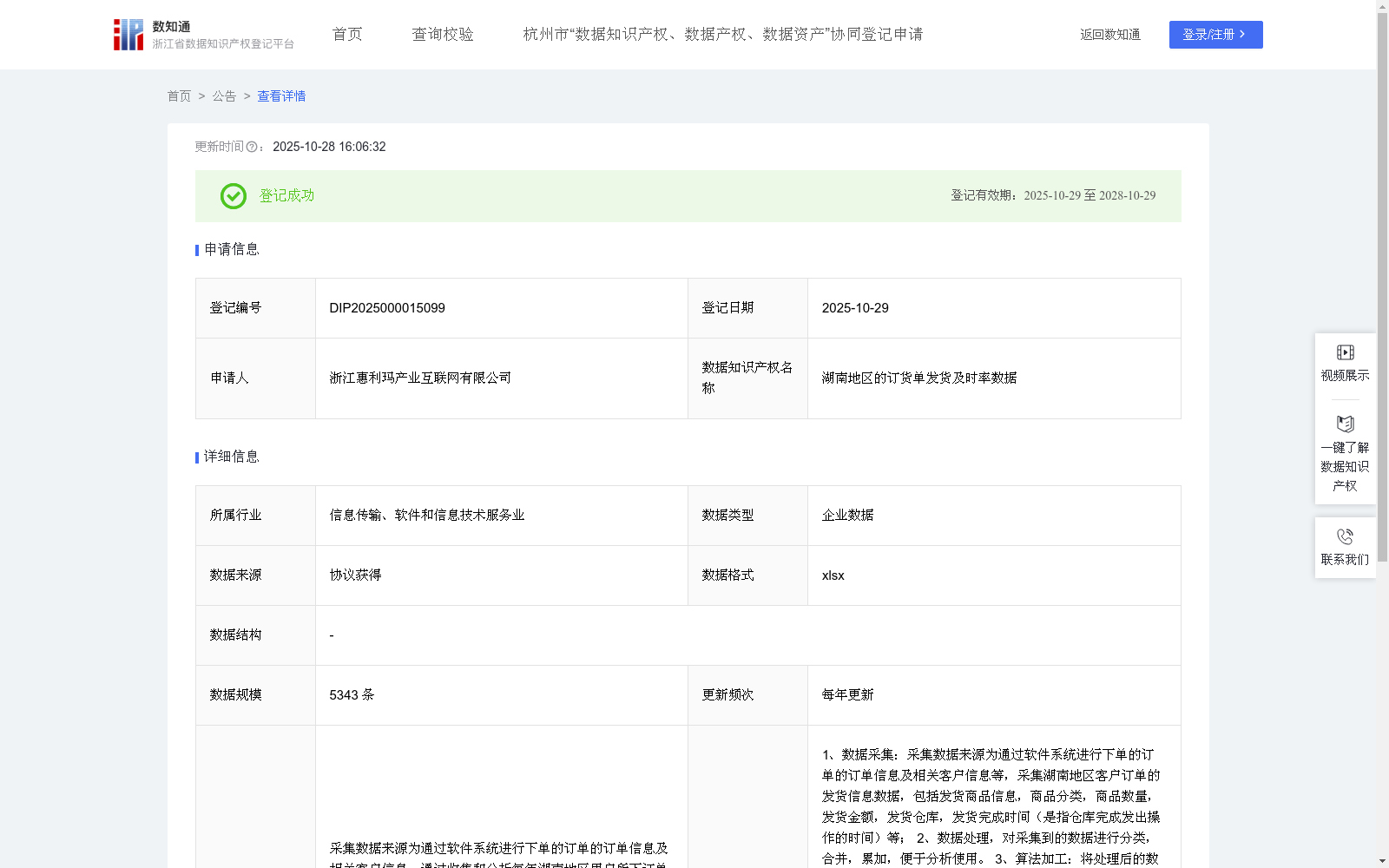
湖南地区的订货单发货及时率数据
收藏资源简介:
采集数据来源为通过软件系统进行下单的订单的订单信息及相关客户信息,通过收集和分析每年湖南地区用户所下订单的发货情况数据,比如发货天数,发货时长等信息,以及发货仓库是否进行调配的信息,综合得出发货及时率的数据,能帮助企业识别出在发货过程中的瓶颈和延迟因素。这有助于制定改进措施,从而提升整体运营效率,例如优化库存管理和运输安排等,通过有效的数据运用,企业能够实现更高的服务质量与运营效率,提高客户满意度,从而增强客户忠诚度和品牌信誉。1、数据采集:采集数据来源为通过软件系统进行下单的订单的订单信息及相关客户信息等,采集湖南地区客户订单的发货信息数据,包括发货商品信息,商品分类,商品数量,发货金额,发货仓库,发货完成时间(是指仓库完成发出操作的时间)等; 2、数据处理,对采集到的数据进行分类,合并,累加,便于分析使用。 3、算法加工:将处理后的数据进行发货及时率分析,发货天数=发货完成时间中的日期-下单时间中的日期(例如某一条发货信息的发货完成时间是“2024/9/1 9:18”,下单时间是“2024/8/31 11:15”,那么发货天数=2024/9/1 -2024/8/31=1天),是否多仓看发货仓库数量,发货及时率根据发货天数和发货仓库数量综合判断。 4、数据分类分级:根据发货天数及是否多仓配货,将订单的发货及时率划分为“及时,有待改进,不及时”;(发货天数≤1或发货天数=2且多仓配货,为“及时”,发货天数=2且单仓配货,为“有待改进”,发货时间≥3天,为“不及时”。 5、后续处理:每个月根据各品类的商品的发货情况,可智能管控调配各仓库后续备货的情况,以及对发货不及时的仓库及品类加强管控力度。
This dataset is constructed using order information and associated customer details from software-system-placed orders. By collecting and analyzing annual shipping-related data of orders placed by users in Hunan Province—including shipping days, transit duration, and whether shipping warehouses were reallocated—the dataset generates on-time shipping rate metrics, which enable enterprises to identify bottlenecks and delay factors in the shipping process. This supports the formulation of targeted improvement measures to enhance overall operational efficiency, such as optimizing inventory management and transportation scheduling. Through effective data utilization, enterprises can achieve higher service quality and operational efficiency, improve customer satisfaction, and thereby strengthen customer loyalty and brand reputation. 1. Data Collection: Data is sourced from order information and relevant customer details of orders placed via software systems. We collect shipping-related data of customer orders in Hunan Province, covering product information of shipped goods, product categories, order quantities, shipping amounts, shipping warehouses, and shipping completion time (defined as the time when the warehouse completes the dispatch operation), among other metrics. 2. Data Processing: The collected data is categorized, merged, and aggregated to facilitate subsequent analytical use. 3. Algorithm Processing: On-time shipping rate analysis is conducted on the processed data. Shipping days are calculated as the date difference between the shipping completion time and the order placement time (e.g., if the shipping completion time of a record is "2024/9/1 9:18" and the order placement time is "2024/8/31 11:15", then shipping days = 2024/9/1 - 2024/8/31 = 1 day). Whether multi-warehouse distribution is applied is determined by the number of shipping warehouses. The on-time shipping rate is comprehensively evaluated based on the shipping days and the number of shipping warehouses. 4. Data Classification and Grading: Based on the shipping days and whether multi-warehouse distribution is adopted, the on-time shipping rate of orders is divided into three categories: "On Time", "Needs Improvement", and "Not On Time". Specifically, orders with shipping days ≤ 1 or shipping days = 2 with multi-warehouse distribution are classified as "On Time"; orders with shipping days = 2 with single-warehouse distribution are classified as "Needs Improvement"; orders with shipping days ≥ 3 are classified as "Not On Time". 5. Follow-up Processing: Each month, based on the shipping performance of each product category, enterprises can intelligently manage and adjust the subsequent stock allocation of each warehouse, and strengthen supervision over warehouses and product categories with delayed shipping.