生产现场安全风险等级判定预训练数据
收藏资源简介:
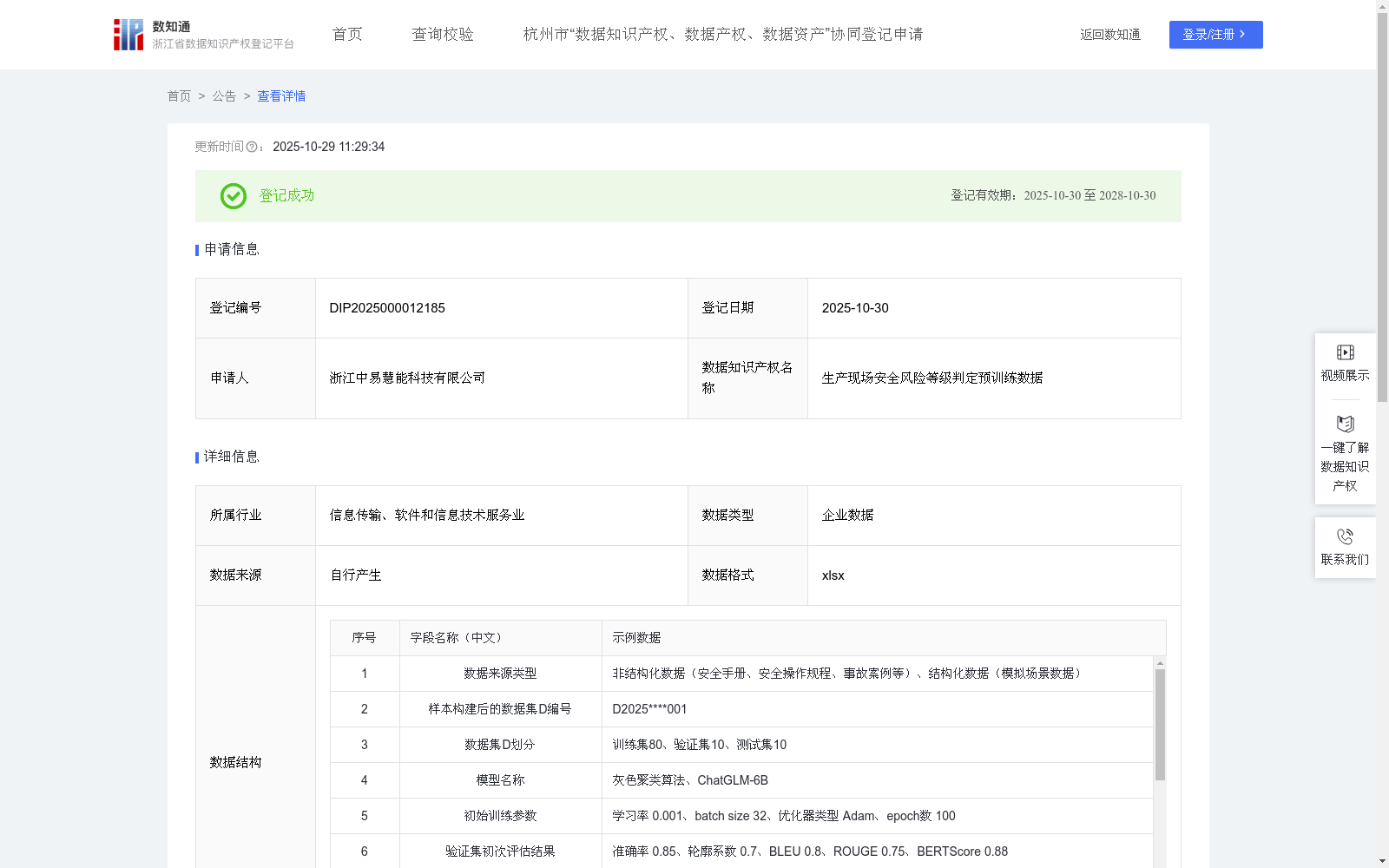
本生产现场安全风险等级判定预训练数据可应用于企业安全生产技术管理相关探索场景。数据通过整合安全手册、操作规程、事故案例等非结构化资料与行业模拟场景数据,经实体识别、关系抽取等NLP技术提取关键要素,结合知识图谱推理生成“行为+情境→风险等级”合成样本,并转化为“输入-输出”格式文本,最终整合形成标准数据集D并按比例划分子集,保障风险等级、场景类型等分布均衡。其有助于模型学习风险行为、作业情境与风险等级的关联规律,有利于提升模型对复杂场景下风险等级判定的准确性;同时,可为企业安全生产管理经验的沉淀与风险防控方法的优化提供参考性数据支撑。1.数据来源与样本构建:(1)原始数据包括公司自主研发形成的安全手册、安全操作规程、事故案例等非结构化数据,以及结合行业通用安全规范和经验构建的模拟场景数据,用于反映典型作业流程下的风险行为模式与等级划分。(2)对非结构化数据应用实体识别、关系抽取、事件链构建等自然语言处理技术,提取行为类型、作业条件、事故诱因、风险等级等关键要素,形成结构化片段数据。(3)基于安全知识图谱推理逻辑与行业经验规则,构建多个典型作业场景(如动火、高处作业、密闭空间等)与相应的风险行为组合,生成“行为+情境 → 风险等级”的合成数据样本。(4)将结构化样本转化为“输入-输出”格式文本,用于语言模型训练。通过语言模板、规则生成、图谱反推等方式构造丰富的语义表达。(5)统一整合非结构化抽取结果、知识推理生成样本与语义化文本构造数据,组成标准数据集D;对数据集D赋予编号。 2.数据集划分:(1)对数据集D按8:1:1比例划分为训练集、验证集和测试集。(2)确保不同风险等级、场景类型、行为模式的分布均衡,避免样本偏态。 3.模型训练与微调:(1)选取灰色聚类算法作为结构化样本的风险等级初步判定模型。(2)结合“指令-输出”格式的语言数据,使用ChatGLM-6B大语言模型进行微调,提升对复杂行为语义与场景逻辑的理解。(3)记录模型训练参数(如学习率、batch size、优化器类型、epoch数)。 4.模型验证与参数调整:(1)在验证集上对聚类模型和语言模型进行性能评估:聚类模型使用准确率、轮廓系数等,语言模型使用BLEU、ROUGE、BERTScore等。(2)结合自动评估与人工抽样审阅结果,调整模型参数。(3)记录每轮优化后的模型性能变化。 5.最终评估与效果分析:(1)在测试集上综合评估模型性能,结构化部分采用MAE、F1-score等,文本输出部分结合语义相似度与风险判定准确率。(2)开展误差分析,识别常见错误模式,为后续优化提供依据。 6.模型优化建议:根据测试结果,给出模型优化建议。 注:本算法规则涉及专利保护。
This pre-trained dataset for safety risk level determination at production sites is applicable to exploration scenarios related to enterprise work safety technology management. The dataset is constructed by integrating unstructured materials such as safety manuals, operating procedures, and accident cases, as well as industry simulation scenario data. Key elements are extracted via NLP technologies including named entity recognition, relation extraction, etc., combined with knowledge graph reasoning to generate synthetic samples in the format of "Behavior + Context → Risk Level", which are then converted into "Input-Output" formatted texts. Finally, the standard dataset D is integrated and split into subsets proportionally to ensure balanced distribution of risk levels, scenario types, and other attributes. 1. Data Source and Sample Construction: (1) The original data includes unstructured data such as safety manuals, safety operating procedures, and accident cases independently developed by the company, as well as simulation scenario data constructed based on general industry safety specifications and experience, which are used to reflect risk behavior patterns and grade divisions under typical operation processes. (2) Natural language processing technologies such as named entity recognition, relation extraction, and event chain construction are applied to unstructured data to extract key elements including behavior types, operating conditions, accident causes, and risk levels, forming structured fragment data. (3) Based on the reasoning logic of safety knowledge graphs and industry experience rules, combinations of multiple typical operation scenarios (such as hot work, high-altitude operation, confined space, etc.) and corresponding risk behaviors are constructed, generating synthetic data samples of "Behavior + Context → Risk Level". (4) Structured samples are converted into "Input-Output" formatted texts for language model training. Rich semantic expressions are constructed through methods such as language templates, rule generation, and graph reversal inference. (5) The structured extraction results from unstructured data, knowledge reasoning generated samples, and semantically constructed texts are unified and integrated to form the standard dataset D, which is assigned a unique identifier. 2. Dataset Splitting: (1) Dataset D is split into training set, validation set, and test set at a ratio of 8:1:1. (2) Balanced distribution of different risk levels, scenario types, and behavior patterns is ensured to avoid sample skewness. 3. Model Training and Fine-tuning: (1) The grey clustering algorithm is selected as the preliminary risk level determination model for structured samples. (2) Combined with the "Instruction-Output" formatted language data, the ChatGLM-6B large language model is used for fine-tuning to improve the understanding of complex behavior semantics and scenario logic. (3) Model training parameters (such as learning rate, batch size, optimizer type, number of epochs) are recorded. 4. Model Validation and Parameter Adjustment: (1) Performance evaluation of the clustering model and language model is conducted on the validation set: accuracy, silhouette coefficient, etc. are used for the clustering model, while BLEU, ROUGE, BERTScore, etc. are used for the language model. (2) Model parameters are adjusted by combining automatic evaluation results and manual sample review results. (3) The performance changes of the optimized model in each round are recorded. 5. Final Evaluation and Effect Analysis: (1) Comprehensive evaluation of model performance is carried out on the test set: MAE, F1-score, etc. are adopted for the structured part, while semantic similarity and risk determination accuracy are combined for the text output part. (2) Error analysis is conducted to identify common error patterns, providing a basis for subsequent optimization. 6. Model Optimization Suggestions: Model optimization suggestions are provided based on the test results. Note: This algorithm rule involves patent protection.