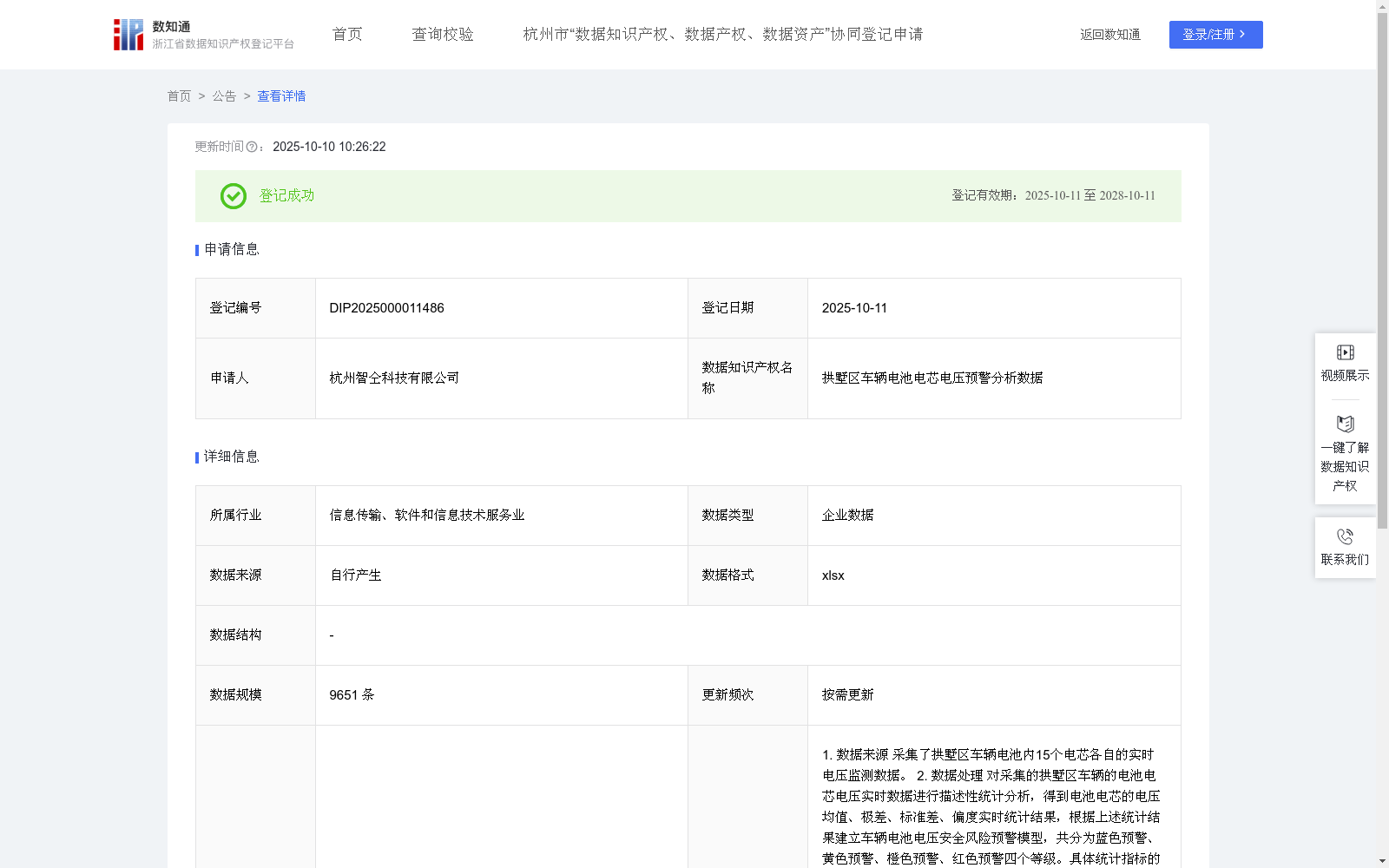
拱墅区车辆电池电芯电压预警分析数据
收藏资源简介:
本分析数据的应用场景是拱墅区车辆电池电压安全风险预警。采集了电池内15个电芯的实时电压监测数据,通过对上述数据进行均值、极差、标准差、偏度等描述性统计分析,可获取电池电芯运行时的关键电压信息,实现对电池电芯电压异常的实时预警,为相关用户或智能系统的电池安全、寿命和性能管理提供决策依据。1. 数据来源 采集了拱墅区车辆电池内15个电芯各自的实时电压监测数据。 2. 数据处理 对采集的拱墅区车辆的电池电芯电压实时数据进行描述性统计分析,得到电池电芯的电压均值、极差、标准差、偏度实时统计结果,根据上述统计结果建立车辆电池电压安全风险预警模型,共分为蓝色预警、黄色预警、橙色预警、红色预警四个等级。具体统计指标的意义介绍如下: 均值用于反映电池电芯整体的电压水平;极差用于反映电芯间电压的差异程度,值越大说明电芯间差异越严重;标准差用于量化电芯电压的离散程度,一般大于50mV则预警;偏度用于判断电芯电压分布对称性,正偏则存在高压离群电芯,负偏则存在低压落后电芯。 车辆电池电压安全风险预警模型等级划分依据如下所示: ①极差<=150mV,标准差<=50mV,-5<=偏度<=5,全部满足为蓝色预警; ②极差>150mV,标准差>50mV,偏度>5或者<-5,只满足其中一个为黄色预警; ③极差>150mV,标准差>50mV,偏度>5或者<-5,只满足其中两个为橙色预警; ④极差>150mV,标准差>50mV,偏度>5或者<-5,全部满足为红色预警。 3. 数据应用 通过拱墅区车辆电池电芯电压实时统计分析结果建立的车辆电池电压安全风险预警模型,能够实现对电池电芯电压异常的实时预警,防范潜在的电池风险,为相关用户或智能系统的电池安全、寿命和性能管理提供决策依据。
The application scenario of this analysis dataset is the safety risk early warning for vehicle battery voltages in Gongshu District. Real-time voltage monitoring data of 15 individual battery cells within vehicle batteries were collected. By performing descriptive statistical analyses including mean, range, standard deviation, and skewness on this data, key voltage information during battery cell operation can be obtained, enabling real-time early warning of abnormal battery cell voltages, and providing decision-making basis for battery safety, lifespan, and performance management of relevant users or intelligent systems. 1. Data Source Real-time voltage monitoring data of 15 individual battery cells in the batteries of vehicles operating in Gongshu District were collected. 2. Data Processing Descriptive statistical analysis was conducted on the real-time voltage data of the battery cells collected from vehicles in Gongshu District, yielding real-time statistical results including the voltage mean, range, standard deviation, and skewness of the battery cells. A vehicle battery voltage safety risk early warning model was established based on the above statistical results, which is divided into four levels: blue alert, yellow alert, orange alert, and red alert. The meanings of the specific statistical indicators are introduced as follows: The mean is used to reflect the overall voltage level of the battery cells; the range is used to reflect the degree of voltage difference between cells, where a larger value indicates a more severe discrepancy between cells; the standard deviation is used to quantify the dispersion of cell voltages, and an early warning is generally triggered when it exceeds 50 mV; the skewness is used to judge the symmetry of the cell voltage distribution, with positive skewness indicating the presence of high-voltage outlier cells and negative skewness indicating the presence of low-voltage underperforming cells. The classification criteria for the levels of the vehicle battery voltage safety risk early warning model are as follows: ① Blue alert is triggered when all of the following conditions are met: range ≤ 150 mV, standard deviation ≤ 50 mV, and -5 ≤ skewness ≤ 5; ② Yellow alert is triggered when exactly one of the following conditions is satisfied: range > 150 mV, standard deviation > 50 mV, or skewness > 5 or < -5; ③ Orange alert is triggered when exactly two of the following conditions are satisfied: range > 150 mV, standard deviation > 50 mV, or skewness > 5 or < -5; ④ Red alert is triggered when all of the following conditions are met: range > 150 mV, standard deviation > 50 mV, and skewness > 5 or < -5. 3. Data Application The vehicle battery voltage safety risk early warning model established based on the real-time statistical analysis results of the battery cell voltages of vehicles in Gongshu District can achieve real-time early warning of abnormal battery cell voltages, prevent potential battery risks, and provide decision-making basis for battery safety, lifespan, and performance management of relevant users or intelligent systems.