球形机器人地形分类数据集
收藏资源简介:
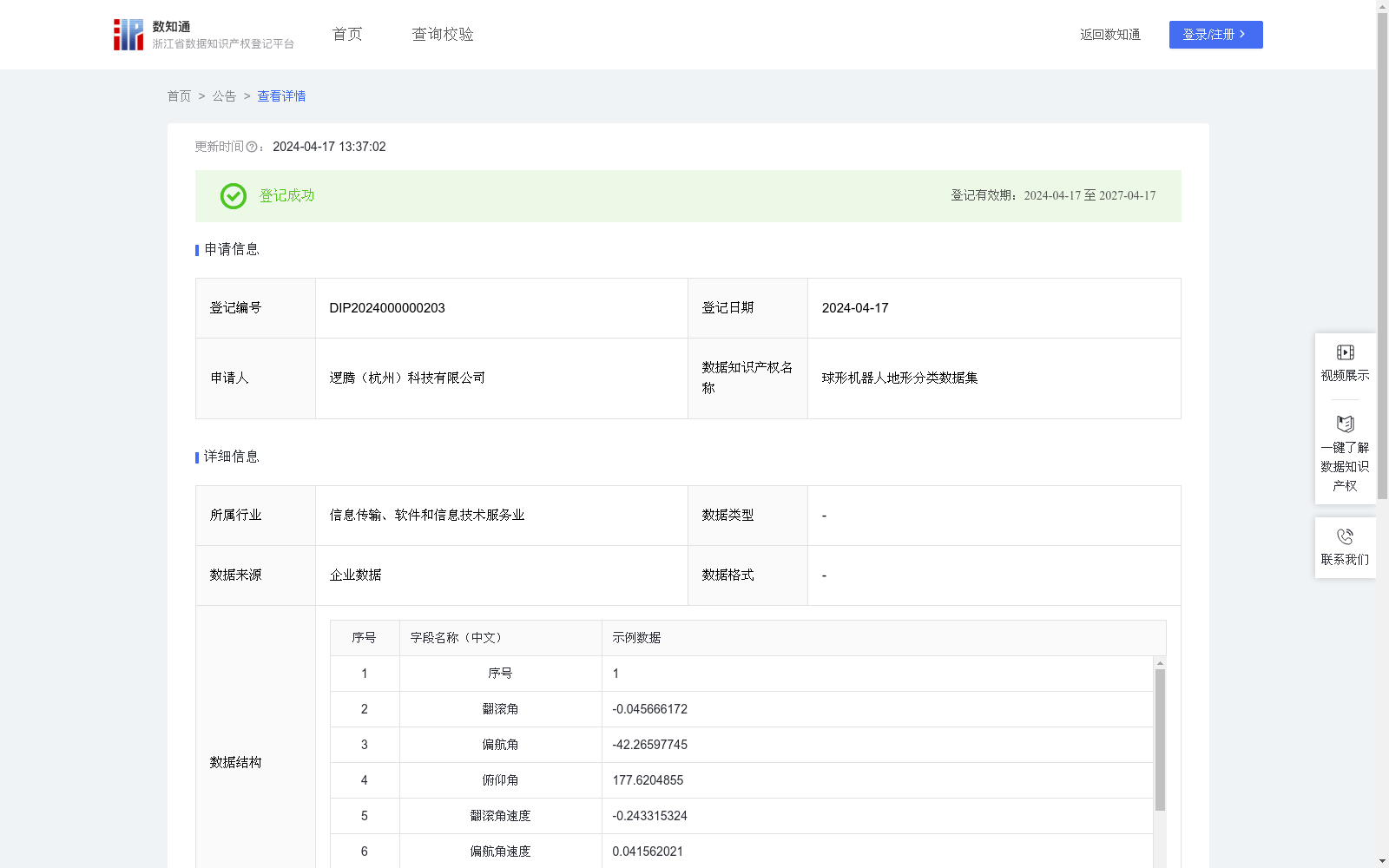
球形机器人运动过程中实时识别地面类型,从而选择适配不同地形的控制器,进而达到更好的运行效果。1. 数据采集:驱动球形机器人在不同地面上进行运动,利用机器人自身所带的九轴惯性测量仪(IMU)采集机器人的三轴速度、角速度及其高阶导数信息:翻滚角、偏航角、俯仰角、翻滚角速度、偏航角速度、俯仰角速度、x轴加速度、y轴加速度、z轴加速度作为分类器输入。 2. 数据预处理:使用滑动窗口法将多帧数据拼接在一起,形成完整的带标签的数据集。 3. 数据训练:将数据集划分为训练集和测试集,去训练基于Xgboost的球形机器人地形分类器。其中Xgboost模型的输入为翻滚角、偏航角、俯仰角、翻滚角速度、偏航角速度、俯仰角速度、x轴加速度、y轴加速度、z轴加速度,输出为搭配地形标签。得到的结果可以表示为1、2、3,分别代表铺装路面,草地、石子地。 4.数据应用:将训练好的地形分类器部署在球形机器人上实时运行,输入实时机器人状态信息,进而输出实时地形标签。
A spherical robot recognizes ground types in real time during its locomotion to select terrain-adaptive controllers, thereby achieving better operational performance. 1. Data Collection: Drive the spherical robot to move on diverse ground surfaces, and use the on-board 9-axis Inertial Measurement Unit (IMU) of the robot to collect the robot's triaxial velocity, angular velocity and their high-order derivative data: roll angle, yaw angle, pitch angle, roll angular velocity, yaw angular velocity, pitch angular velocity, x-axis acceleration, y-axis acceleration and z-axis acceleration, which are used as input features for the classifier. 2. Data Preprocessing: Use the sliding window method to stitch multiple frames of data together to form a complete labeled dataset. 3. Model Training: Split the dataset into training and test sets, and train a terrain classifier for spherical robots based on XGBoost. The input of the XGBoost model consists of roll angle, yaw angle, pitch angle, roll angular velocity, yaw angular velocity, pitch angular velocity, x-axis acceleration, y-axis acceleration and z-axis acceleration, while the output is the corresponding terrain label. The classification results can be represented by 1, 2 and 3, which correspond to paved roads, grasslands and gravel grounds respectively. 4. Deployment and Application: Deploy the trained terrain classifier on the spherical robot for real-time inference, input real-time robot state information, and then output real-time terrain labels.