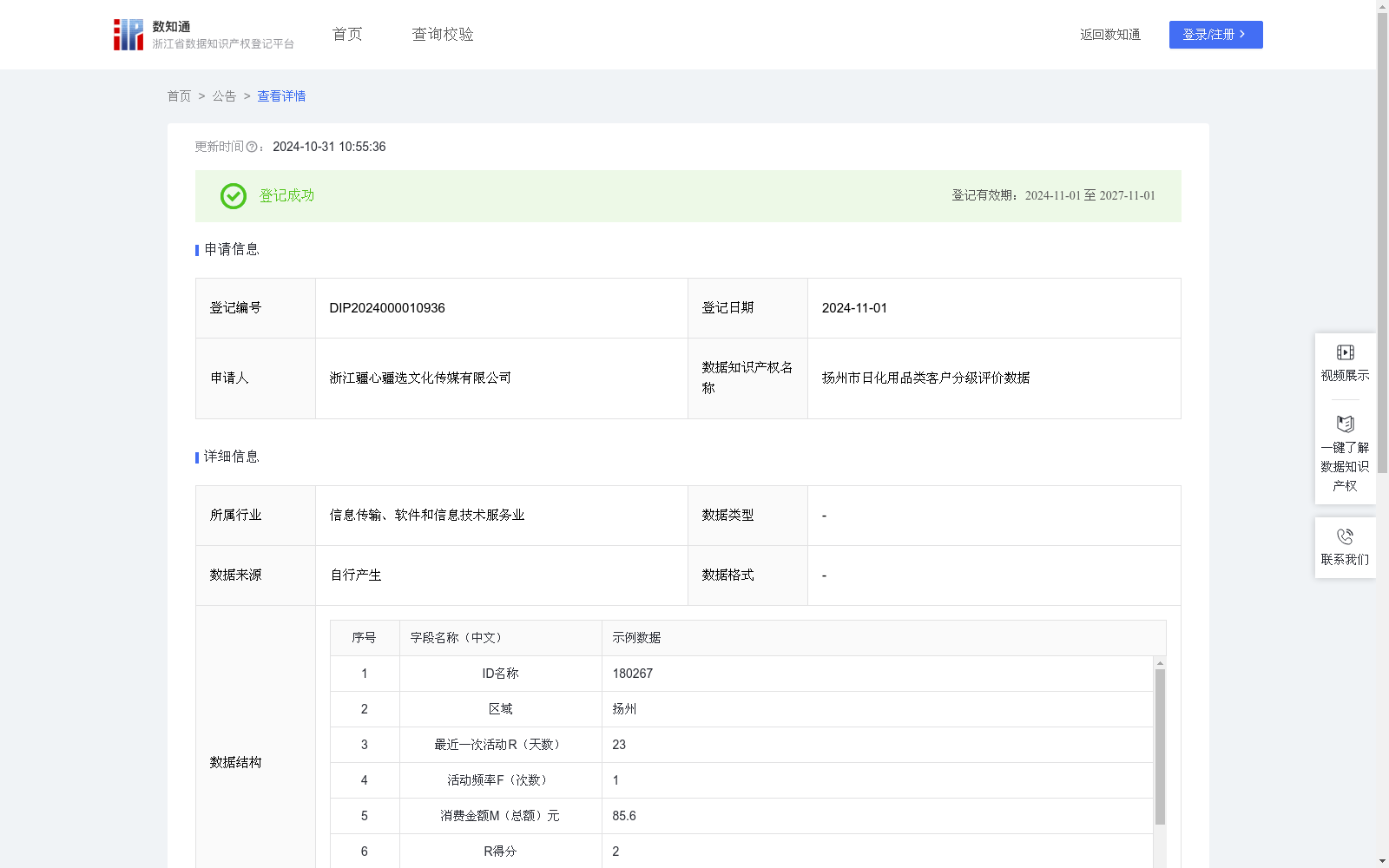
扬州市日化用品类客户分级评价数据
收藏资源简介:
采集扬州市日化用品类客户的最近一次消费时间(R)、最近一段时间消费频次(F)、最近一段时间消费金额(M),采用RFM模型对客户进行价值评级,用RFM分析方法把客户分为ABCD四级,对细分过后的不同客户采取相应营销策略,进行精准有效的运营。通过对客户进行分级管理,满足不同等级客户的个性化需求,并为同行业企业管理不同等级的客户,实现精准个性化服务提供数据支持。1、数据处理:对从扬州市采集到的数据进行脱敏、降噪、清洗、聚集、分析。2、数据加工:运用RFM模型结合客户最近一次消费时间(R)、客户最近一段时间消费频次(F)和客户最近一段时间消费金额(M)的得分排名对客户进行一个综合排名,最终得出一个RFM总评分。 a.提取出客户最近一次消费时间(R)、客户最近一段时间消费频次(F)和客户最近一段时间消费金额(M)进行分类,最近一次消费时间间隔最短的客户排在最上面。按照从1-5评分,前20%的客户获得5分,接下来的20%用户获得4分,再下来20%的客户为3分,再下来20% 的客户为2分,最后20% 的客户为1分。 b.根据客户最近一段时间消费频次(F)从高到底依次对用户进行分类,前20%的客户在用户活动频率的分数为5,以此类推。 C, 根据客户最近一段时间消费金额(M),前20%的客户在消费金额的分数为5,以此类推。消费金额最少的20%客户则分数为1。 RFM得分=0.3*(R得分)+0.3*(F得分)+0.4*(M得分) 评分大于等于4分的为A级客户,大于等于3小于4的为B级客户,大于等于2小于3的为C 级客户,低于2的为D 级客户。
This dataset collects the Recency (R, time since the latest consumption), Frequency (F, count of recent consumption occurrences) and Monetary Value (M, total recent consumption amount) of daily chemical product customers in Yangzhou City. The RFM model is adopted to conduct customer value rating, and the RFM analysis framework is used to divide customers into four tiers: Level A, B, C and D. Targeted marketing strategies are formulated for different segmented customer groups to carry out precise and efficient operation management. Through hierarchical customer management, the dataset meets the personalized demands of customers at different tiers, and provides data support for enterprises in the same industry to manage multi-level customers and implement precise personalized services. 1. Data Processing: Perform desensitization, denoising, cleaning, aggregation and analysis on the raw data collected from Yangzhou City. 2. Data Refinement: Use the RFM model combined with the score rankings of customers' Recency (R), Frequency (F) and Monetary Value (M) to conduct a comprehensive customer ranking, and finally calculate an overall RFM score. a. Extract the indicators of customers' Recency (R), Frequency (F) and Monetary Value (M) for classification. Rank customers in ascending order of the interval since their latest consumption (i.e., customers with the shortest interval are ranked first). Assign scores from 1 to 5: the top 20% of customers receive 5 points, the next 20% receive 4 points, the subsequent 20% receive 3 points, the next 20% receive 2 points, and the last 20% receive 1 point. b. Rank customers in descending order of their recent consumption frequency (F). The top 20% of customers are assigned 5 points for their frequency score, and the remaining customers are assigned scores following the same pattern. c. Rank customers in descending order of their recent consumption monetary value (M). The top 20% of customers are assigned 5 points for their monetary value score, and the 20% of customers with the lowest consumption monetary value receive 1 point, following the same scoring pattern. The overall RFM score is calculated as: RFM Score = 0.3 * (R Score) + 0.3 * (F Score) + 0.4 * (M Score) Customers are categorized into four tiers based on their overall RFM score: - Level A: Score ≥ 4 - Level B: 3 ≤ Score < 4 - Level C: 2 ≤ Score < 3 - Level D: Score < 2