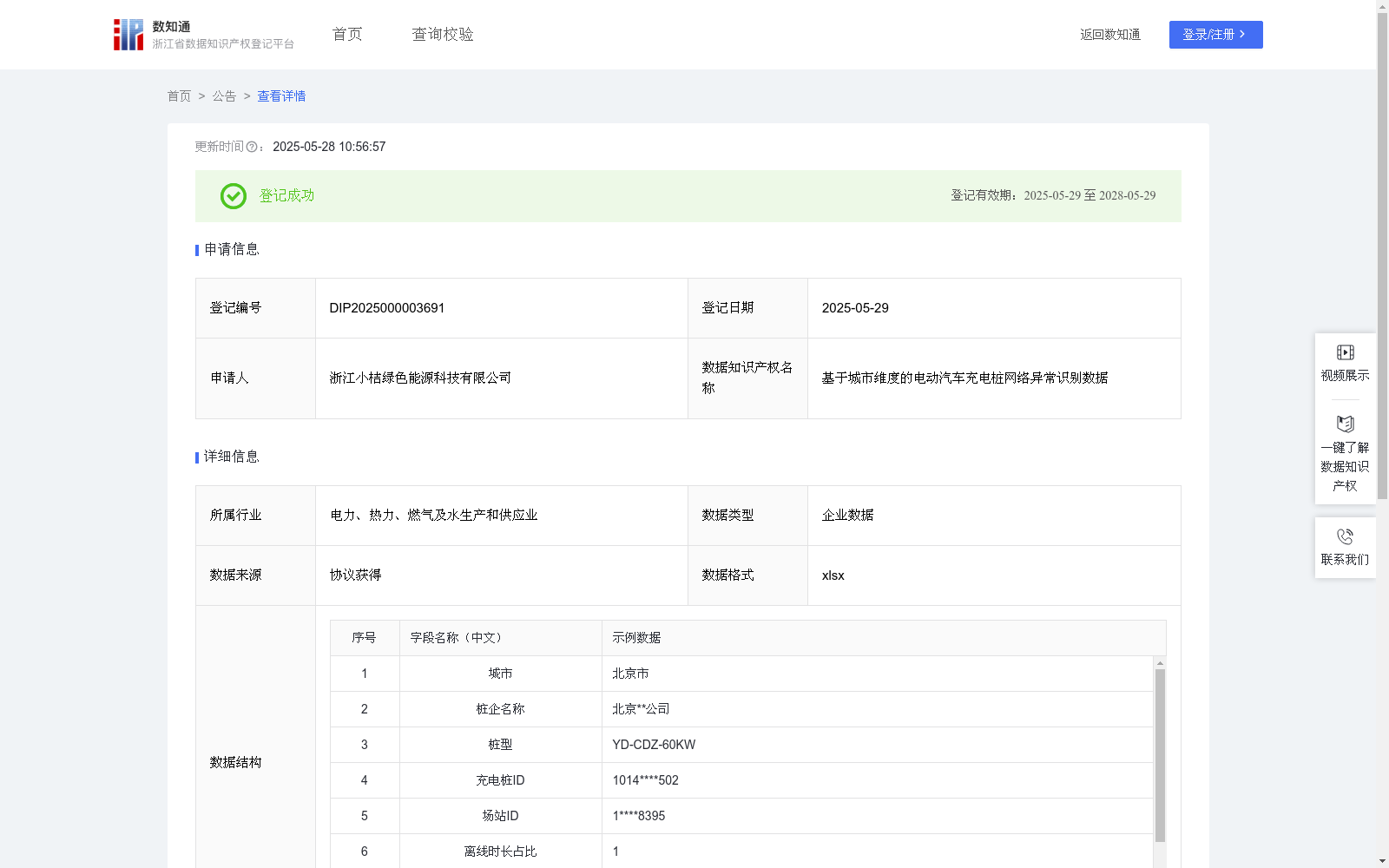
基于城市维度的电动汽车充电桩网络异常识别数据
收藏资源简介:
本数据在充电桩网络运维领域提供区域性风险预警能力,具体应用场景如下: 1. 对平台的价值(智能运维决策):通过城市维度离线特征自动识别区域性网络问题,动态推送网络优化建议,降低人工巡检成本。 2. 对场站商家的价值(运营保障):优先对网络异常高发城市(如连续3次判定异常)的场站增配备用通信模块,减少充电桩断网导致的订单流失,提升用户充电成功率。 3. 对城市管理的价值(基建规划):支撑识别城市级通信盲区,协同通信运营商完善基站部署,支撑“充电+5G”新型基础设施规划。 4. 对通信服务商的价值:基于异常结论与离线特征(单次最大离线时长、频次),定位高负荷基站并优化网络容量分配,降低区域断网风险。1.数据采集。原始数据经授权合法获取并使用,采集字段包括城市、桩企名称、桩型、充电桩ID、场站ID。 2.特征加工。以1小时为间隔,滚动截取每台桩前30小时数据形成滑动窗口。加工字段包括:①离线时长占比:窗口内离线总时长/30小时;②离线次数:窗口内离线事件累计次数;③单次最大离线时长:窗口内最长单次离线持续时间。 3.样本构建。按城市维度划分正负样本:正样本为人工确认存在区域网络问题的城市,负样本为同维度内随机抽取的正常城市,比例1:3。样本特征包含特征加工字段及城市,输出目标为网络状态标签(0-正常,1-异常)。 4.模型训练。采用XGBoost算法,输入城市维度加工特征,输出异常结论。训练时通过城市交叉验证增强对区域性干扰的敏感性,利用SHAP值剔除桩企、桩型等非城市因素干扰。 5.异常诊断。实时滑动窗口数据输入模型,输出0/1异常结论(0-正常,1-异常)。
This dataset delivers regional risk early warning capabilities in the field of charging pile network operation and maintenance, with specific application scenarios as follows: 1. Value for the platform (intelligent operation and maintenance decision-making): Automatically identify regional network problems using city-level offline features, dynamically push network optimization recommendations, and reduce manual inspection costs. 2. Value for charging station merchants (operation guarantee): Prioritize equipping spare communication modules for charging stations in cities with high network anomaly incidence (e.g., 3 consecutive confirmed anomalies), reduce order losses caused by charging pile network outages, and improve users' charging success rate. 3. Value for urban management (infrastructure planning): Support the identification of city-level communication blind spots, collaborate with communication operators to optimize base station deployment, and facilitate the planning of new "charging + 5G" infrastructure. 4. Value for communication service providers: Based on anomaly conclusions and offline features (single maximum offline duration, occurrence frequency), locate high-load base stations and optimize network capacity allocation, thereby reducing regional network outage risks. 1. Data Collection. The original data is legally obtained and used with explicit authorization. The collected fields include city, charging pile enterprise name, pile type, charging pile ID, and station ID. 2. Feature Engineering. Using a 1-hour interval, rollingly intercept the first 30 hours of data for each charging pile to form a sliding window. The processed features include: ① Offline duration ratio: total offline duration within the window / 30 hours; ② Offline count: cumulative number of offline events within the window; ③ Single maximum offline duration: the longest duration of a single offline event within the window. 3. Sample Construction. Divide positive and negative samples by city dimension: positive samples refer to cities with manually confirmed regional network problems, while negative samples are normal cities randomly selected from the same dimension, with a positive-to-negative sample ratio of 1:3. The sample features include the features from feature engineering and city information, and the output target is the network status label (0 for normal, 1 for abnormal). 4. Model Training. The XGBoost algorithm is adopted, which takes city-level processed features as input and outputs anomaly determination results. During training, city-based cross-validation is employed to enhance sensitivity to regional disturbances, and SHAP values are used to eliminate interference from non-city factors such as charging pile enterprises and pile types. 5. Anomaly Diagnosis. Real-time sliding window data is fed into the model, and a 0/1 anomaly conclusion is output (0 for normal, 1 for abnormal).