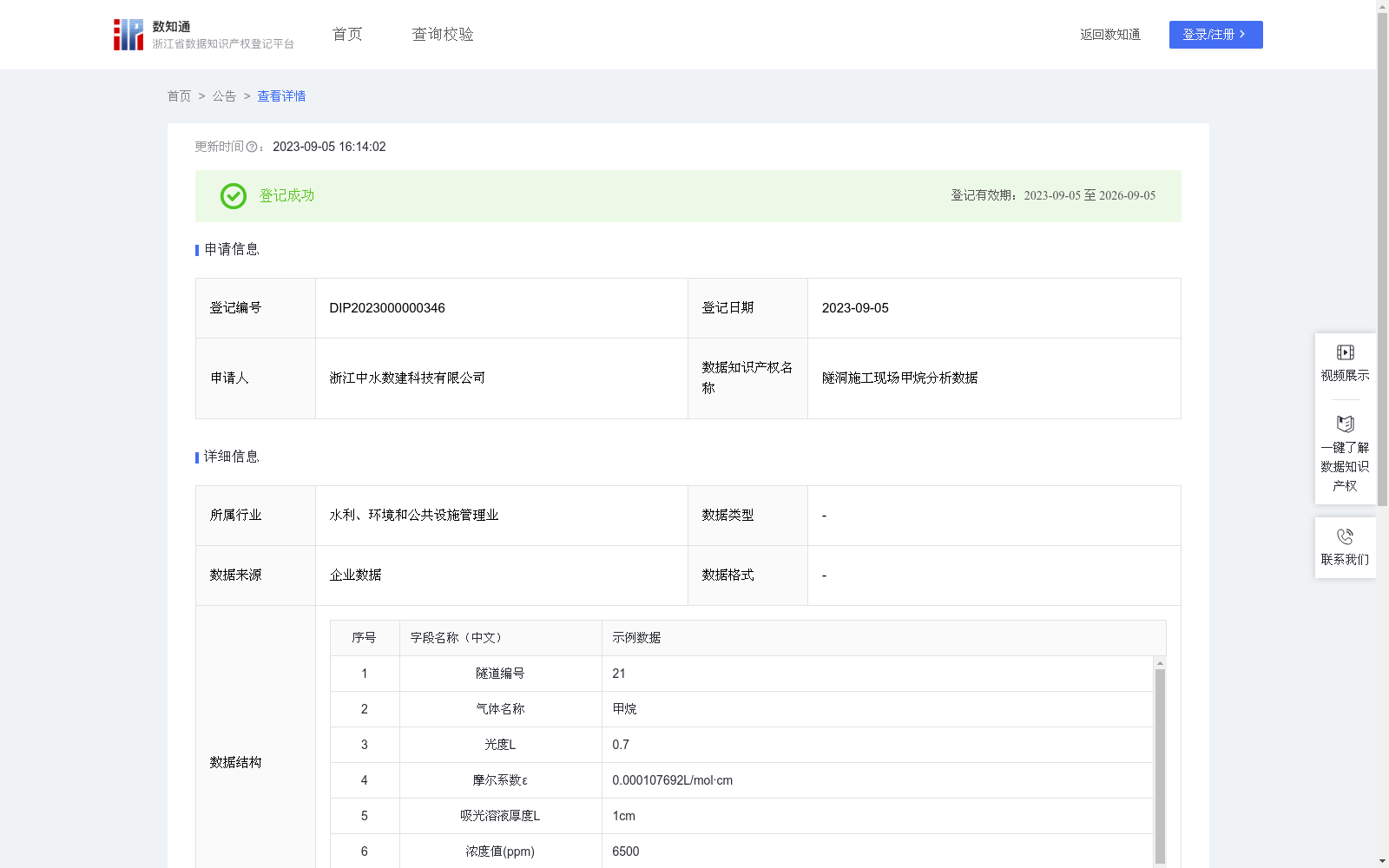
隧洞施工现场甲烷分析数据
收藏资源简介:
通过采集隧洞内甲烷气体的检测值(分子量),分析隧洞内单位范围内的气体浓度,实现隧洞施工现场内甲烷浓度的预警及报警,保障隧洞内施工人员的人身安全。通过实时上传的监测数据计算出单位范围内气体浓度,实现隧洞现场内有毒气体的预警及报警,具体过程如下: (1)数据采集:实时检测隧洞施工现场的甲烷,由于气体分子近红外光谱选择吸收的特性,不同物质分子会选择性吸收一定波长的光,甲烷气体在1653.7nm左右的单色光处吸收效果最好。 (2)数据处理:根据红外吸收原理与朗伯-比尔定律通过传感器中的光度可计算出甲烷浓度,甲烷浓度根据A =ε*C*L公式计算隧洞施工现场的甲烷浓度;(A为光度,ε为摩尔吸光系数,C为吸光物质浓度,L为吸光溶液的厚度) (3)将上述甲烷浓度与系统中预先设置的预警值相比较,实现隧洞现场内甲烷浓度的实时预警及报警。 (4)同时可根据采集所得的数据按天、月、年等时间维度进行趋势分析,形成安全报表数据。
This dataset is developed by collecting detected values (related to molecular weight) of methane gas inside tunnels, analyzing the gas concentration per unit volume within the tunnel space, and implementing early warning and alarm for methane concentration at tunnel construction sites to safeguard the personal safety of on-site construction workers. Additionally, it calculates the gas concentration per unit volume using real-time uploaded monitoring data, to enable early warning and alarm for toxic gases at tunnel construction sites, with the specific operational workflow as follows: (1) Data Collection: Real-time detection of methane at tunnel construction sites. Based on the characteristic of selective absorption of near-infrared light by gas molecules, different substance molecules selectively absorb light of specific wavelengths. Methane gas exhibits the optimal absorption performance at monochromatic light around 1653.7 nm. (2) Data Processing: The methane concentration can be derived from the luminosity data collected by the sensor, based on the infrared absorption principle and Lambert-Beer Law. The methane concentration at the tunnel construction site is calculated using the formula A = ε*C*L, where A represents luminosity, ε is the molar absorption coefficient, C is the concentration of the light-absorbing substance, and L is the light path length of the absorbing medium. (3) Compare the calculated methane concentration with the pre-configured early warning thresholds set in the system, to achieve real-time early warning and alarm for methane concentration at the tunnel construction site. (4) Furthermore, trend analysis can be conducted on the collected data across time dimensions including day, month and year, to generate standardized safety report data.