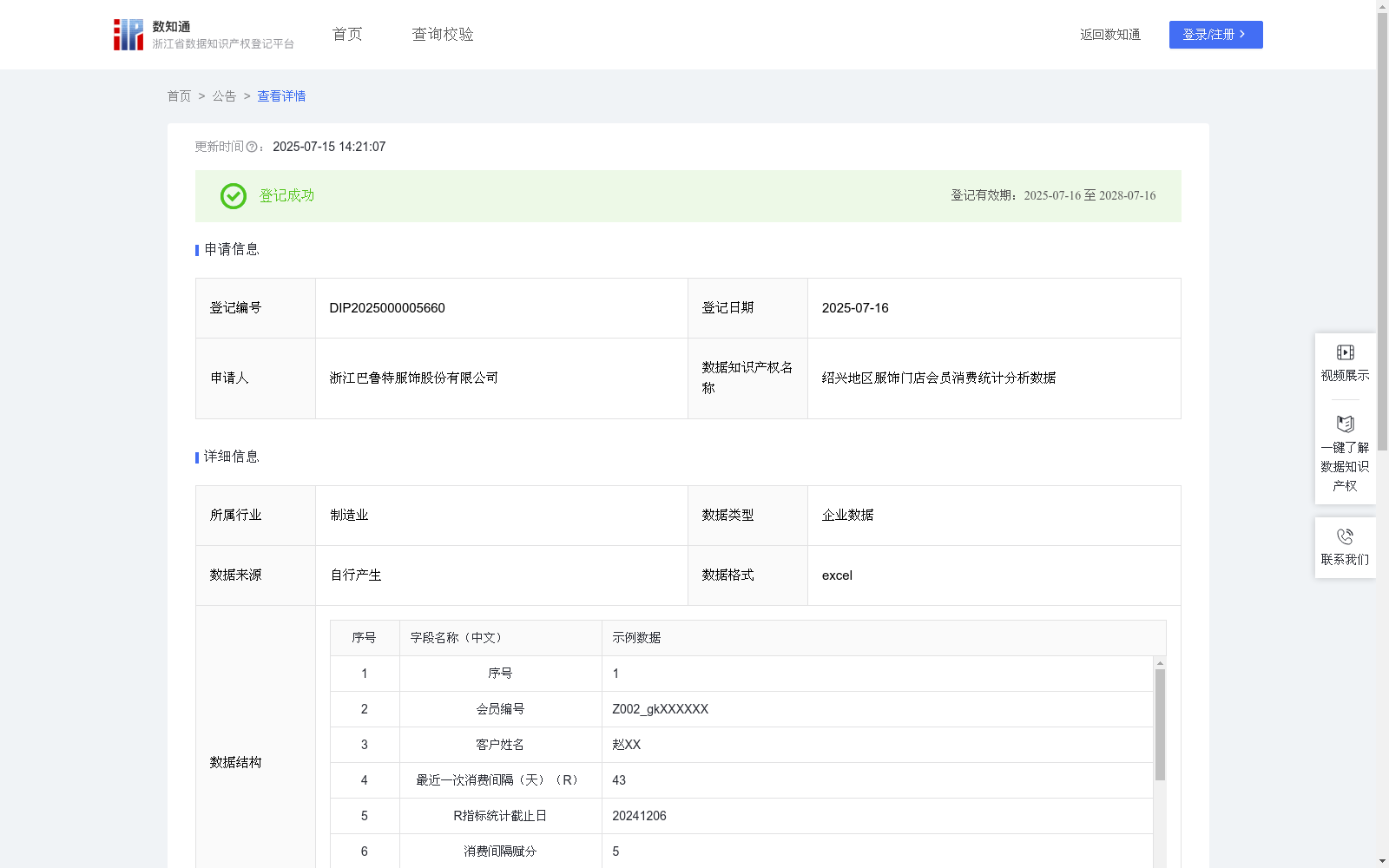
绍兴地区服饰门店会员消费统计分析数据
收藏资源简介:
通过对绍兴地区会员2024年消费统计数据进行分析,利用RFM模型对会员进行分级,从而为不同等级制定相应的销售策略,通过私人形象管家服务、圈层社交运营、动态升级激励、场景化套餐设计、场景化唤醒等策略设计,协助针对不同等级客户实施精准营销,提升门店运营效率。1、 数据采集:基于基准日,分别收集过去一年绍兴地区注册会员的基本信息,包括会员号、会员姓名以及最近一次消费间隔(天)(代号R,即最后消费支付日期距离基准日期的天数)、消费频率(次)(代号F,即过去一年消费次数)、消费金额(元)(代号M,即过去一年消费金额); 2、 数据处理:对上述采集的最近一次消费(R)、消费频率(F)和消费金额(M)数据进行分析,其中: 对于R值,根据用户最后支付时间距离当前分析时间的天数(D),划分为5个区间:0≤D≤60为5分,60<D≤120 为4分,120<D≤180 为3分,180<D≤240为2分,D >240为1分。 对于F值,根据用户在过去一年订单数量(C),划分为5个区间:C=1为1分,C=2为2分,C=3为3分,C=4为4分,C≥5为5分。 对于M值,根据用户在过去一年消费金额(G),划分为5个区间:0≤G≤500为1分,500<G≤1000为2分,1000<G≤1500为3分,1500<G≤2000为4分,G>2000为5分。 3、 算法加工:在前述数据处理基础上进行RFM综合评分,RFM综合评分X=0.2*R+0.3*F+0.5*M,再根据RFM综合评分X对客户进行分类,0≤X≤1为低粘度客户,1<X≤2为一般粘度客户,2<X≤3 为潜力深耕客户,3<X≤4为重要维系客户,X >4为高粘度客户, 4、 分析结果应用:基于消费频次、消费金额等不同维度获得的聚类分组成果分析,制定不同的营销策略。
By analyzing the 2024 consumption statistics of registered members in the Shaoxing region, this dataset employs the RFM model to tier members, thereby developing tailored sales strategies for each tier. Leveraging strategies including personalized image steward services, community social operation, dynamic upgrade incentives, scenario-based package design, and scenario-based customer re-engagement, it supports precise marketing for customers of different tiers and enhances store operational efficiency. 1. Data Collection: Based on a reference date, basic information of registered members in the Shaoxing region over the past year is collected, including member ID, member name, recency (R, defined as the number of days between the user's last consumption payment date and the reference date), frequency (F, defined as the total number of consumption times over the past year), and monetary value (M, defined as the total consumption amount over the past year in RMB); 2. Data Processing: The collected recency (R), frequency (F) and monetary value (M) data are analyzed as follows: For the R value, it is divided into 5 intervals based on the number of days (D) between the user's last payment time and the current analysis time: 5 points for 0 ≤ D ≤ 60, 4 points for 60 < D ≤ 120, 3 points for 120 < D ≤ 180, 2 points for 180 < D ≤ 240, and 1 point for D > 240. For the F value, it is divided into 5 intervals based on the number of orders (C) placed by the user over the past year: 1 point for C=1, 2 points for C=2, 3 points for C=3, 4 points for C=4, and 5 points for C ≥ 5. For the M value, it is divided into 5 intervals based on the user's total consumption amount (G) over the past year: 1 point for 0 ≤ G ≤ 500, 2 points for 500 < G ≤ 1000, 3 points for 1000 < G ≤ 1500, 4 points for 1500 < G ≤ 2000, and 5 points for G > 2000; 3. Algorithm Processing: A comprehensive RFM score is calculated based on the aforementioned data processing results, with the formula X = 0.2*R + 0.3*F + 0.5*M. Customers are then classified according to the comprehensive RFM score X: low-stickiness customers for 0 ≤ X ≤ 1, general-stickiness customers for 1 < X ≤ 2, potential deep-engagement customers for 2 < X ≤ 3, key retention customers for 3 < X ≤ 4, and high-stickiness customers for X > 4; 4. Application of Analysis Results: Targeted marketing strategies are formulated based on the analysis of cluster grouping results derived from multiple dimensions such as consumption frequency and consumption amount.