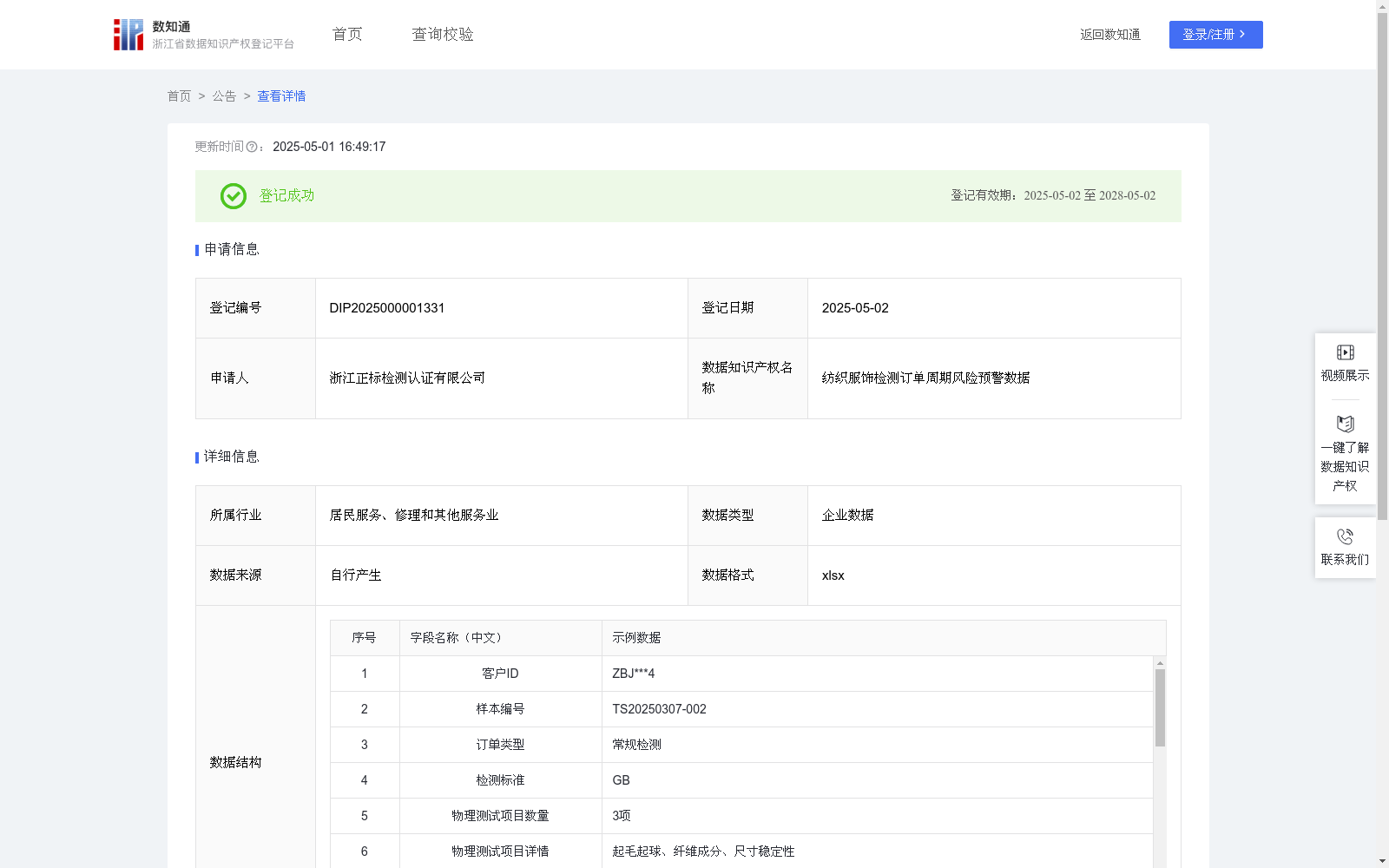
纺织服饰检测订单周期风险预警数据
收藏资源简介:
通过分析订单检测周期达成率与超时预警分布,建立实验室效率动态评估体系,优化检测资源配置与设备调度策略,显著提升检测产能利用率;基于超时订单溯源机制主动对接重点客户,提供检测流程透明化服务与定制化解决方案,增强客户服务响应效率与长期合作黏性;通过整合检测成本与时效偏差数据,构建智能决策模型指导实验室业务优化与高附加值服务延伸,推动检测服务标准化进程。系统有效降低合同纠纷率,助力服装企业缩短产品研发周期,为纺织行业供应链数字化转型提供支撑,对规范检测服务标准、保障消费者权益、促进产业协同升级具有战略意义,其模型框架具备向食品、环境等跨领域检测场景迁移的技术适配性。1、数据采集:收集实验室自动采集系统录入的字段(如订单类型、检测标准、检测项目数量等),通过实验室管理系统获取当前待检订单数、可用检测员数量、设备状态,以及调用历史数据中同类订单的历史平均耗时。 2、数据预处理:对采集的数据进行清洗、去噪、优化、补全。 3、数据加工和分析: (1)基础时间计算:T_{base}=(∑物理测试耗时+∑化学测试耗时)×标准系数;(2)负载修正时间:T _{load}=T_{base}×{1+ 当前待检订单数/(可用检测员×10)};(3)订单检测预测总时间=(负载修正时间+特殊设备等待时间)×加急系数;(4)预警条件=预测总时间>历史平均时间×1.1,避免轻微超时触发无效预警。
By analyzing the order detection cycle achievement rate and timeout warning distribution, a dynamic laboratory efficiency evaluation system is established to optimize testing resource allocation and equipment scheduling strategies, significantly improving testing production capacity utilization. Based on the timeout order tracing mechanism, the system proactively connects with key customers, provides transparent testing process services and customized solutions, and enhances customer service response efficiency and long-term cooperation stickiness. By integrating testing cost and timeliness deviation data, an intelligent decision-making model is constructed to guide laboratory business optimization and the extension of high-value-added services, promoting the standardization process of testing services. The system effectively reduces the contract dispute rate, helps apparel enterprises shorten their product R&D cycles, provides support for the digital transformation of the textile industry supply chain, and has strategic significance for standardizing testing service standards, protecting consumer rights and interests, and promoting industrial collaborative upgrading. Its model framework has technical adaptability for migration to cross-domain testing scenarios such as food and environmental testing. 1. Data Collection: Collect fields entered by the laboratory automatic collection system (such as order type, testing standards, number of testing items, etc.), obtain the number of current pending orders, number of available inspectors, equipment status via the laboratory management system, and call the historical average duration of similar orders from historical data. 2. Data Preprocessing: Clean, denoise, optimize and complete the collected data. 3. Data Processing and Analysis: (1) Basic time calculation: $T_{base}=(sum ext{physical test time} + sum ext{chemical test time}) imes ext{standard coefficient}$; (2) Load correction time: $T_{load}=T_{base} imes {1 + ext{current number of pending orders}/( ext{available inspectors} imes 10)}$; (3) Predicted total order detection time = (load correction time + special equipment waiting time) $ imes$ expedited coefficient; (4) Early warning condition: Predicted total time > historical average time $ imes$ 1.1, to avoid invalid warnings triggered by minor timeouts.