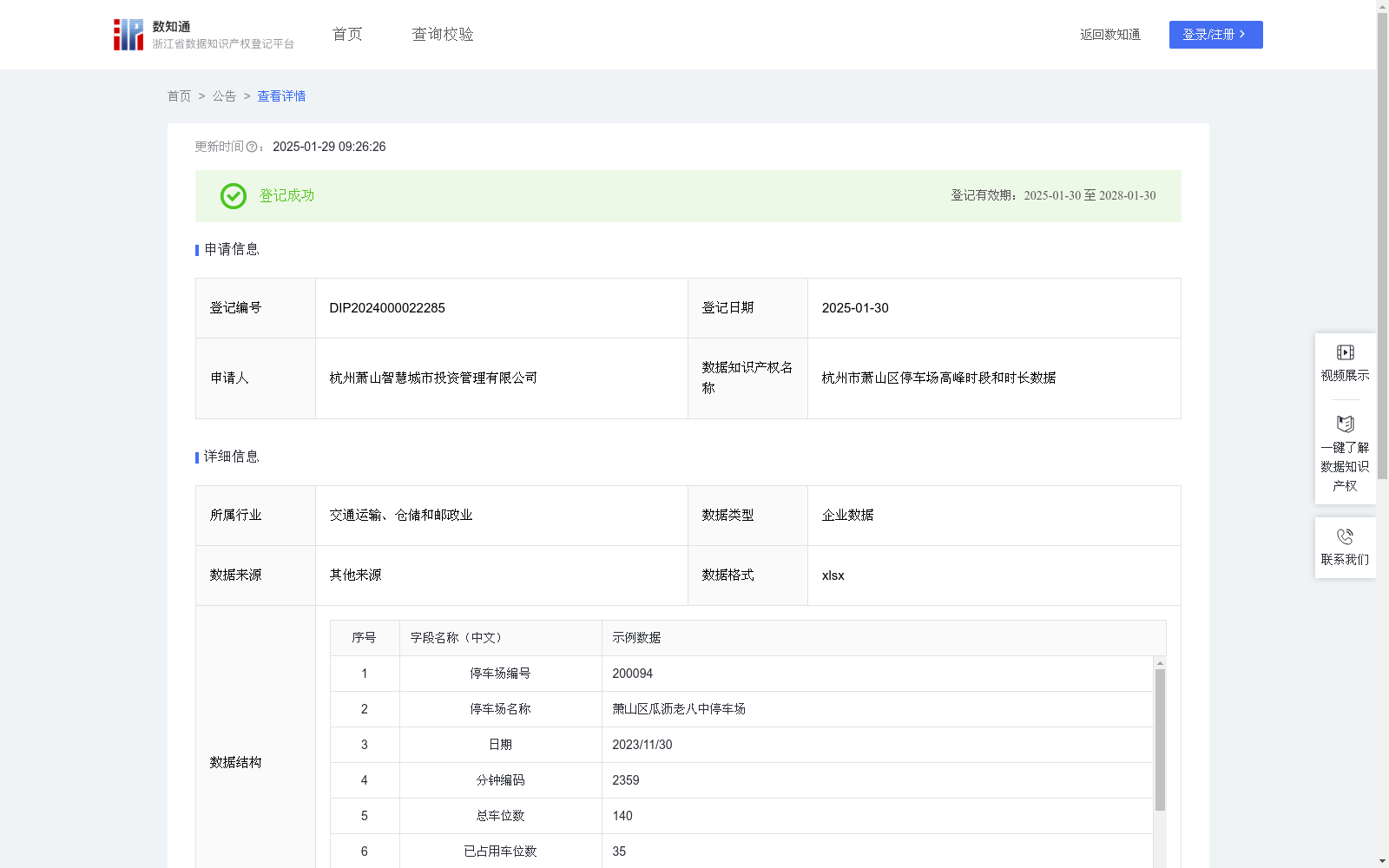
杭州市萧山区停车场高峰时段和时长数据
收藏资源简介:
本数据的面向用户及其应用场景描述如下: 1.面向停车场运营商:一是有助于帮助运营商精准把握停车场的高峰时段,据此合理调整人员排班,在高峰时提供充足服务。二是有助于探索时段定价策略,例如在高峰时段适当提高收费,引导车辆错峰停放,从而优化停车场资源配置,提升服务质量和运营效率。三是可根据高峰时段优化停车场内的广告投放策略,提高投放的效果。 2.面向交通管理部门:交通管理部门可根据本数据进一步推演出停车场附近交通流量的分布和变化特征,进而为优化道路设计、交通信号控制等交通管理措施提供决策支持,缓解交通拥堵问题。 3.面向停车场所在商圈的商户:商户可根据本数据进一步推演出商圈的客流活跃情况,从而有针对性地调整经营策略,优化商业布局,例如在停车高峰时段开展促销活动等。 4.面向社区管理者:社区管理者可根据本数据进一步掌握居民的出行规律,为社区活动规划和居民服务提供决策支持。 5.面向导航软件开发商:可为导航软件和停车应用提供实时的停车场高峰时段数据,帮助用户做出合理的停车行为选择,提升用户体验。1.数据获取和预处理:(1)通过授权获得萧山区不同停车场每日的车位占用数据,具体数据字段包括停车场编号、停车场名称、日期、分钟编码(按0000至2359编码,一共1440个编码,代表一天划分为1440分钟)、总车位数、已占用车位数(以每分钟末即第59秒为统计截止时间)。(2)对获取的数据进行清洗,包括去除异常值和缺失值,按分钟编码顺序对数据进行排序。 2.数据加工:(1)计算每分钟的停车场车位占有率,公式为:某分钟的停车场车位占用率=某分钟的已占用车位数÷总车位数×100%。(2)高峰时段判定:根据停车场的历史停车情况合理设置阈值,通过对比每分钟的停车场车位占用率和阈值,判定停车场是否处于高峰时间,如果某分钟的停车场车位占用率≥阈值,则认为停车场在该分钟处于高峰时段,反之则认为停车场在该分钟未处于高峰时段。(3)高峰时段统计:确定停车场每日的高峰时段,即从高峰开始时间至高峰结束时间。利用SUM函数计算每日停车场的高峰时长,公式为:每日停车场高峰时长=SUM(每日停车场高峰时段的持续时间)。
The target users and their applicable scenarios of this dataset are described as follows: 1. For parking lot operators: First, it helps operators accurately grasp the peak hours of parking lots, so as to reasonably adjust staff scheduling and provide sufficient services during peak periods. Second, it helps explore time-based pricing strategies, for example, appropriately increasing fees during peak hours to guide vehicles to park during off-peak hours, thereby optimizing parking lot resource allocation and improving service quality and operational efficiency. Third, it can optimize the advertising placement strategy within the parking lot based on peak hours to enhance advertising effectiveness. 2. For traffic management departments: They can further deduce the distribution and changing characteristics of traffic flow near parking lots using this dataset, and then provide decision support for traffic management measures such as road design optimization and traffic signal control, so as to alleviate traffic congestion. 3. For merchants in the business district where the parking lot is located: They can further deduce the active passenger flow situation of the business district using this dataset, so as to adjust business strategies and optimize commercial layout in a targeted manner, such as launching promotional activities during peak parking hours. 4. For community managers: They can further grasp the travel patterns of residents using this dataset, and provide decision support for community event planning and resident services. 5. For navigation software developers: It can provide real-time peak hour data of parking lots for navigation software and parking applications, helping users make reasonable parking choices and improve user experience. 1. Data acquisition and preprocessing: (1) Obtain daily parking space occupancy data of different parking lots in Xiaoshan District through authorization. The specific data fields include parking lot number, parking lot name, date, minute code (coded from 0000 to 2359, totaling 1440 codes, representing that a day is divided into 1440 minutes), total number of parking spaces, and number of occupied parking spaces (the statistical deadline is the 59th second at the end of each minute). (2) Clean the acquired data, including removing outliers and missing values, and sort the data in the order of minute codes. 2. Data processing: (1) Calculate the parking space occupancy rate per minute. The formula is: Parking space occupancy rate for a certain minute = (Number of occupied parking spaces in that minute ÷ Total number of parking spaces) × 100%. (2) Peak hour determination: Set a reasonable threshold based on the historical parking situation of the parking lot, and determine whether the parking lot is in peak hours by comparing the parking space occupancy rate per minute with the threshold. If the parking space occupancy rate of a certain minute is ≥ the threshold, the parking lot is considered to be in peak hours during that minute; otherwise, it is considered not in peak hours. (3) Peak hour statistics: Determine the daily peak hours of the parking lot, i.e., the period from the peak start time to the peak end time. Use the SUM function to calculate the daily peak duration of the parking lot. The formula is: Daily peak duration of the parking lot = SUM (Duration of the daily peak hours of the parking lot).