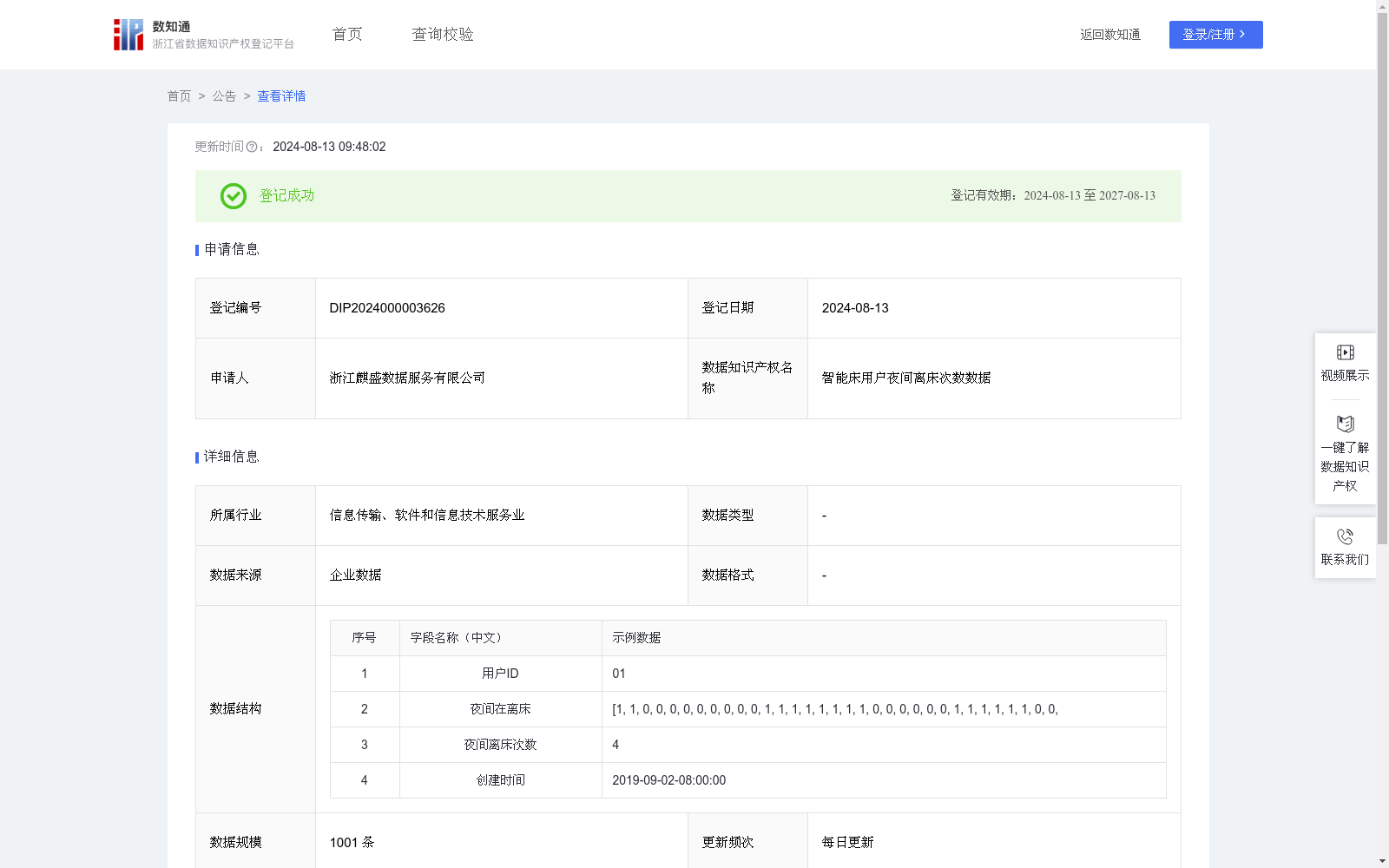
智能床用户夜间离床次数数据
收藏资源简介:
智能床用户夜间离床次数数据可用于多个领域和场景: 1、个人健康管理:夜间频繁离床可能是不良睡眠质量的指标,监测这一数据可以帮助用户了解自己的睡眠状况,并采取措施改善。这一指标对于老年人特别重要,因为夜间频繁离床可能增加跌倒的风险。 2、医疗辅助诊断:医生可以利用夜间离床次数数据帮助诊断诸如夜间排尿症、睡眠障碍等健康问题。 在长期护理和疗养中心,这一数据可用于监测病人的夜间活动,以提供更好的照护。 3、睡眠研究:研究人员可以利用这一数据分析睡眠模式和行为,探究影响睡眠质量的各种因素。 可用于大规模流行病学研究,了解人群睡眠行为的普遍特征。 4、家居自动化:在智能家居环境中,夜间离床次数数据可以与其他设备(如灯光、温度控制器)联动,当检测到用户离床时自动调整家居环境,提升用户体验。1、数据采集: 智能床的传感器以5分钟的间隔进行采集,检测用户的在床或离床状态。每5分钟生成一个数据点,值为1(在床)或0(离床)。 2、离床时间段识别: 算法通过连续的“0”信号(离床)来识别一个离床事件的开始和结束。例如,如果连续收到三个“0”信号,算法将认为用户已离床,并开始计时。当接收到“1”信号(在床)时,算法判定离床事件结束,并记录一次离床事件。 3、数据累加: 将一夜中的所有有效的离床事件累加,得到用户的夜间离床次数。
The data on nighttime bed exit counts of smart bed users can be applied to multiple fields and scenarios: 1. Personal Health Management: Frequent nighttime bed exits may indicate poor sleep quality. Monitoring this data helps users understand their own sleep status and take corresponding measures to improve it. This indicator is particularly crucial for the elderly, as frequent nighttime bed exits may elevate the risk of falls. 2. Medical Auxiliary Diagnosis: Doctors can utilize nighttime bed exit count data to assist in diagnosing health issues such as nocturia and sleep disorders. In long-term care and convalescent centers, this data can be used to monitor patients' nighttime activities to deliver better care services. 3. Sleep Research: Researchers can use this data to analyze sleep patterns and behaviors, and explore various factors that affect sleep quality. It can also be employed in large-scale epidemiological studies to understand the general characteristics of population sleep behaviors. 4. Home Automation: In a smart home environment, nighttime bed exit count data can be linked with other devices (such as lights and temperature controllers) to automatically adjust the home environment when a user's bed exit is detected, thereby enhancing user experience. 1. Data Collection: The sensors of the smart bed collect data at 5-minute intervals to detect the user's bed occupancy or bed exit status. A data point is generated every 5 minutes, with a value of 1 (bed occupancy) or 0 (bed exit). 2. Bed Exit Time Period Identification: The algorithm identifies the start and end of a bed exit event via consecutive "0" signals (indicating bed exit). For example, if three consecutive "0" signals are received, the algorithm will determine that the user has left the bed and start timing. When a "1" signal (bed occupancy) is received, the algorithm judges that the bed exit event has ended and records one bed exit event. 3. Data Accumulation: All valid bed exit events within one night are accumulated to obtain the user's total nighttime bed exit count.