
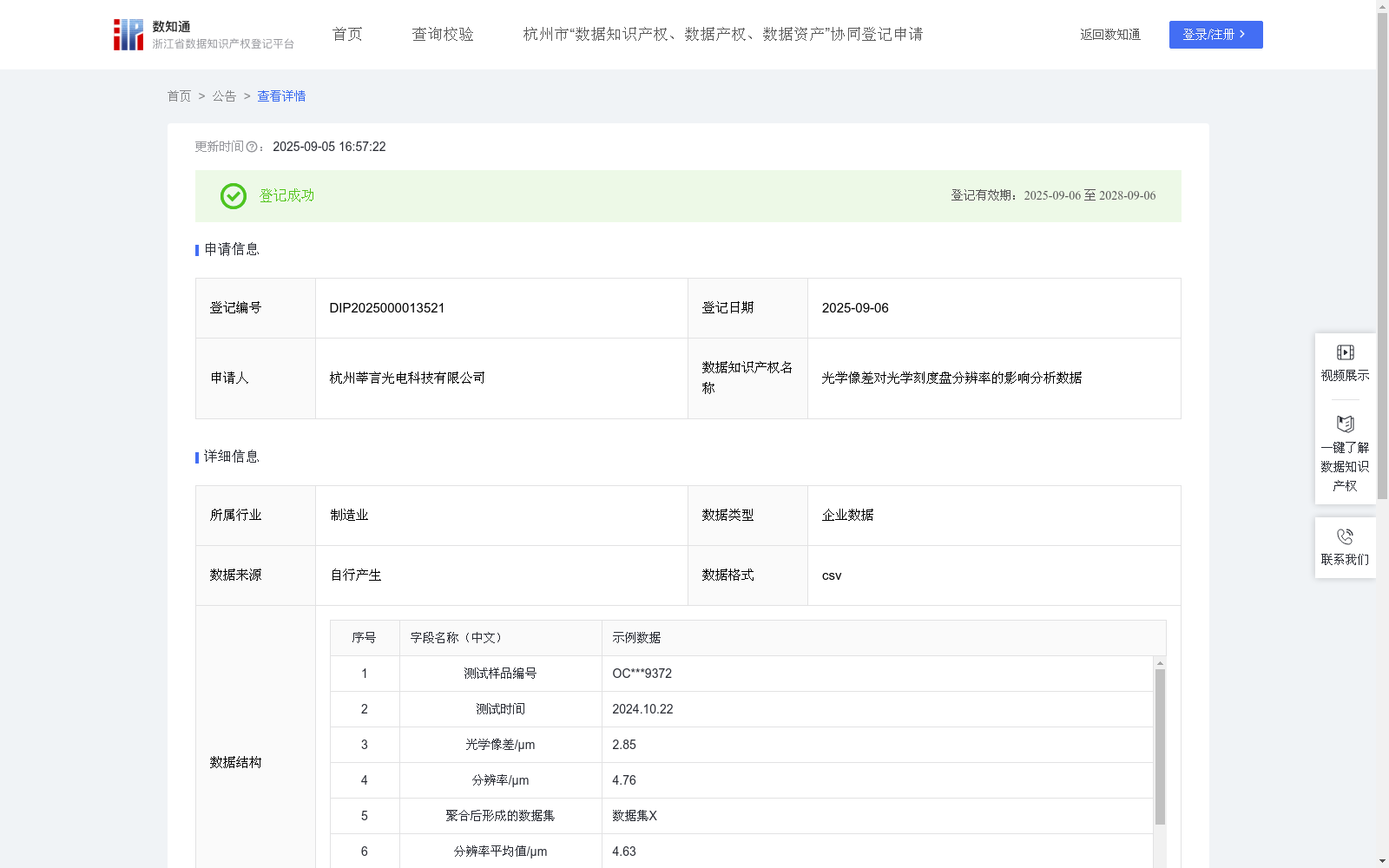
光学像差对光学刻度盘分辨率的影响分析数据
收藏浙江省数据知识产权登记平台2025-09-05 更新2025-09-06 收录
下载链接:
https://www.zjip.org.cn/home/announce/trends/175767
下载链接
链接失效反馈官方服务:
资源简介:
本数据聚焦于分析光学像差对光学刻度盘分辨率的影响,揭示了光学系统成像质量与刻度盘测量精度之间的量化关系,为公司(作为生产商)及外部相关方提供了重要的决策依据,具有显著的应用价值。具体体现在以下方面:
1.优化产品开发和生产工艺:公司可通过分析光学像差对分辨率的影响,可以精准优化光学系统设计,改进透镜组配置方案,科学制定像差补偿标准和质量控制参数,提升产品成像质量和测量精度。
2.推动行业科技进步:本数据可以给光学仪器制造领域的相关科研工作者、技术研发人员、质量管理人员、产品检验人员等使用,为他们开展光学测量系统像差分析、分辨率优化、因果关系探索、质量控制、科学研究、技术改进等工作提供支撑。1.数据采集:
实时记录不同光学像差条件下的光学刻度盘分辨率测试数据,包括测试样品编号、测试时间、光学像差/μm、分辨率/μm等字段。
2.数据预处理:
(1)对采集的数据进行去噪处理,确保数据准确性。
(2)将历史采集的数据(包含本次采集)进行聚合,形成数据集X,并针对数据集X中的分辨率字段,计算出其平均值。
3.计算线性回归斜率a和截距b:
(1)基于数据集X(以光学像差为自变量、分辨率为因变量),运用SLOPE函数,基于最小二乘法原理确定斜率a,运用INTERCEPT函数确定截距b。
(2)斜率a表示单位光学像差变化对分辨率的影响程度,截距b表示基准光学像差下光学刻度盘的分辨率值。
4.结果运用:
(1)计算比例系数k:k=|a/分辨率平均值|×100%。
(2)若k≥10%,则判定为"高影响",若5%≤k<10%,则判定为"中影响",若k<5%,则判定为"低影响"。
This dataset focuses on analyzing the impact of optical aberrations on the resolution of optical dial gauges, and reveals the quantitative relationship between the imaging quality of optical systems and the measurement accuracy of dial gauges. It provides important decision-making basis for the company (as a manufacturer) and external relevant parties, and has significant application value, which is specifically reflected in the following aspects:
1. Optimize product development and production processes: By analyzing the impact of optical aberrations on resolution, the company can accurately optimize the design of optical systems, improve the configuration scheme of lens groups, scientifically formulate aberration compensation standards and quality control parameters, and enhance the imaging quality and measurement accuracy of products.
2. Promote scientific and technological progress in the industry: This dataset can be used by relevant researchers, technical R&D personnel, quality management personnel, product inspectors and other practitioners in the field of optical instrument manufacturing, providing support for their work such as aberration analysis of optical measurement systems, resolution optimization, causal relationship exploration, quality control, scientific research and technical improvement.
1. Data Collection:
Real-time recording of optical dial resolution test data under different optical aberration conditions, including fields such as test sample number, test time, optical aberration/μm, resolution/μm, etc.
2. Data Preprocessing:
(1) Denoise the collected data to ensure data accuracy.
(2) Aggregate the historically collected data (including this collection) to form dataset X, and calculate the average value of the resolution field in dataset X.
3. Calculation of Linear Regression Slope a and Intercept b:
(1) Based on dataset X (with optical aberration as the independent variable and resolution as the dependent variable), use the SLOPE function to determine the slope a based on the principle of least squares, and use the INTERCEPT function to determine the intercept b.
(2) The slope a represents the degree of influence of unit optical aberration change on resolution, and the intercept b represents the resolution value of the optical dial under the reference optical aberration.
4. Result Application:
(1) Calculate the proportional coefficient k: k = |a / average resolution value| × 100%.
(2) If k ≥ 10%, it is judged as "high impact"; if 5% ≤ k < 10%, it is judged as "medium impact"; if k < 5%, it is judged as "low impact".
提供机构:
杭州莘言光电科技有限公司创建时间:
2025-08-04
搜集汇总
数据集介绍
背景与挑战
背景概述
该数据集包含557条CSV格式记录,通过测试光学像差和分辨率数据,量化分析像差对刻度盘测量精度的影响;采用线性回归算法计算比例系数k并判定影响等级,应用于制造业的产品优化和行业技术改进,具有明确的决策支持价值。
以上内容由遇见数据集搜集并总结生成

暂无相关数据集


