
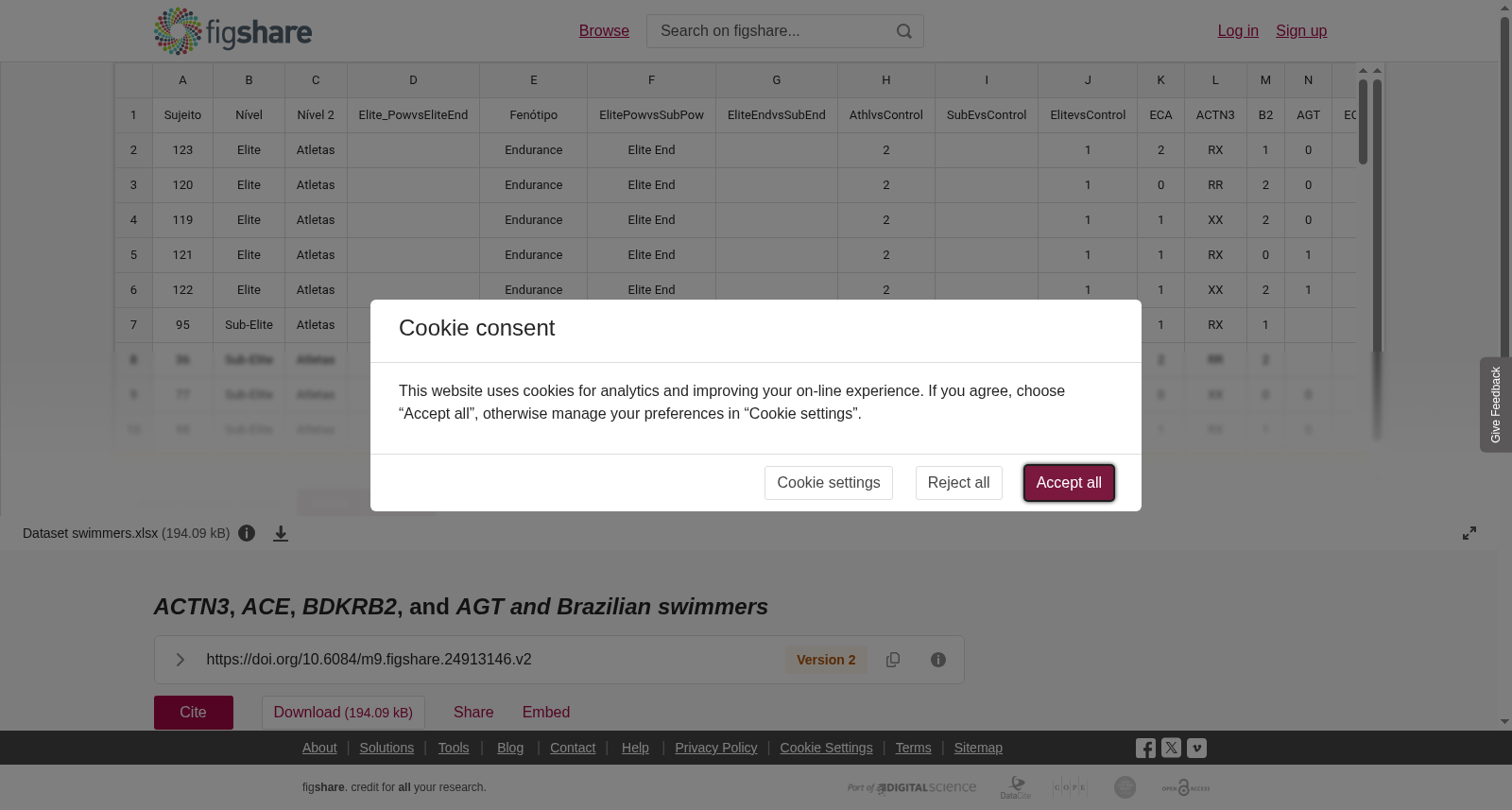
<b><i>ACTN3</i></b><b>, </b><b><i>ACE</i></b><b>, </b><b><i>BDKRB2</i></b><b>, and </b><b><i>AGT and Brazilian swimmers</i></b>
收藏DataCite Commons2025-04-01 更新2024-08-18 收录
下载链接:
https://figshare.com/articles/dataset/_b_i_ACTN3_i_b_b_b_b_i_ACE_i_b_b_b_b_i_BDKRB2_i_b_b_and_b_b_i_AGT_and_Brazilian_swimmers_i_b_/24913146/2
下载链接
链接失效反馈官方服务:
资源简介:
The influence of genetic polymorphisms on athletic performance has been widely explored. This study investigated the interactions between the polymorphisms <i>ACTN3 </i>(R577X), <i>ACE </i>(I/D), <i>BDKRB2 </i>(-9/+9), and <i>AGT </i>(M/T) and their association with endurance and strength phenotypes in Brazilian swimmers. 123 athletes (aged 20–30 years) and 718 controls participated in the study. The athletes were divided into elite and sub-elite (N=19 and 104, respectively) and strength and endurance experts (N=98 and 25, respectively). Hardy-Weinberg equilibrium was observed in all groups. Considering the <i>ACE</i> polymorphism, it was observed a higher frequency of the DD genotype than expected in the strength experts of the elite group, whereas the strength experts sub-elite athletes had a higher frequency of the ID genotype (χ<sup>2</sup>=8.17; p=0.01). Subjects with XX genotypes of <i>ACTN3</i> are more likely to belong to the athlete group when compared to the control group (OR=1.79, p=0.04). The DD homozygotes of the <i>ACE</i> are more likely to belong to the elite group with strength phenotypes than the group of sub-elite (OR=7.96, p=0.01) and elite strength experts compared to elite endurance (OR=18.0, p=0.03). However, no significant differences were observed in the allelic distribution of the polymorphisms evaluated when comparing Elite, sub-elite athletes and controls. In conclusion, <i>ACE</i> and <i>ACTN3</i> allele frequencies should be considered with regard to performance influencing factors in Brazilian swimmers.
遗传多态性对运动表现的影响已得到广泛探究。本研究针对巴西游泳运动员群体,分析了α-辅肌动蛋白3(ACTN3,R577X)、血管紧张素转换酶(ACE,I/D)、缓激肽B2受体(BDKRB2,-9/+9)与血管紧张素原(AGT,M/T)这四种基因多态性的相互作用,及其与运动员耐力、力量表型的关联。本研究共纳入123名年龄介于20~30岁的运动员,以及718名对照个体。运动员被划分为精英组与亚精英组(两组样本量分别为19与104),同时按运动表型分为力量型与耐力型运动员(两组样本量分别为98与25)。所有组别均符合哈迪-温伯格平衡(Hardy-Weinberg equilibrium)。针对ACE基因多态性,精英组力量型运动员的DD基因型频率高于预期;亚精英组力量型运动员的ID基因型频率则显著更高(χ²=8.17;p=0.01)。与对照组相比,携带ACTN3基因XX基因型的个体更易被归入运动员群体(比值比Odds Ratio,OR=1.79,p=0.04)。与亚精英组相比,携带ACE基因DD纯合基因型的个体更有可能属于力量表型精英组(OR=7.96,p=0.01);且精英力量型运动员相较于精英耐力型运动员,前者携带DD纯合基因型的概率更高(OR=18.0,p=0.03)。不过,在精英组、亚精英组运动员与对照组之间,所评估的各多态性的等位基因分布未发现显著差异。综上,在巴西游泳运动员中,ACE与ACTN3的等位基因频率可作为运动表现影响因素纳入考量范畴。
提供机构:
figshare创建时间:
2023-12-28
搜集汇总
数据集介绍
以上内容由遇见数据集搜集并总结生成


