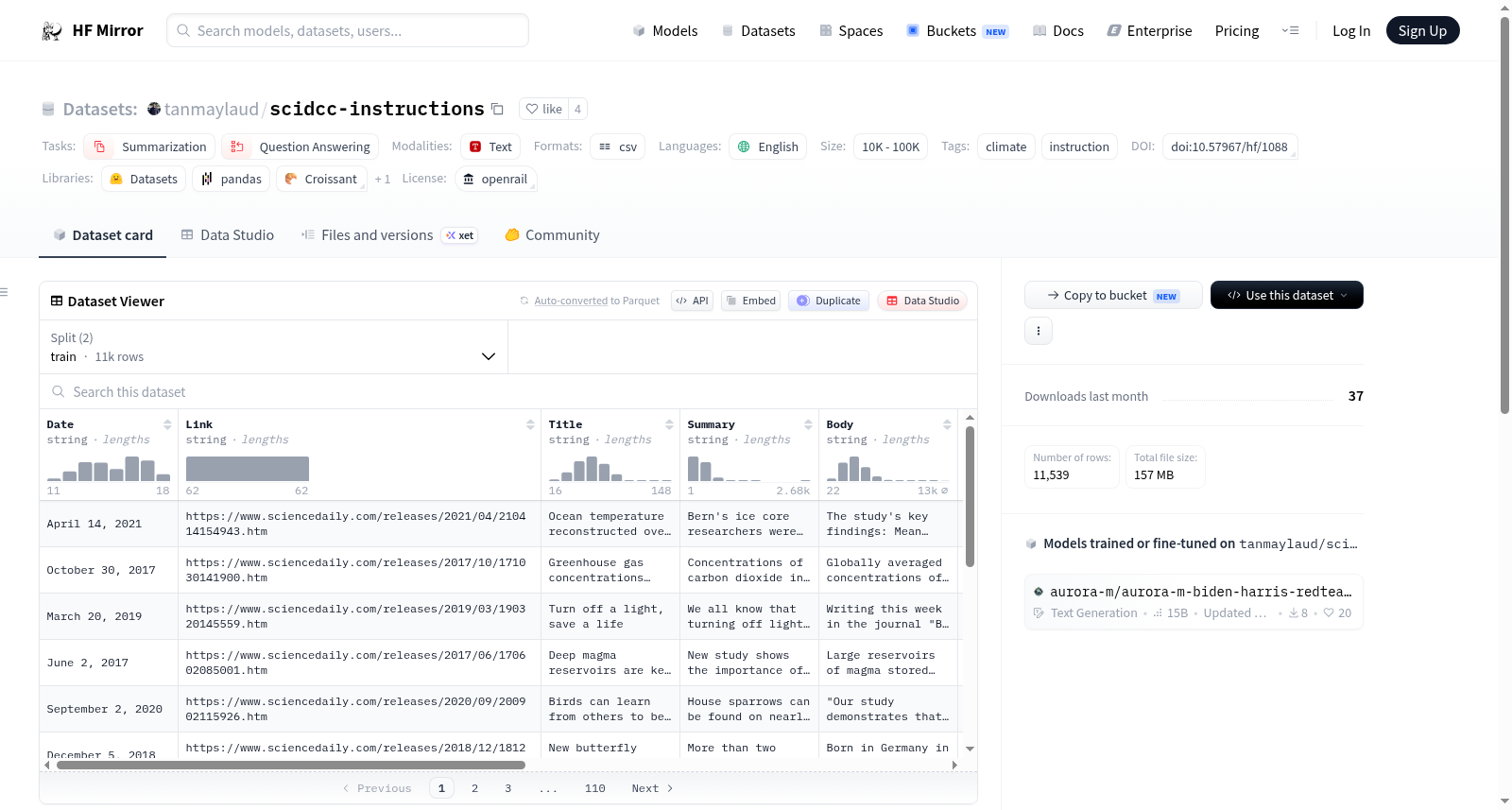
tanmaylaud/scidcc-instructions
收藏资源简介:
--- license: openrail task_categories: - conversational - summarization - question-answering language: - en tags: - climate - instruction pretty_name: scidcc-instr size_categories: - 1K<n<10K source_datasets: - scidcc --- ### Dataset Summary Instruction-Response pairs generated using the SciDCC Climate Dataset from [Climabench](https://huggingface.co/datasets/iceberg-nlp/climabench) ### Format ``` ### Instruction: Present a fitting title for the provided text. For those who study earthquakes, one major challenge has been trying to understand all the physics of a fault -- both during an earthquake and at times of "rest" -- in order to know more about how a particular region may behave in the future. Now, researchers at the California Institute of Technology (Caltech) have developed the first computer model of an earthquake-producing fault segment that reproduces, in a single physical framework, the available observations of both the fault's seismic (fast) and aseismic (slow) behavior. ### Response: Greater insight into earthquake cycles ``` #### 4 distinct instruction-response pairs per scidcc article. (Refer to columns instruction1, instruction2, instruction3, instruction4)
许可证:OpenRail 任务类别: - 对话式任务 - 摘要生成任务 - 问答任务 语言: - 英语 标签: - 气候 - 指令 展示名称:scidcc-instr 规模类别: - 1000 < 样本量 < 10000 源数据集: - scidcc --- ### 数据集概览 本数据集采用源自[Climabench](https://huggingface.co/datasets/iceberg-nlp/climabench)的SciDCC气候数据集,生成了多组指令-响应对。 ### 数据格式 ### 指令: 为给定文本撰写一个合适的标题。 对于地震研究人员而言,理解断层的全部物理特性始终是一项核心挑战——无论是地震发生期间还是“静止”时段——以便更深入地了解特定区域未来的地震活动规律。如今,加州理工学院(Caltech)的研究人员已开发出首个可模拟产震断层段的计算机模型,该模型能够在单一物理框架下复现该断层已知的地震(快速)与非地震(缓慢)两种活动观测结果。 ### 响应: 深化对地震周期的认知 #### 每篇scidcc文章对应4组独立的指令-响应对(请参考instruction1、instruction2、instruction3、instruction4列)
数据集概述
数据集简介
该数据集包含使用SciDCC气候数据集生成的指令-响应对,源自Climabench。
数据格式
数据集中的每个条目包含一个指令和一个响应,示例如下:
Instruction:
Present a fitting title for the provided text. For those who study earthquakes, one major challenge has been trying to understand all the physics of a fault -- both during an earthquake and at times of "rest" -- in order to know more about how a particular region may behave in the future. Now, researchers at the California Institute of Technology (Caltech) have developed the first computer model of an earthquake-producing fault segment that reproduces, in a single physical framework, the available observations of both the faults seismic (fast) and aseismic (slow) behavior.
Response:
Greater insight into earthquake cycles
数据结构
每个SciDCC文章包含4个不同的指令-响应对,对应于列instruction1, instruction2, instruction3, instruction4。