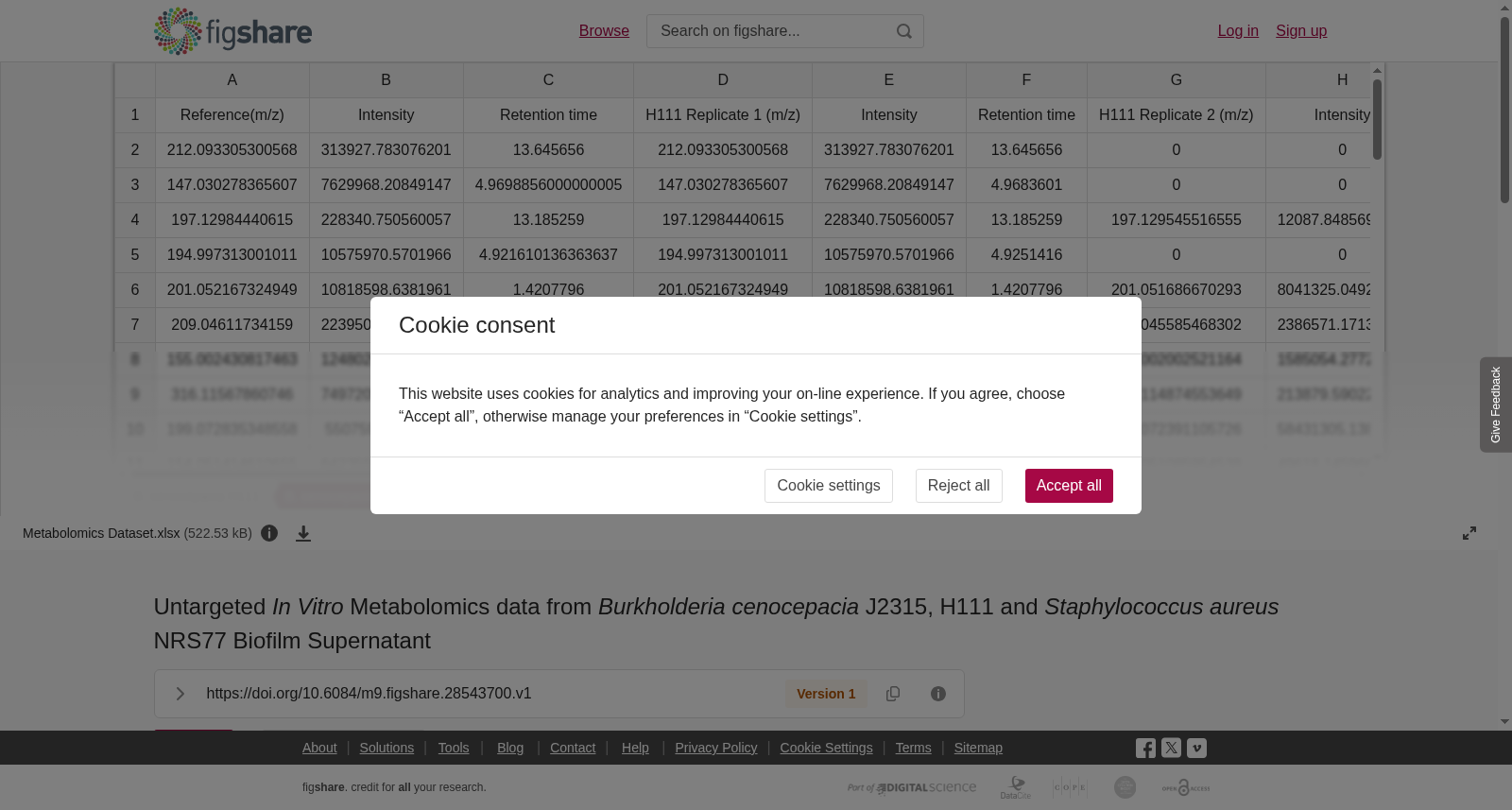
Untargeted <i>In Vitro</i> Metabolomics data from <i>Burkholderia cenocepacia </i>J2315, H111 and <i>Staphylococcus aureus </i>NRS77 Biofilm Supernatant
收藏资源简介:
Here, we offer a metabolomics dataset generated via high-performance-liquid chromatography and high-resolution mass spectrometry analysis of <i>in vitro</i> biofilm supernatant harvested from the human pathogens <i>Burkholderia cenocepacia</i> H111 & J2315 and <i>Staphylococcus aureus</i> NRS77. Polar metabolites from uninoculated media (LB+1% glucose, 150 mM MOPS) is also included as a control condition.<br><br><b>METHODS</b><br><b>Sample Collection</b><br>B. cenocepacia or Staphylococcus strains were inoculated into T LB Lennox + 1% glucose + 150 mM MOPS at 10^6 CFU/mL and incubated at 37 °C for 3 days in replicate wells of a 96-well PVC plate. After 7 days, the biofilm supernatants were removed via a micropipette, centrifuged at 21,130 x g for 1 min, and filter-sterilized through a 0.45 µm syringe filter (VWR 28145-505).<br><b>Extraction</b><br>Sterile supernatant was collected for each sample and frozen at -80 °C for 2 h or overnight, then freeze dried in a LabConco 2.5L Benchtop Freeze Dryer. Dried sample was reconstituted into 2 mL 50% acetonitrile and transferred into an autosampler injection vial after filtered with a 0.22 µm filter.<br><b>Chromatography</b>All samples were run on a Thermo DIONEX UltiMate 3000 HPLC system (Thermo Fisher Scientific, Waltham, MA, USA). The LC system was equipped with a reversed phase column (RPC, a Waters Acquity UPLC HSS T3 column, 2.1 x 150 mm, 1.8 µm) and hydrophilic interaction chromatography column (HILIC, a Millipore SeQuant ZIC-cHILIC column, 2.1 x 150 mm, 3 µm). The two LC columns were configured in parallel, and each column was connected with a 2-μL sample loop. The column temperature was set to 40 °C. For separation on the RPC column, water with 0.1% formic acid and acetonitrile with 0.1% formic acid were mobile phase A and B, respectively. The flow rate was 0.35 mL/min. The solvent gradient was set as 0-6 min 0% B, 6-14 min increased from 0% to 28% B, 14-16 min increased from 28% to 50% B, 16-20 min increased from 50% to 100% B, 21-33 min back to 0% B. For separation on the HILIC column, 10 mM ammonium acetate (pH=3.25) and acetonitrile with 0.1% formic acid were mobile phase A and B, respectively. The flow rate was 0.3 mL/min. The solvent gradient was set to 0-1.3 min 95% B, 1.3-8.3 min decreased from 95% to 0% B, 8.3-11 min kept 0% B, 11.5-33 min kept 95% B<br><br><b>Mass Spectrometry</b><br>All samples were run on a Thermo Q Exactive HF Hybrid Quadrupole-Orbitrap Mass Spectrometer. All samples were randomly analyzed in positive (+) and negative (-) modes to obtain full MS data for metabolite quantification. For the metabolite identification, the pooled sample was analyzed by 2D LC-MS/MS in positive and negative modes at three collision energies, 20, 40 and 60 eV.<br><br><b>Data Transformation</b><br>The raw data was converted mzML format using the MSCovert software, and XCMS software was used for spectrum deconvolution[1] and MetSign software for metabolite identification, cross-sample peak list alignment, normalization and statistical analysis[2][3].<br>Refs:<br>[1] Tautenhahn, R., Patti, G.J., Rinehart, D., and Siuzdak, G. (2012). XCMS On-line: a web-based platform to process untargeted metabolomic data. Anal Chem 84, 5035-5039. 10.1021/ac300698c.<br>[2] Wei, X., Shi, X., Kim, S., Patrick, J.S., Binkley, J., Kong, M., McClain, C., and Zhang, X. (2014). Data dependent peak model based spectrum deconvolution for analysis of high resolution LC-MS data. Anal Chem 86, 2156-2165. 10.1021/ac403803a.<br>[3] He, L., Li, F., Yin, X., Bohman, P., Kim, S., McClain, C.J., Feng, W., and Zhang, X. (2019). Profiling of Polar Metabolites in Mouse Feces Using Four Analytical Platforms to Study the Effects Of Cathelicidin-Related Antimicrobial Peptide in Alcoholic Liver Disease. J Proteome Res 18, 2875-2884. 10.1021/acs.jproteome.9b00181.<br><b>Metabolite Identification</b><br>To identify metabolites, 2D LC-MS/MS data was first matched to our own proprietary database that contains parent ion m/z, MS/MS spectra and retention time of 363 authentic standards. Thresholds were set as spectral similarity ≥ 0.4, retention time difference ≤ 0.15 and m/z variation window ≤ 5 ppm. 2D LC-MS/MS data without a match with the metabolites in the proprietary database were further analyzed using Compound Discoverer software (v 2.0, Thermo Fisher Scientific, Germany), where MS/MS spectra similarity score threshold was set ≥ 40 with a maximum score of 100. The suite of databases utilized though Compound Discoverer v3.1 software are as follows: E. coli Metabolome Database; Fecal Metabolome database; KEGG; Saliva Metabolome Database; Urine Metabolome Database; Compound Classes/Therapeutics/Prescription Drugs (including only the Endogenous Metabolites; Natural Products/Medicines; Natural Toxins; Small Molecule Chemicals; Steroids/Vitamins/Hormones; and Therapeutics/Prescription Drugs groups).<br>
本数据集为通过高效液相色谱(high-performance liquid chromatography, HPLC)与高分辨质谱(high-resolution mass spectrometry, HRMS)分析获得的代谢组学数据集,分析样本为<i>in vitro</i>(体外)培养的人类致病菌<i>Burkholderia cenocepacia</i>(洋葱伯克霍尔德菌)H111与J2315株,以及<i>Staphylococcus aureus</i>(金黄色葡萄球菌)NRS77株的生物膜上清液。同时纳入未接种的培养基(LB+1%葡萄糖、150 mM MOPS)的极性代谢物作为对照。<br><br><b>方法</b><br><b>样本采集</b><br>将<i>Burkholderia cenocepacia</i>(洋葱伯克霍尔德菌)或葡萄球菌菌株以10^6 CFU/mL(菌落形成单位/毫升)的接种量接入LB Lennox培养基(添加1%葡萄糖与150 mM MOPS)中,于37℃下在96孔PVC板的复孔中培养3天。培养7天后,用移液枪收集生物膜上清液,以21,130×g离心1分钟,再通过0.45 μm针式过滤器(VWR 28145-505)进行过滤除菌。<br><b>样本提取</b><br>收集每份样品的无菌上清液,于-80℃冷冻2小时或过夜,随后在LabConco 2.5L台式冷冻干燥机中进行冷冻干燥。将干燥后的样品重悬于2 mL 50%乙腈溶液中,经0.22 μm过滤器过滤后转移至自动进样器进样瓶中。<br><b>色谱分析</b>所有样品均在赛默飞DIONEX UltiMate 3000高效液相色谱(HPLC)系统(赛默飞世尔科技,美国马萨诸塞州沃尔瑟姆)上完成分析。该液相色谱系统并行配置了反相色谱柱(RPC:Waters Acquity UPLC HSS T3柱,2.1 × 150 mm,1.8 μm)与亲水相互作用色谱柱(HILIC:默克SeQuant ZIC-cHILIC柱,2.1 × 150 mm,3 μm),两根色谱柱均连接2 μL定量环。柱温设置为40℃。针对反相色谱柱分离:流动相A为含0.1%甲酸的水溶液,流动相B为含0.1%甲酸的乙腈溶液,流速为0.35 mL/min。洗脱梯度设置为:0-6 min 0% B,6-14 min B相从0%升至28%,14-16 min B相从28%升至50%,16-20 min B相从50%升至100%,21-33 min B相回落至0%。针对亲水相互作用色谱柱分离:流动相A为10 mM乙酸铵溶液(pH=3.25),流动相B为含0.1%甲酸的乙腈溶液,流速为0.3 mL/min。洗脱梯度设置为:0-1.3 min 95% B,1.3-8.3 min B相从95%降至0%,8.3-11 min维持0% B,11.5-33 min维持95% B<br><br><b>质谱分析</b><br>所有样品均在赛默飞Q Exactive HF 混合四极杆-轨道阱质谱仪上完成分析。为获取用于代谢物定量的全质谱数据,所有样品采用正离子模式与负离子模式随机交替进样。针对代谢物鉴定,混合样品采用二维液相色谱-串联质谱(2D LC-MS/MS)在正、负离子模式下,以20、40、60 eV三种碰撞能量进行分析。<br><br><b>数据处理</b><br>原始数据使用MSCovert软件转换为mzML格式,采用XCMS软件进行谱图去卷积[1],并使用MetSign软件完成代谢物鉴定、跨样本峰表对齐、归一化与统计分析[2][3]。<br>参考文献:<br>[1] Tautenhahn, R., Patti, G.J., Rinehart, D., and Siuzdak, G. (2012). XCMS On-line: a web-based platform to process untargeted metabolomic data. Anal Chem 84, 5035-5039. 10.1021/ac300698c.<br>[2] Wei, X., Shi, X., Kim, S., Patrick, J.S., Binkley, J., Kong, M., McClain, C., and Zhang, X. (2014). Data dependent peak model based spectrum deconvolution for analysis of high resolution LC-MS data. Anal Chem 86, 2156-2165. 10.1021/ac403803a.<br>[3] He, L., Li, F., Yin, X., Bohman, P., Kim, S., McClain, C.J., Feng, W., and Zhang, X. (2019). Profiling of Polar Metabolites in Mouse Feces Using Four Analytical Platforms to Study the Effects Of Cathelicidin-Related Antimicrobial Peptide in Alcoholic Liver Disease. J Proteome Res 18, 2875-2884. 10.1021/acs.jproteome.9b00181.<br><b>代谢物鉴定</b><br>代谢物鉴定流程如下:首先将二维LC-MS/MS数据与本实验室自有专属数据库进行匹配,该数据库包含363种标准品的母离子质荷比(m/z)、串联质谱(MS/MS)谱图与保留时间。匹配阈值设置为:谱图相似度≥0.4、保留时间差≤0.15、质荷比偏差窗口≤5 ppm。未匹配到专属数据库代谢物的二维LC-MS/MS数据,进一步使用Compound Discoverer软件(v2.0,赛默飞世尔科技,德国)进行分析,该软件的MS/MS谱图相似度得分阈值设置为≥40(满分100)。通过Compound Discoverer v3.1软件使用的数据库集合包括:大肠杆菌代谢组数据库、粪便代谢组数据库、京都基因与基因组百科全书(KEGG)、唾液代谢组数据库、尿液代谢组数据库;以及化合物类别/治疗药物/处方药数据库(仅纳入内源性代谢物、天然产物/药物、天然毒素、小分子化学品、类固醇/维生素/激素、治疗药物/处方药类别)。