
gsarti/wmt_vat
收藏Hugging Face2022-10-27 更新2024-03-04 收录
下载链接:
https://hf-mirror.com/datasets/gsarti/wmt_vat
下载链接
链接失效反馈官方服务:
资源简介:
---
annotations_creators:
- found
language_creators:
- expert-generated
language:
- cs
- de
- en
- et
- fi
- fr
- gu
- iu
- ja
- kk
- km
- lt
- lv
- pl
- ps
- ro
- ru
- ta
- tr
- zh
license:
- unknown
multilinguality:
- multilingual
- translation
size_categories:
- unknown
source_datasets:
- extended|wmt16
- extended|wmt17
- extended|wmt18
- extended|wmt19
- extended|wmt20
task_categories:
- text-generation
- translation
task_ids: []
pretty_name: wmt_vat
tags:
- conditional-text-generation
---
# Dataset Card for Variance-Aware MT Test Sets
## Table of Contents
- [Dataset Card for Variance-Aware MT Test Sets](#dataset-card-for-variance-aware-mt-test-sets)
- [Table of Contents](#table-of-contents)
- [Dataset Description](#dataset-description)
- [Dataset Summary](#dataset-summary)
- [Supported Tasks and Leaderboards](#supported-tasks-and-leaderboards)
- [Machine Translation](#machine-translation)
- [Languages](#languages)
- [Dataset Structure](#dataset-structure)
- [Data Instances](#data-instances)
- [Data Fields](#data-fields)
- [Data Splits](#data-splits)
- [Dataset Creation](#dataset-creation)
- [Additional Information](#additional-information)
- [Dataset Curators](#dataset-curators)
- [Licensing Information](#licensing-information)
- [Citation Information](#citation-information)
## Dataset Description
- **Repository:** [Github](https://github.com/NLP2CT/Variance-Aware-MT-Test-Sets)
- **Paper:** [NeurIPS](https://openreview.net/forum?id=hhKA5k0oVy5)
- **Point of Contact:** [Runzhe Zhan](mailto:nlp2ct.runzhe@gmail.com)
### Dataset Summary
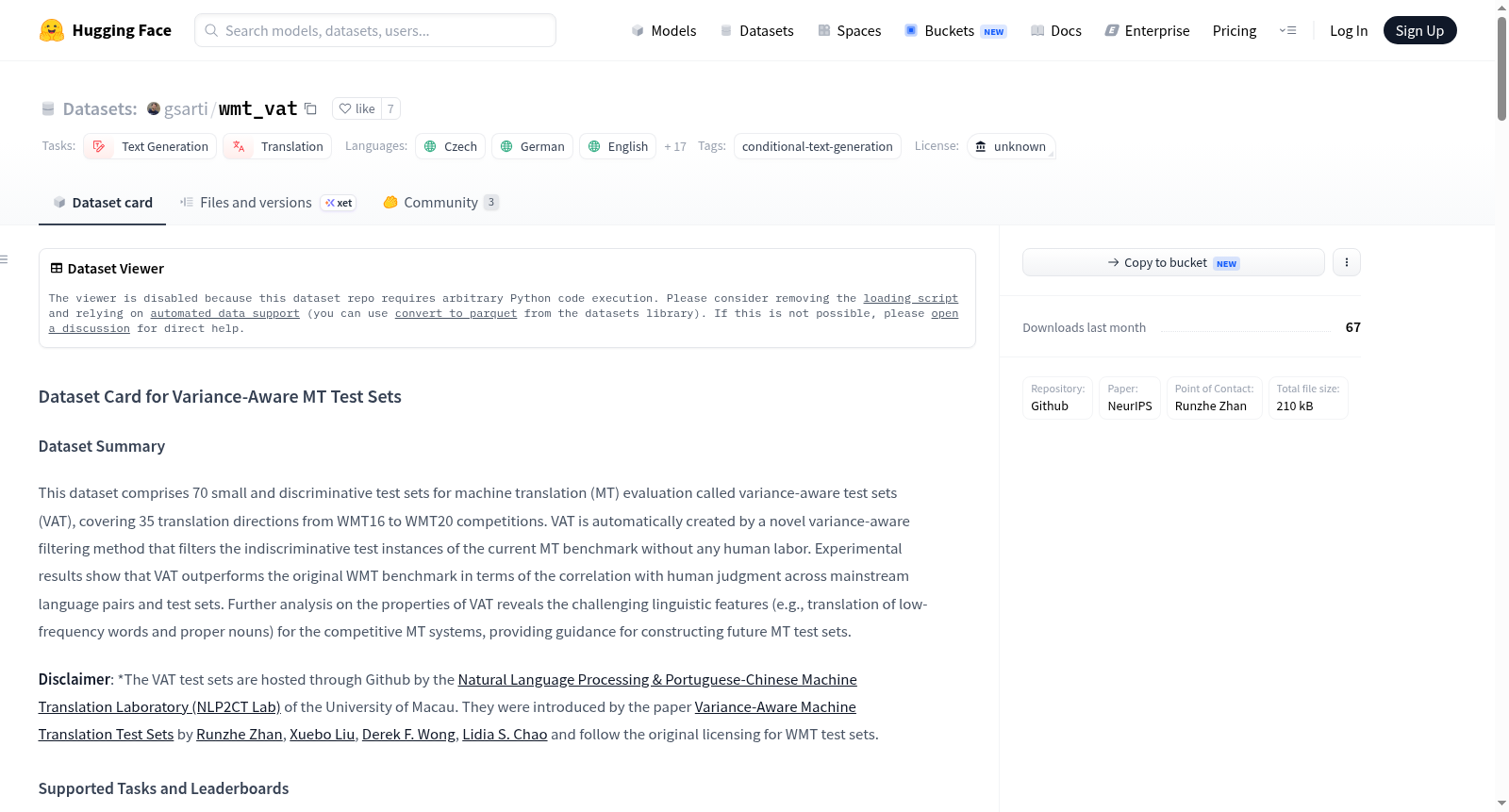
This dataset comprises 70 small and discriminative test sets for machine translation (MT) evaluation called variance-aware test sets (VAT), covering 35 translation directions from WMT16 to WMT20 competitions. VAT is automatically created by a novel variance-aware filtering method that filters the indiscriminative test instances of the current MT benchmark without any human labor. Experimental results show that VAT outperforms the original WMT benchmark in terms of the correlation with human judgment across mainstream language pairs and test sets. Further analysis on the properties of VAT reveals the challenging linguistic features (e.g., translation of low-frequency words and proper nouns) for the competitive MT systems, providing guidance for constructing future MT test sets.
**Disclaimer**: *The VAT test sets are hosted through Github by the [Natural Language Processing & Portuguese-Chinese Machine Translation Laboratory (NLP2CT Lab)](http://nlp2ct.cis.um.edu.mo/) of the University of Macau. They were introduced by the paper [Variance-Aware Machine Translation Test Sets](https://openreview.net/forum?id=hhKA5k0oVy5) by [Runzhe Zhan](https://runzhe.me/), [Xuebo Liu](https://sunbowliu.github.io/), [Derek F. Wong](https://www.fst.um.edu.mo/personal/derek-wong/), [Lidia S. Chao](https://aclanthology.org/people/l/lidia-s-chao/) and follow the original licensing for WMT test sets.
### Supported Tasks and Leaderboards
#### Machine Translation
Refer to the [original paper](https://openreview.net/forum?id=hhKA5k0oVy5) for additional details on model evaluation on VAT.
### Languages
The following table taken from the original paper lists the languages supported by the VAT test sets, for a total of 70 language pairs:
| ↔️ | `wmt16` | `wmt17` | `wmt18` | `wmt19` | `wmt20` |
|----------:|:--------|:--------|:--------|--------:|--------:|
| `xx_en` | `cs`,`de`,`fi`, <br /> `ro`,`ru`,`tr` | `cs`,`de`,`fi`,`lv`, <br /> `ru`,`tr`,`zh` | `cs`,`de`,`et`,`fi`, <br /> `ru`,`tr`,`zh` | `de`,`fi`,`gu`, <br /> `kk`,`lt`,`ru`,`zh` | `cs`,`de`,`iu`,`ja`,`km`, <br /> `pl`,`ps`,`ru`,`ta`,`zh`|
| `en_xx` | `ru` | `cs`,`de`,`fi`, <br /> `lv`,`ru`,`tr`,`zh` | `cs`,`de`,`et`,`fi`, <br /> `ru`,`tr`,`zh` | `cs`,`de`,`fi`,`gu`, <br /> `kk`,`lt`,`ru`,`zh` | `cs`,`de`,`ja`,`pl`, <br /> `ru`,`ta`,`zh`|
| `xx_yy` | / | / | / | `de_cs`,`de_fr`, <br /> `fr_de` | / |
To use any one of the test set, pass `wmtXX_src_tgt` as configuration name to the `load_dataset` command. E.g. to load the English-Russian test set from `wmt16`, use `load_dataset('gsarti/wmt_vat', 'wmt16_en_ru')`.
## Dataset Structure
### Data Instances
A sample from the `test` split (the only available split) for the WMT16 English-Russian language (`wmt16_en_ru` config) is provided below. All configurations have the same structure.
```python
{
'orig_id': 0,
'source': 'The social card of residents of Ivanovo region is to be recognised as an electronic payment instrument.',
'reference': 'Социальная карта жителя Ивановской области признается электронным средством платежа.'
}
```
The text is provided as-in the original dataset, without further preprocessing or tokenization.
### Data Fields
- `orig_id`: Id corresponding to the row id in the original dataset, before variance-aware filtering.
- `source`: The source sentence.
- `reference`: The reference sentence in the target language.
### Data Splits
Taken from the original repository:
| Configuration | # Sentences | # Words | # Vocabulary |
| :-----------: | :--------: | :-----: | :--------------: |
| `wmt20_km_en` | 928 | 17170 | 3645 |
| `wmt20_cs_en` | 266 | 12568 | 3502 |
| `wmt20_en_de` | 567 | 21336 | 5945 |
| `wmt20_ja_en` | 397 | 10526 | 3063 |
| `wmt20_ps_en` | 1088 | 20296 | 4303 |
| `wmt20_en_zh` | 567 | 18224 | 5019 |
| `wmt20_en_ta` | 400 | 7809 | 4028 |
| `wmt20_de_en` | 314 | 16083 | 4046 |
| `wmt20_zh_en` | 800 | 35132 | 6457 |
| `wmt20_en_ja` | 400 | 12718 | 2969 |
| `wmt20_en_cs` | 567 | 16579 | 6391 |
| `wmt20_en_pl` | 400 | 8423 | 3834 |
| `wmt20_en_ru` | 801 | 17446 | 6877 |
| `wmt20_pl_en` | 400 | 7394 | 2399 |
| `wmt20_iu_en` | 1188 | 23494 | 3876 |
| `wmt20_ru_en` | 396 | 6966 | 2330 |
| `wmt20_ta_en` | 399 | 7427 | 2148 |
| `wmt19_zh_en` | 800 | 36739 | 6168 |
| `wmt19_en_cs` | 799 | 15433 | 6111 |
| `wmt19_de_en` | 800 | 15219 | 4222 |
| `wmt19_en_gu` | 399 | 8494 | 3548 |
| `wmt19_fr_de` | 680 | 12616 | 3698 |
| `wmt19_en_zh` | 799 | 20230 | 5547 |
| `wmt19_fi_en` | 798 | 13759 | 3555 |
| `wmt19_en_fi` | 799 | 13303 | 6149 |
| `wmt19_kk_en` | 400 | 9283 | 2584 |
| `wmt19_de_cs` | 799 | 15080 | 6166 |
| `wmt19_lt_en` | 400 | 10474 | 2874 |
| `wmt19_en_lt` | 399 | 7251 | 3364 |
| `wmt19_ru_en` | 800 | 14693 | 3817 |
| `wmt19_en_kk` | 399 | 6411 | 3252 |
| `wmt19_en_ru` | 799 | 16393 | 6125 |
| `wmt19_gu_en` | 406 | 8061 | 2434 |
| `wmt19_de_fr` | 680 | 16181 | 3517 |
| `wmt19_en_de` | 799 | 18946 | 5340 |
| `wmt18_en_cs` | 1193 | 19552 | 7926 |
| `wmt18_cs_en` | 1193 | 23439 | 5453 |
| `wmt18_en_fi` | 1200 | 16239 | 7696 |
| `wmt18_en_tr` | 1200 | 19621 | 8613 |
| `wmt18_en_et` | 800 | 13034 | 6001 |
| `wmt18_ru_en` | 1200 | 26747 | 6045 |
| `wmt18_et_en` | 800 | 20045 | 5045 |
| `wmt18_tr_en` | 1200 | 25689 | 5955 |
| `wmt18_fi_en` | 1200 | 24912 | 5834 |
| `wmt18_zh_en` | 1592 | 42983 | 7985 |
| `wmt18_en_zh` | 1592 | 34796 | 8579 |
| `wmt18_en_ru` | 1200 | 22830 | 8679 |
| `wmt18_de_en` | 1199 | 28275 | 6487 |
| `wmt18_en_de` | 1199 | 25473 | 7130 |
| `wmt17_en_lv` | 800 | 14453 | 6161 |
| `wmt17_zh_en` | 800 | 20590 | 5149 |
| `wmt17_en_tr` | 1203 | 17612 | 7714 |
| `wmt17_lv_en` | 800 | 18653 | 4747 |
| `wmt17_en_de` | 1202 | 22055 | 6463 |
| `wmt17_ru_en` | 1200 | 24807 | 5790 |
| `wmt17_en_fi` | 1201 | 17284 | 7763 |
| `wmt17_tr_en` | 1203 | 23037 | 5387 |
| `wmt17_en_zh` | 800 | 18001 | 5629 |
| `wmt17_en_ru` | 1200 | 22251 | 8761 |
| `wmt17_fi_en` | 1201 | 23791 | 5300 |
| `wmt17_en_cs` | 1202 | 21278 | 8256 |
| `wmt17_de_en` | 1202 | 23838 | 5487 |
| `wmt17_cs_en` | 1202 | 22707 | 5310 |
| `wmt16_tr_en` | 1200 | 19225 | 4823 |
| `wmt16_ru_en` | 1199 | 23010 | 5442 |
| `wmt16_ro_en` | 800 | 16200 | 3968 |
| `wmt16_de_en` | 1200 | 22612 | 5511 |
| `wmt16_en_ru` | 1199 | 20233 | 7872 |
| `wmt16_fi_en` | 1200 | 20744 | 5176 |
| `wmt16_cs_en` | 1200 | 23235 | 5324 |
### Dataset Creation
The dataset was created by retaining a subset of the top 40% instances from various WMT test sets for which the variance between automatic scores (BLEU, BLEURT, COMET, BERTScore) was the highest. Please refer to the original article [Variance-Aware Machine Translation Test Sets](https://openreview.net/forum?id=hhKA5k0oVy5) for additional information on dataset creation.
## Additional Information
### Dataset Curators
The original authors of VAT are the curators of the original dataset. For problems or updates on this 🤗 Datasets version, please contact [gabriele.sarti996@gmail.com](mailto:gabriele.sarti996@gmail.com).
### Licensing Information
The variance-aware test set were created based on the original WMT test set. Thus, the the [original data licensing plan](http://www.statmt.org/wmt20/translation-task.html) already stated by WMT organizers is still applicable:
> The data released for the WMT news translation task can be freely used for research purposes, we just ask that you cite the WMT shared task overview paper, and respect any additional citation requirements on the individual data sets. For other uses of the data, you should consult with original owners of the data sets.
### Citation Information
Please cite the authors if you use these corpora in your work. It is also advised to cite the original WMT shared task paper for the specific test sets that were used.
```bibtex
@inproceedings{
zhan2021varianceaware,
title={Variance-Aware Machine Translation Test Sets},
author={Runzhe Zhan and Xuebo Liu and Derek F. Wong and Lidia S. Chao},
booktitle={Thirty-fifth Conference on Neural Information Processing Systems, Datasets and Benchmarks Track},
year={2021},
url={https://openreview.net/forum?id=hhKA5k0oVy5}
}
```
提供机构:
gsarti原始信息汇总
数据集概述
数据集名称
- 名称: Variance-Aware MT Test Sets (VAT)
数据集描述
- 概述: 包含70个小型的、具有区分性的机器翻译评估测试集,覆盖从WMT16到WMT20的35个翻译方向。
- 创建方法: 通过一种新颖的方差感知过滤方法自动创建,无需人工劳动。
- 性能: 在主流语言对和测试集上,与人类判断的相关性优于原始WMT基准。
支持的任务
- 任务: 机器翻译
语言支持
- 语言: 支持多种语言,包括但不限于cs, de, en, et, fi, fr, gu, iu, ja, kk, km, lt, lv, pl, ps, ro, ru, ta, tr, zh。
数据集结构
- 数据实例: 每个实例包含原始ID、源句子和参考句子。
- 数据字段: 包括orig_id, source, reference。
- 数据分割: 仅包含测试集。
数据集创建
- 创建过程: 从多个WMT测试集中筛选出方差最高的40%实例。
许可证信息
- 许可证: 未知,遵循WMT测试集的原始许可。
引用信息
- 引用: bibtex @inproceedings{ zhan2021varianceaware, title={Variance-Aware Machine Translation Test Sets}, author={Runzhe Zhan and Xuebo Liu and Derek F. Wong and Lidia S. Chao}, booktitle={Thirty-fifth Conference on Neural Information Processing Systems, Datasets and Benchmarks Track}, year={2021}, url={https://openreview.net/forum?id=hhKA5k0oVy5} }
搜集汇总
数据集介绍
构建方式
在机器翻译(MT)评估领域,传统测试集往往因缺乏区分度而难以有效甄别系统间的性能差异。为此,研究者基于WMT16至WMT20竞赛的官方测试集,创新性地提出了一种方差感知过滤方法(Variance-Aware Filtering),自动筛选出对主流MT系统最具判别力的测试实例。具体而言,该方法针对每个源句计算BLEU、BLEURT、COMET及BERTScore等多项自动评估指标的得分方差,仅保留方差最高的前40%实例,从而在无需任何人工干预的前提下,构建出70个覆盖35个翻译方向的小型、高判别力测试集,即方差感知测试集(Variance-Aware Test Sets, VAT)。
特点
VAT测试集的核心特点在于其卓越的判别力与语言学洞察力。与原始WMT测试集相比,VAT在多个主流语言对上的评估结果与人工判断的相关性显著提升,能够更精准地区分不同MT系统的翻译质量。深入分析VAT的实例属性后发现,这些测试集尤其聚焦于低频率词汇、专有名词等对现有系统构成挑战的语言现象,从而为揭示MT系统的薄弱环节提供了宝贵线索。此外,VAT覆盖了从英语到捷克语、德语、芬兰语乃至中文等20种语言的广泛翻译方向,每个方向的测试集规模虽小(约数百句),却兼具高效性与代表性。
使用方法
VAT测试集可通过HuggingFace Datasets库便捷加载使用。用户只需指定相应的配置名称,格式为'wmtXX_src_tgt',例如加载WMT16英俄测试集时调用load_dataset('gsarti/wmt_vat', 'wmt16_en_ru')。数据集仅包含'test'划分,每个样本提供'orig_id'(原始数据集中的行ID)、'source'(源语言句子)和'reference'(目标语言参考译文)三个字段,文本保持原始未经预处理的格式。使用者可参照原始论文中的评估协议,利用VAT对MT系统进行细粒度评测,并通过对比不同系统的得分方差,深入分析模型在处理特定语言现象时的表现差异。
背景与挑战
背景概述
机器翻译评估是自然语言处理领域的核心挑战之一,其关键在于构建能够有效区分不同系统性能的高质量测试集。传统WMT基准测试虽被广泛采用,却存在测试实例区分度不足的问题,难以精准反映翻译系统间的真实差异。为此,澳门大学自然语言处理与葡中机器翻译实验室(NLP2CT Lab)的Runzhe Zhan、Xuebo Liu、Derek F. Wong及Lidia S. Chao等研究人员于2021年提出了方差感知机器翻译测试集(VAT),相关成果发表于NeurIPS 2021数据集与基准轨道。该数据集覆盖WMT 2016至2020共35个翻译方向,通过创新的方差感知过滤方法,自动筛选出对系统间差异最敏感的测试实例,无需人工标注。VAT在主流语言对上与人工判断的相关性显著优于原始WMT基准,为机器翻译评估提供了更为精准和可靠的工具,对推动评估方法学的发展具有重要影响力。
当前挑战
VAT数据集所应对的核心领域挑战在于现有机器翻译基准测试中大量测试实例缺乏区分度,导致不同系统的性能差异被掩盖,评估结果难以反映真实能力。传统WMT测试集在构建时未充分考虑实例的鉴别力,使得高表现系统与低表现系统间的分数差距可能无法准确体现翻译质量的实际鸿沟。在构建过程中,研究团队面临的挑战包括:如何在无需人工干预的前提下自动识别并保留最具区分度的实例;如何确保过滤后的子集在多种语言对上均能保持评估稳定性;以及如何处理低资源语言对中数据稀疏带来的方差估计不稳定性。此外,VAT的创建还需克服多维度自动评分指标(如BLEU、BLEURT、COMET、BERTScore)的方差计算复杂性,并验证筛选结果在不同系统间的一致性,从而保证测试集在广泛场景下的普适性与可靠性。
常用场景
经典使用场景
在机器翻译领域,模型性能评估的可靠性与可重复性一直是研究焦点。wmt_vat数据集通过引入方差感知过滤方法,从WMT 2016至2020年的海量测试实例中自动筛选出最具判别力的子集,构建了涵盖35个翻译方向的70个精细化测试集。该数据集的核心应用场景在于为神经机器翻译系统提供一种更敏感、更精准的评估基准,尤其适用于检验模型在低频率词汇、专有名词等复杂语言现象上的翻译能力,从而弥补传统WMT测试集在区分不同模型性能上的不足。
衍生相关工作
wmt_vat数据集的提出催生了一系列围绕机器翻译评测方法论改进的后续研究。其方差感知过滤思想启发了多种自动化测试集构建策略,例如基于模型不确定性的样本筛选、面向特定语言现象的定向测试集生成等。同时,该数据集已被广泛应用于对比不同翻译模型(如Transformer变体、多语言预训练模型)在挑战性样本上的表现差异,并作为验证新评估指标(如COMET、BLEURT)判别力的标准基准之一。这些衍生工作共同推动了机器翻译评测从粗粒度向细粒度、从静态向动态的转型。
数据集最近研究
最新研究方向
在神经机器翻译评估领域,传统静态测试集(如WMT基准)因难以区分高性能模型间的细微差异而面临瓶颈。gsarti/wmt_vat数据集通过方差感知过滤方法,从WMT16至WMT20的35个翻译方向上自动筛选出最具区分力的测试实例,构建了70个高方差测试子集。这一创新与当前前沿研究方向紧密相连——即推动机器翻译评估从粗粒度得分向细粒度、高鲁棒性方向发展,尤其关注低资源语种、专有名词及低频词等挑战性语言特征。该数据集在NeurIPS 2021发表后,迅速成为评估模型泛化能力的关键工具,其方法论也启发了后续在跨语言理解、生成任务中的方差引导测试集构建,显著提升了自动评估与人类判断的一致性,对推动机器翻译系统的公平性评估与鲁棒性优化具有里程碑意义。
以上内容由遇见数据集搜集并总结生成


