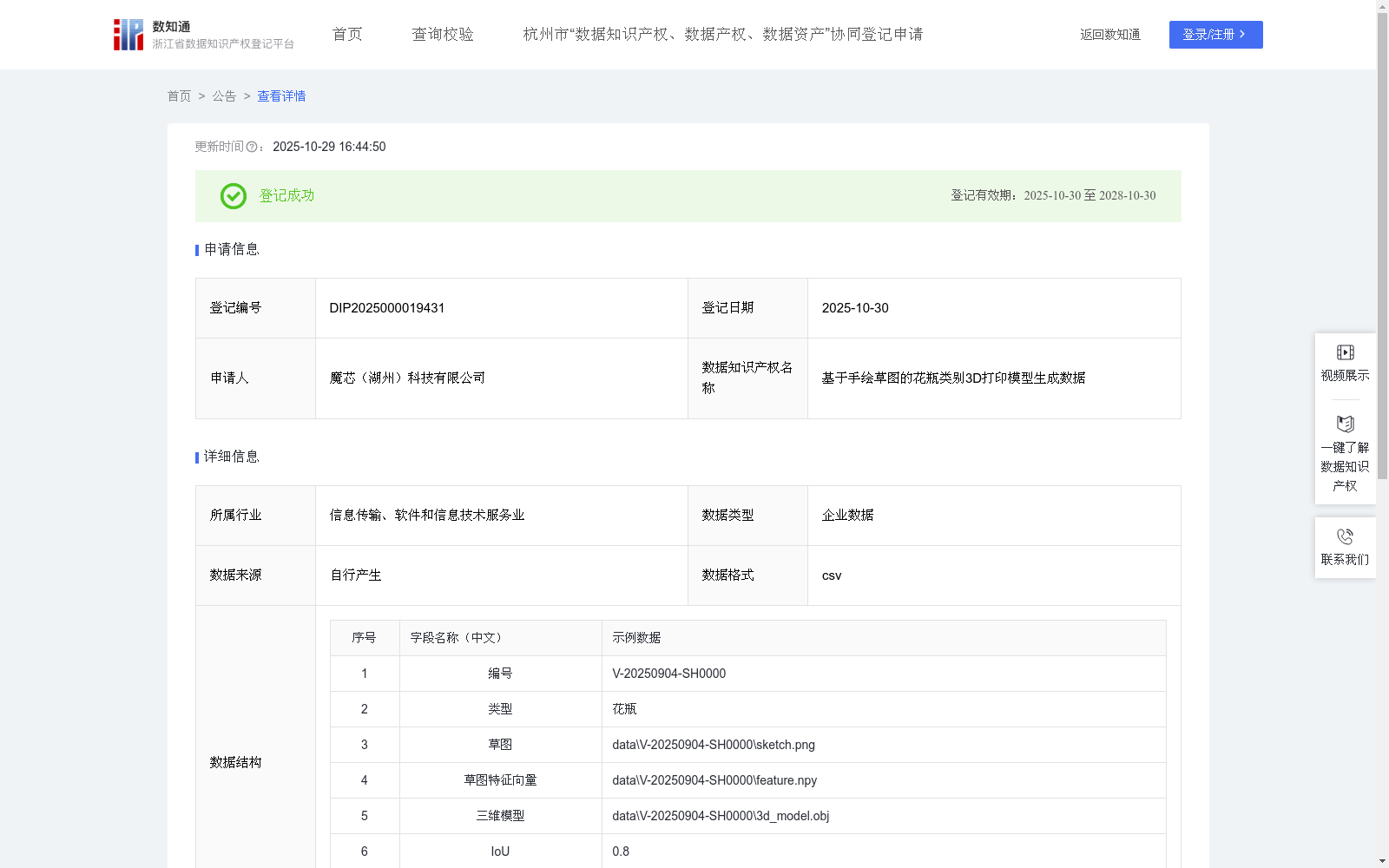
基于手绘草图的花瓶类别3D打印模型生成数据
收藏资源简介:
通过构建一个包含大量不同外形、且均为水密性的花瓶3D打印模型及其对应的手绘设计草图(2D线稿图)的大规模配对数据集,可以为深度学习模型提供训练基础,使其学习从二维线条轮廓生成功能性的三维物体。这一数据集主要适用于个性化办公用品和桌面收纳的定制服务、中小学设计与制造课程教学以及创意产品原型的快速验证。利用该数据训练出的模型,能够让普通用户甚至儿童通过随手画一张花瓶的草图,就能生成一个可直接用于3D打印的实体模型,解决了即便是简单功能性物品也需要专业三维建模软件才能设计,以及普通人无法将创意草图快速实物化的问题。基于手绘草图生成特定类别(如花瓶)的可3D打印模型,旨在实现创意的快速物化。具体过程包括:(1)数据收集:用户在纸上或平板电脑上绘制一张能清晰表达花瓶外轮廓的2D设计草图(I_sketch)。(2)数据处理:将输入的草图图片进行预处理,然后送入一个在草图数据集上训练过的图像编码器,以提取代表设计意图的草图特征向量。特征向量通过公式 F_sketch = Encoder_sketch(I_sketch) 提取,其中 F_sketch 为草图特征向量,Encoder_sketch 为图像编码器。(3)模型构建:使用提取的草图特征向量作为输入,设计并搭建一个专注于从2D轮廓生成3D实体的几何解码模型。该模型生成花瓶的隐式三维表示,并确保其具有中空结构以实现花瓶功能。根据公式 SDF = Decoder_3D(F_sketch) 从草图特征中解码出三维模型,Decoder_3D 为三维形状解码器。关键的评估指标包括交并比(Intersection over Union, IoU)和倒角距离(Chamfer Distance, CD)。此方法适用于将非专业用户的2D手绘创意直接转化为功能性的3D打印实物,极大地简化了实用物品的设计流程。
Constructing a large-scale paired dataset encompassing a diverse range of watertight 3D printable vase models and their corresponding hand-drawn design sketches (2D line drawings) provides a robust training foundation for deep learning models, enabling them to learn the task of generating functional 3D objects from 2D line contours. This dataset is primarily suited for three main scenarios: customized services for personalized office supplies and desktop organizers, teaching in K-12 design and manufacturing courses, and rapid validation of creative product prototypes. Models trained on this dataset can allow ordinary users and even children to generate a directly 3D-printable physical model by casually drawing a vase sketch, addressing two long-standing pain points: first, the requirement of professional 3D modeling software to design even simple functional items, and second, the inability of non-experts to quickly turn their creative sketches into physical objects. The core objective of generating category-specific (e.g., vases) 3D printable models from hand-drawn sketches is to achieve rapid materialization of creative ideas. The specific workflow is as follows: 1. Data Collection: Users draw a 2D design sketch (denoted as $I_{sketch}$) that clearly depicts the outer contour of a vase on paper or a tablet. 2. Data Processing: The input sketch image is first preprocessed, then fed into an image encoder trained on sketch datasets to extract sketch feature vectors that represent the user's design intent. The feature vector is extracted using the formula $F_{sketch} = Encoder_{sketch}(I_{sketch})$, where $F_{sketch}$ refers to the sketch feature vector, and $Encoder_{sketch}$ is the image encoder. 3. Model Construction: Taking the extracted sketch feature vectors as input, a geometric decoding model specialized in generating 3D entities from 2D contours is designed and implemented. This model generates an implicit 3D representation of the vase and ensures the model has a hollow structure to fulfill the functional requirements of a vase. The 3D model is decoded from the sketch features via the formula $SDF = Decoder_{3D}(F_{sketch})$, where $Decoder_{3D}$ is the 3D shape decoder. Key evaluation metrics for this task include Intersection over Union (IoU) and Chamfer Distance (CD). This approach enables the direct conversion of 2D hand-drawn creative ideas from non-professional users into functional 3D printable physical objects, greatly simplifying the design workflow for practical daily items.