
16S rDNA sequencing data for characterizing the endosymbionts of leaf curl plum aphid ( Brachycaudus helichrysi) clones
收藏Mendeley Data2024-04-13 更新2024-06-27 收录
下载链接:
https://datadryad.org/stash/dataset/doi:10.5061/dryad.zpc866tgn
下载链接
链接失效反馈官方服务:
资源简介:
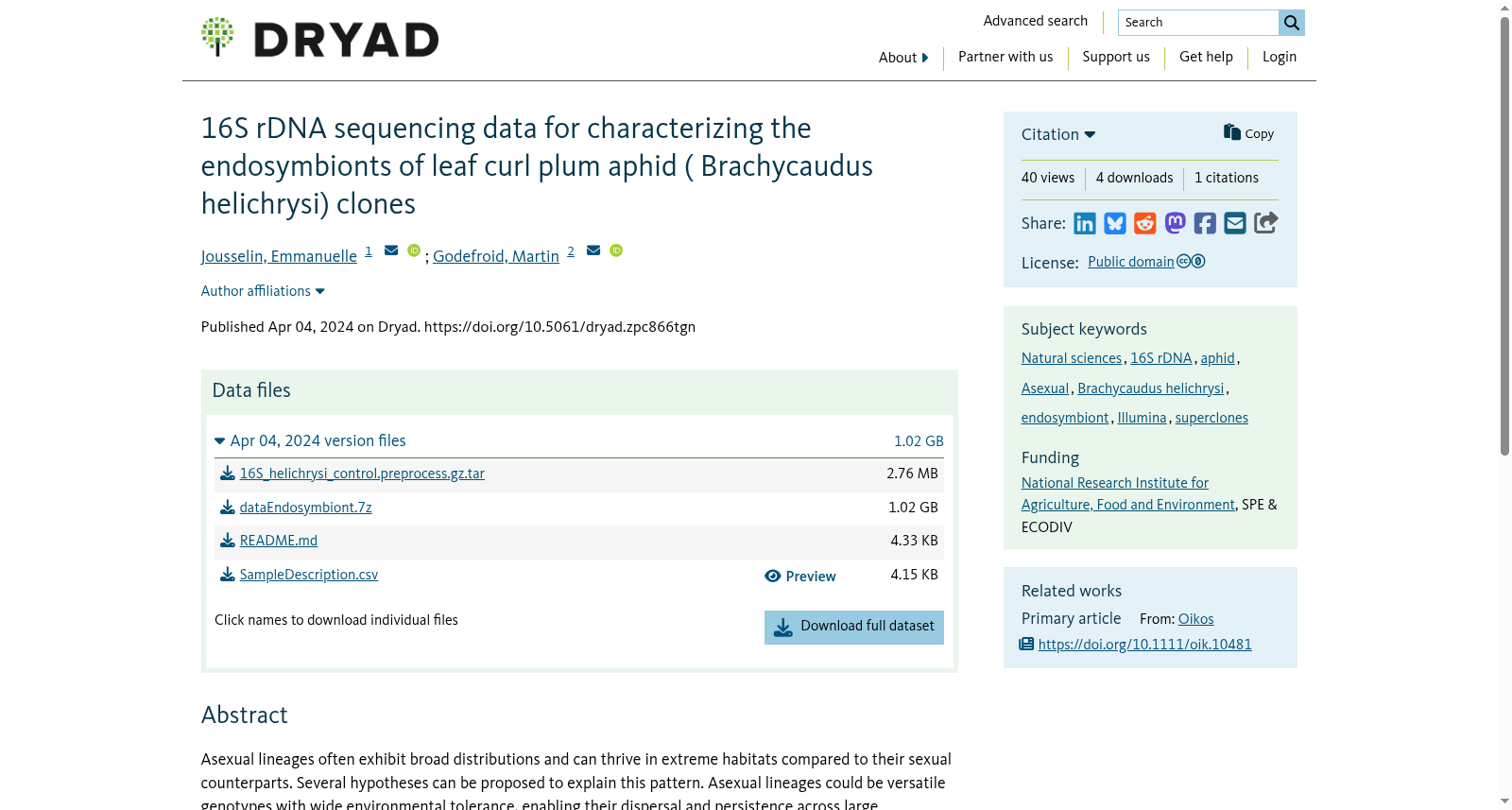
# 16S rDNA sequencing data for characterizing the endosymbionts of leaf curl plum aphid ( Brachycaudus helichrysi) clones [https://doi.org/10.5061/dryad.zpc866tgn](https://doi.org/10.5061/dryad.zpc866tgn) The data set contains raw reads resulting from the illumina sequencing of a fragment of 16S rDNA gene on a world wide Brachycaudus helichrysi sampling. A total of 102 individuals, representative of six *B. helichrysi* clones and the diversity of their geographic distribution were used for characterising bacterial endosymbionts. Using DNA extracts from the same individuals utilised for microsatellite genotyping in Piffaretti et al. (2013) or Popkin et al. (2017), we amplified a 251 bp portion of the V4 region of the 16S rRNA gene (Mizrahi-Man et al. 2013) and used targeted sequencing of indexed bacterial fragments on a MiSeq (Illumina) platform (Kozich et al. 2013) following the protocol described in Jousselin et al. (2016). Each DNA sample was amplified twice (replicates were conducted on distinct 96-well microplates). We also used negative controls (DNA extraction and PCR controls conducted on blank templates) to filter out bacterial contamination during laboratory procedures. A total of 216 PCR products (comprising DNA extracts and controls) were obtained, pooled, and then separated by gel electrophoresis. Bands based on the expected size of the PCR products were excised from the gel, purified with a PCR clean-up and gel extraction kit (Macherey-Nagel), and quantified with the Kapa Library Quantification Kit (Kapa Biosystems). Paired-end sequencing of the DNA pool was carried out on a MISEQ (Illumina) FLOWCELL with a 500-cycle Reagent Kit v2 (Illumina). Sequencing reads of DNA extraction and PCR controls are also provided ## Description of the data and file structure Sequencing Reads are demultiplexed by individuals. Each fast.gz file corresponds to the sequencing of a pcr product: extension "L001_R1_001" corresponds to sequencing using forward primers, and extension "L001_R2_001" corresponds to the sequencing using reverse primer. PCR protocol is described above. Each individual has been amplified twice (i.e. file extension "-BIS" corresponds to a PCR replicate . Sample description (i.e sample name with collection details : date of collection, host plant association, clone identify, locality) is given in a table attached to this submission (and also Appendix S3 of the paper). ## Code/Software FROGS pipeline (Escudié et al. 2018) have been used to generate an abundance table of symbiont lineages across samples given as a supplemntary material of the paper. References Escudié, F., Auer, L., Bernard, M., Mariadassou, M., Cauquil, L., Vidal, K., Maman, S., Hernandez-Raquet, G., Combes, S. and Pascal, G. 2018. FROGS: find, rapidly, OTUs with galaxy solution. - Bioinformatics 34: 1287–1294. Jousselin, E., Clamens, A.-L., Galan, M., Bernard, M., Maman, S., Gschloessl, B., Duport, G., Meseguer, A. S., Calevro, F. and Coeur D’Acier, A. 2016. Assessment of a 16S rRNA amplicon Illumina sequencing procedure for studying the microbiome of a symbiont-rich aphid genus. - Mol Ecol Resour 16: 628–640. Kozich, J. J., Westcott, S. L., Baxter, N. T., Highlander, S. K. and Schloss, P. D. 2013. Development of a dual-index sequencing strategy and curation pipeline for analyzing amplicon sequence data on the MiSeq Illumina sequencing platform. - Appl Environ Microbiol 79: 5112–5120. Mizrahi-Man, O., Davenport, E. R. and Gilad, Y. 2013. Taxonomic classification of bacterial 16S rRNA genes using short sequencing reads: evaluation of effective study designs. - PLoS One 8: e53608. Piffaretti, J., Clamens, A.-L., Vanlerberghe-masutti, F., Gupta, R. K., Call, E., Halbert, S. and Jousselin, E. 2013a. Regular or covert sex defines two lineages and worldwide superclones within the leaf-curl plum aphid (*Brachycaudus helichrysi*, Kaltenbach). - Mol Ecol 22: 3916–3932. Popkin, M., Piffaretti, J., Clamens, A.-L., Qiao, G.-X., Chen, J., Vitalis, R., Vanlerberghe-Masutti, F., Gupta, R. K., Lamaari, M., Langella, O. and others 2017. Large-scale phylogeographic study of the cosmopolitan aphid pest *Brachycaudus helichrysi* reveals host plant associated lineages that evolved in allopatry. - Biological Journal of the Linnean Society 120: 102–114.
## 用于表征李缩叶蚜(Brachycaudus helichrysi)克隆体内共生菌的16S核糖体DNA(16S rDNA)测序数据 [https://doi.org/10.5061/dryad.zpc866tgn]
本数据集包含针对全球范围内采集的李缩叶蚜(Brachycaudus helichrysi)样本的16S rDNA基因片段进行Illumina测序所得的原始读段。研究共纳入102个个体,代表6个李缩叶蚜克隆及其地理分布多样性,用于表征其细菌内共生菌。研究使用了Piffaretti等人(2013)及Popkin等人(2017)中用于微卫星基因分型的同一批个体的DNA提取物,扩增了16S rRNA基因V4区的251 bp片段(Mizrahi-Man等人,2013),并参照Jousselin等人(2016)的实验方案,在MiSeq(Illumina)平台上对带索引的细菌片段进行靶向测序(Kozich等人,2013)。每个DNA样本均进行两次扩增(重复实验在不同的96孔微孔板上完成)。同时设置了阴性对照(以空白模板进行DNA提取与PCR对照),以过滤实验室操作过程中的细菌污染。最终共获得216个PCR产物(包含DNA提取物与对照样本),将其混合后通过凝胶电泳分离。根据PCR产物的预期分子量切下对应条带,使用PCR纯化与凝胶回收试剂盒(Macherey-Nagel)进行纯化,再通过Kapa文库定量试剂盒(Kapa Biosystems)进行定量。随后使用500循环试剂试剂盒v2(Illumina)在MiSeq(Illumina)流动池(FLOWCELL)上对DNA混合液进行双端测序。本数据集同时提供了DNA提取与PCR对照的测序读段。
## 数据与文件结构说明
测序读段已按个体进行双端拆分。每个fastq.gz文件对应一个PCR产物的测序结果:后缀"L001_R1_001"代表使用正向引物的测序读段,后缀"L001_R2_001"代表使用反向引物的测序读段。PCR实验方案如前文所述。每个个体均进行两次扩增(即后缀"-BIS"代表PCR重复样本)。样本描述信息(即包含采集细节的样本名称:采集日期、宿主植物关联信息、克隆标识、采样地点)已随本提交材料附带的表格(以及论文附录S3)一并提供。
## 代码与软件
本研究使用FROGS流程(Escudié等人,2018)生成了各样本中共生菌谱系的丰度表,该丰度表作为论文的补充材料发布。
## 参考文献
Escudié, F., Auer, L., Bernard, M., Mariadassou, M., Cauquil, L., Vidal, K., Maman, S., Hernandez-Raquet, G., Combes, S. & Pascal, G. 2018. FROGS: find, rapidly, OTUs with galaxy solution. - 《生物信息学》(Bioinformatics)34: 1287–1294.
Jousselin, E., Clamens, A.-L., Galan, M., Bernard, M., Maman, S., Gschloessl, B., Duport, G., Meseguer, A. S., Calevro, F. & Coeur D’Acier, A. 2016. Assessment of a 16S rRNA amplicon Illumina sequencing procedure for studying the microbiome of a symbiont-rich aphid genus. - 《分子生态学资源》(Molecular Ecology Resources)16: 628–640.
Kozich, J. J., Westcott, S. L., Baxter, N. T., Highlander, S. K. & Schloss, P. D. 2013. Development of a dual-index sequencing strategy and curation pipeline for analyzing amplicon sequence data on the MiSeq Illumina sequencing platform. - 《应用与环境微生物学》(Applied and Environmental Microbiology)79: 5112–5120.
Mizrahi-Man, O., Davenport, E. R. & Gilad, Y. 2013. Taxonomic classification of bacterial 16S rRNA genes using short sequencing reads: evaluation of effective study designs. - 《公共科学图书馆·综合》(PLOS ONE)8: e53608.
Piffaretti, J., Clamens, A.-L., Vanlerberghe-masutti, F., Gupta, R. K., Call, E., Halbert, S. & Jousselin, E. 2013a. Regular or covert sex defines two lineages and worldwide superclones within the leaf-curl plum aphid (Brachycaudus helichrysi, Kaltenbach). - 《分子生态学》(Molecular Ecology)22: 3916–3932.
Popkin, M., Piffaretti, J., Clamens, A.-L., Qiao, G.-X., Chen, J., Vitalis, R., Vanlerberghe-Masutti, F., Gupta, R. K., Lamaari, M., Langella, O. et al. 2017. Large-scale phylogeographic study of the cosmopolitan aphid pest Brachycaudus helichrysi reveals host plant associated lineages that evolved in allopatry. - 《林奈学会生物学杂志》(Biological Journal of the Linnean Society)120: 102–114.
创建时间:
2024-04-07
搜集汇总
数据集介绍
背景与挑战
背景概述
该数据集包含针对全球分布的叶卷梅蚜(Brachycaudus helichrysi)六个无性系克隆的16S rDNA测序数据,用于表征其细菌内共生菌群落。数据基于102个个体样本,通过Illumina MiSeq平台测序获得,包括原始序列文件和样本描述信息,旨在支持研究蚜虫无性系的气候生态位分化,并排除内共生菌对热耐受性的干扰。
以上内容由遇见数据集搜集并总结生成


