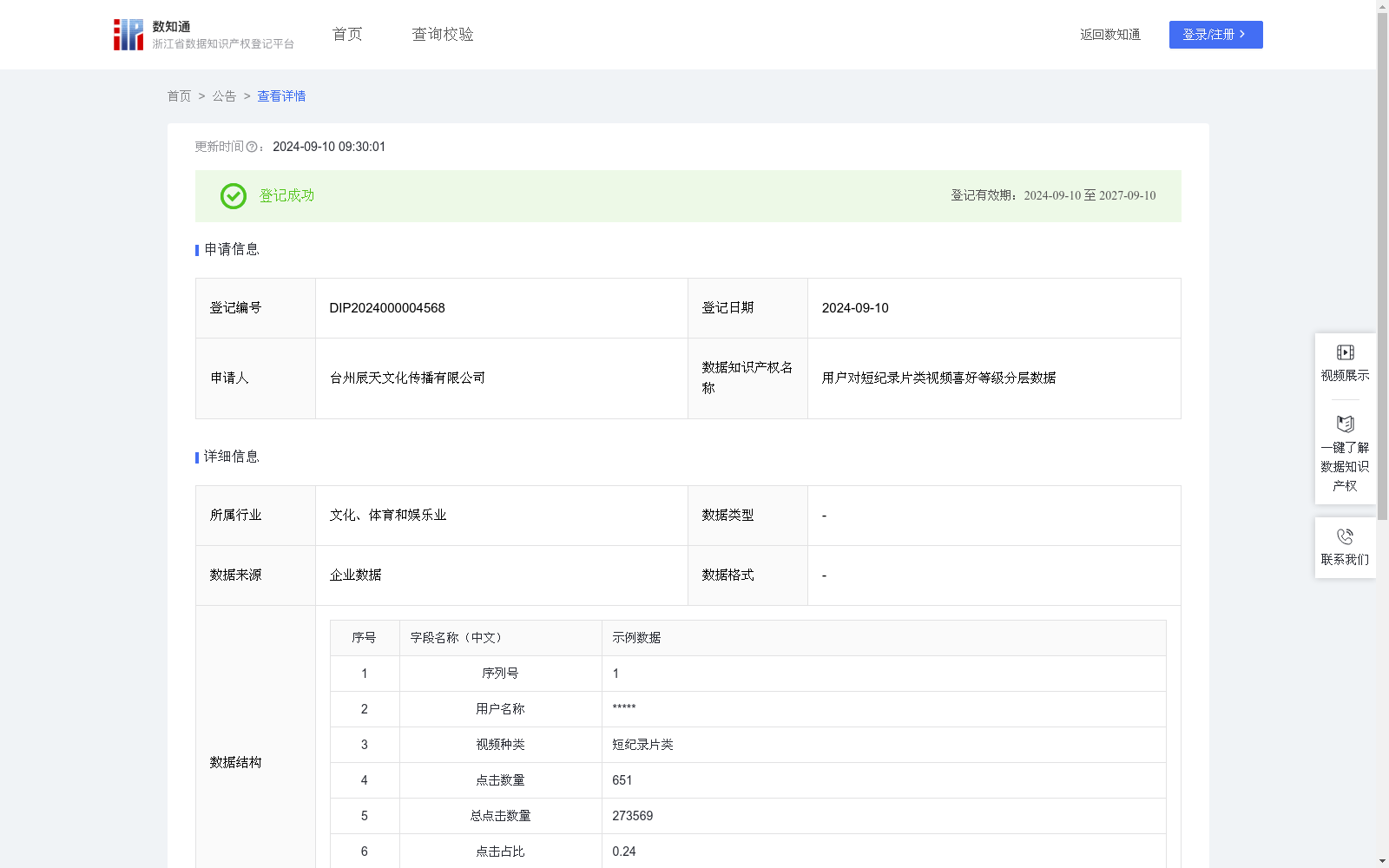
用户对短纪录片类视频喜好等级分层数据
收藏资源简介:
在日常生活工作之余,越来越多的人喜欢刷视频来缓解压力,有部分人群对短纪录片类视频感兴趣。统计分析用户观看短纪录片类视频的数据,通过对历史观看用户建立表格,对用户进行标签制定,定位用户喜好级别,通过大数据推广,为用户推送符合喜好的视频提供数据支持。1. 数据采集:采集用户对短纪录片类视频的点击数量等信息; 2. 用户点击数量占总点击数量的比例=用户点击数量/总点击数量*100%; 3. 用户点击数量占总点击数量的比例按从大到小进行排名;分类运用ABCDEF分类法,对占比0.26%以上的,给予“A类用户”分层;占比0.21%到0.25%区间的,则给予“B类用户”分层;占比在0.16%到0.20%区间,则给予“C类用户”分层;占比在0.11%到0.15%区间,则给予“D类用户”分层;占比在0.06%到0.1%区间,则给予“E类用户”分层;占比在0.05%以下,则给予“F类用户”分层; 4. 数据应用: 短纪录片类视频的点击次数结果可以作为用户喜好等级评价的依据,为监管部门向监管提供技术支撑。
Against the backdrop that an increasing number of people turn to short video browsing to alleviate stress during their spare time following daily work and life, a subset of the population shows interest in short documentary videos. This dataset conducts statistical analysis on user viewing data of short documentary videos, including establishing a table for historical viewers, formulating user tags, positioning users' preference levels, and providing data support for delivering personalized video recommendations via big data promotion. 1. Data Collection: Collect information such as the number of clicks users make on short documentary videos; 2. Calculation of Click Proportion: The proportion of a single user's clicks in the total clicks of all users is calculated as: (User's Click Count / Total Click Count) * 100%; 3. User Stratification: Rank the calculated click proportions from highest to lowest. Adopt the ABCDEF classification framework for stratification: users with a proportion exceeding 0.26% are categorized as "Type A Users"; those with a proportion ranging from 0.21% to 0.25% are "Type B Users"; those with a proportion between 0.16% and 0.20% are "Type C Users"; those with a proportion between 0.11% and 0.15% are "Type D Users"; those with a proportion between 0.06% and 0.10% are "Type E Users"; and users with a proportion below 0.05% are "Type F Users"; 4. Data Application: The click count results of short documentary videos can serve as the basis for evaluating users' preference levels, providing technical support for regulatory authorities to carry out their supervision work.