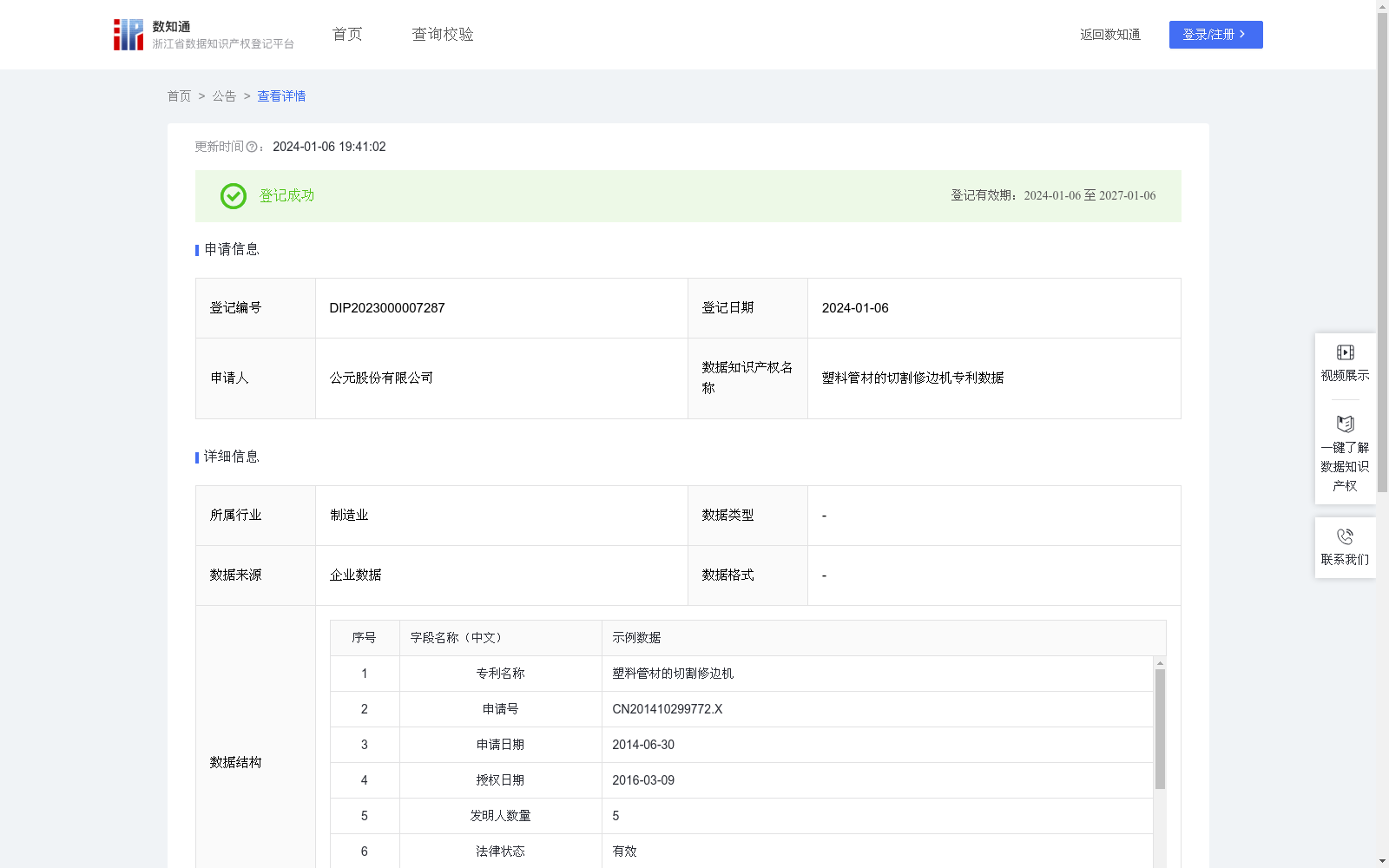
塑料管材的切割修边机专利数据
收藏资源简介:
数据包中主要包括了全球专利数据库中有关塑料管材的切割修边机的专利数据,并根据自有算法对专利数据进行了评价和分类,可用于横向、纵向了解专利数据变化情况及发展方向,有助于了解塑料管材的切割修边机知识产权工作成果;通过各项专利数据的对比,技术发展趋势,有助于企业避免重复研发,避免企业开发的技术侵犯他人的知识产权。本数据基于熵权法的 AHP 模型,目标层为专利价值,指标层将专利价值指标体系分为市场、技术、法律、战略、经济五大价值维度,指标层向下分准则层,包括:技术价值:IPC分类号、被引证专利数、被引证数、简单同族专利申请数量、简单同族被引用数量、授权日;经济价值:剩余有效期、转让次数,许可次数;法律价值:申请时间,法律状态;战略价值:发明人数量、同族数、被引用次数;市场价值:IPC分类号、专利类型。基于层次分析(AHP)的主观赋值方法,通过专利接口数据获取专利评价对应的数据指标,采用1-9分标度法(最低为1分,最高为9分),求得相应的指标权重,用权重技术各个指标的分值,所有指标分值的和即为专利得分,根据分值的区间段对专利进行划分,80-100为高价值专利、60-80位重要专利、60分以下为一般专利,为本领域的研发人员提供技术参考及指引,为公司提供研发决策指导。
The dataset mainly includes patent data related to plastic pipe cutting and trimming machines from the global patent database. It evaluates and classifies the patent data using proprietary algorithms, enabling users to understand the changes and development trends of patent data both horizontally and longitudinally, and facilitating insights into the intellectual property achievements of plastic pipe cutting and trimming machines. By comparing various patent data and analyzing technological development trends, it helps enterprises avoid redundant R&D and prevent the developed technologies from infringing others' intellectual property rights. This dataset is built based on the AHP (Analytic Hierarchy Process) model incorporating the entropy weight method. The target layer of the model is patent value, while the index layer divides the patent value indicator system into five value dimensions: market, technology, law, strategy, and economy. The index layer is further decomposed into criterion layers, which include: - Technical value: IPC classification number, number of cited patents, number of citations received, number of simple patent family applications, number of citations received by simple patent families, authorization date - Economic value: remaining validity period, number of transfers, number of licenses - Legal value: application date, legal status - Strategic value: number of inventors, number of patent families, number of citations received - Market value: IPC classification number, patent type Based on the subjective assignment method of AHP, the data indicators corresponding to patent evaluation are obtained through patent interface data. The 1-9 point scaling method (with 1 being the lowest score and 9 being the highest) is adopted to calculate the corresponding indicator weights. The weights are used to compute the scores of each indicator, and the sum of all indicator scores constitutes the patent score. Patents are categorized based on their score ranges: 80-100 are high-value patents, 60-80 are important patents, and those below 60 are general patents. This dataset provides technical references and guidance for R&D professionals in this field, and offers decision-making support for corporate R&D activities.