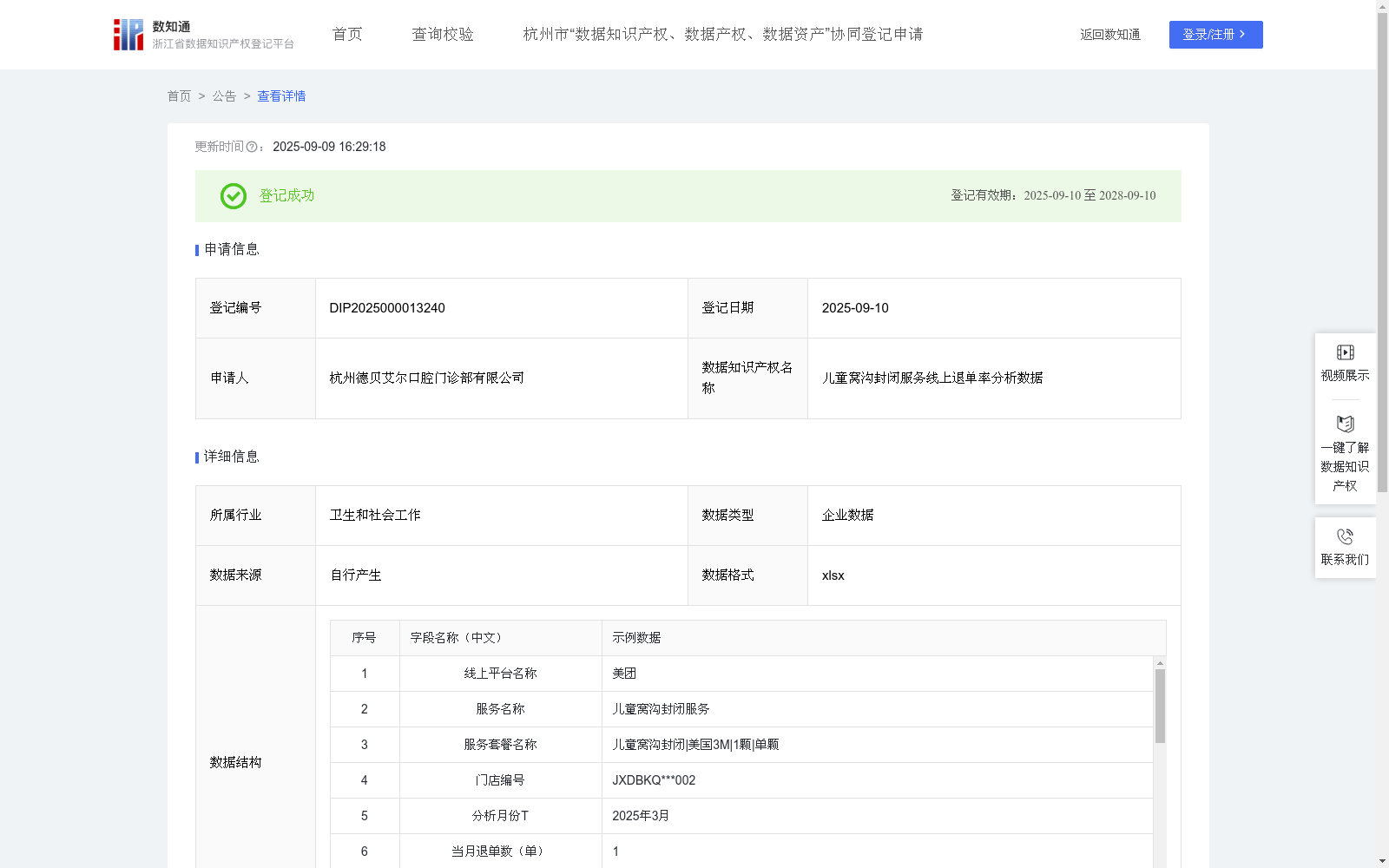
儿童窝沟封闭服务线上退单率分析数据
收藏资源简介:
每月统计退单数和总订单数,结合前三个月的数据,计算历史退单率均值和标准差,并以Z-Score方法判定当月儿童窝沟封闭服务线上退单率是否超出正常波动范围。当|Z|>2时,即识别出异常高或低的退单波动,提示口腔门诊及时排查原因,如服务变动、机构问题或活动影响。通过退单率分析预警退单率异常,帮助其精准锁定风险环节,优化服务流程。该数据亦可为行业内其他口腔医疗机构提供风险监控的参考。1.数据采集和预处理:(1)从公司口腔连锁门诊管理系统采集儿童窝沟封闭服务有关的销售数据,字段包括:线上平台名称、服务名称、服务套餐名称(共有3类套餐)、门店编号(公司拥有7家门店)、分析月份T、当月退单数、当月订单数、T-1月退单数、T-2月退单数、T-3月退单数、T-1月订单数、T-2月订单数、T-3月订单数;(2)对采集的数据进行清洗;2.计算当月退单率、T-1月退单率、T-2月退单率、T-3月退单率:退单率 = 某月退单数 / 当月订单数;计算历史退单率均值:历史退单率均值 = (T-1月退单数 + T-2月退单数 + T-3月退单数)/ 3;3.通过Z-Score方法识别异常:历史退单率标准差 = √{[(T-1月退单率-历史退单率均值)^2+(T-2月退单率-历史退单率均值)^2+(T-3月退单率-历史退单率均值)^2]/3};当月Z-Score = (当月退单率 – 历史退单率均值)/历史退单率标准差;4.异常判定:若|Z|>2,说明当月退单率异常;若|Z|≤2,说明当月退单率正常。
Monthly statistics on refund order volume and total order volume are performed. Combined with data from the preceding three months, the mean and standard deviation of historical refund rates are calculated, and the Z-Score method is employed to determine whether the online refund rate of children's pit and fissure sealing services in the current month deviates beyond the normal fluctuation range. When |Z| > 2, abnormally high or low refund rate fluctuations are identified, prompting dental clinics to promptly investigate potential causes such as service adjustments, institutional issues, or the impacts of promotional campaigns. Refund rate analysis enables early warning of abnormal refund rates, helping clinics accurately identify risk links and optimize service workflows. This dataset can also serve as a reference for risk monitoring among other dental medical institutions within the industry. 1. Data Collection and Preprocessing: (1) Sales data related to children's pit and fissure sealing services are collected from the company's dental chain clinic management system. The collected data fields include: online platform name, service name, service package name (totaling 3 types of packages), store number (the company operates 7 stores), analysis month T, monthly refund order volume, monthly total order volume, T-1 month refund order volume, T-2 month refund order volume, T-3 month refund order volume, T-1 month total order volume, T-2 month total order volume, and T-3 month total order volume; (2) Perform data cleaning on the collected dataset. 2. Refund Rate Calculation: Calculate the refund rates for the current month, T-1 month, T-2 month, and T-3 month as follows: Refund Rate = Monthly Refund Order Volume / Monthly Total Order Volume; Calculate the historical refund rate mean: Historical Refund Rate Mean = (T-1 Month Refund Order Volume + T-2 Month Refund Order Volume + T-3 Month Refund Order Volume) / 3; 3. Anomaly Detection via Z-Score Method: Compute the historical refund rate standard deviation using the formula: Historical Refund Rate Standard Deviation = sqrt( [(T-1 Month Refund Rate - Historical Refund Rate Mean)² + (T-2 Month Refund Rate - Historical Refund Rate Mean)² + (T-3 Month Refund Rate - Historical Refund Rate Mean)²] / 3 ); Calculate the current month's Z-Score as: Current Month Z-Score = (Current Month Refund Rate - Historical Refund Rate Mean) / Historical Refund Rate Standard Deviation; 4. Anomaly Determination: If |Z| > 2, the refund rate of the current month is deemed abnormal; if |Z| ≤ 2, the refund rate of the current month is considered normal.