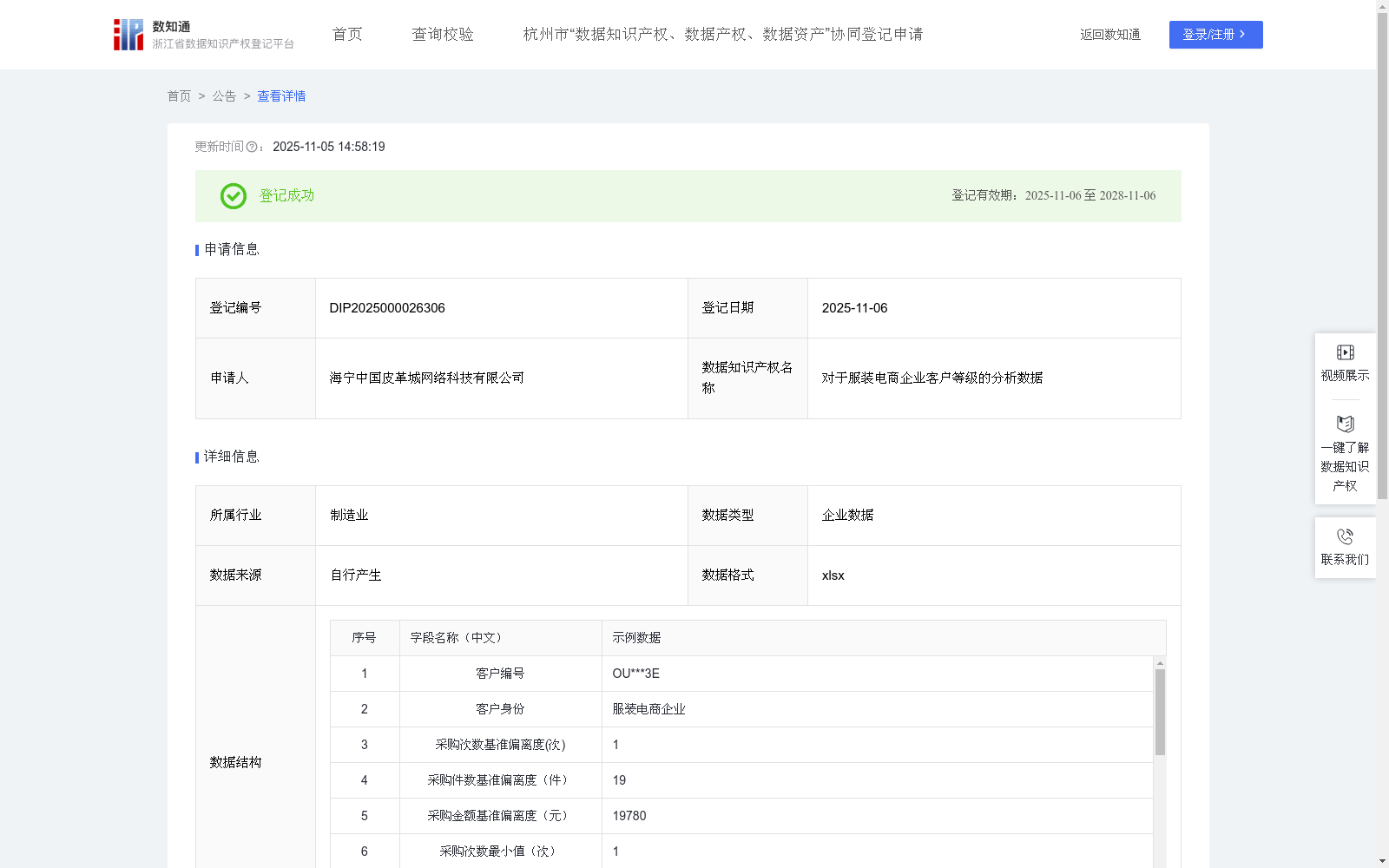
对于服装电商企业客户等级的分析数据
收藏资源简介:
通过收集和分析服装电商企业客户对皮革服装采购的相关数据,了解客户的购买力水平和采购偏好,一是可以为本行业的所有企业制定生产策略提供依据,二是市场管理方可以制定更精准的生产营销策略,为企业提供个性化的商品和服务。对于S级客户每月进行市场信息精准推送,对于A等级客户每季度进行市场信息精准推送,对于B等级每半年进行市场信息精准推送,对于C等级客户每年进行市场信息精准推送,对于D等级客户每两年进行市场信息精准推送。1、数据处理:对采集到的数据进行降噪、清洗、脱敏、聚集、分析。 2.数据加工:客户评分=0.25*(采购次数基准偏离度/采购次数极差)+0.25*(采购件数基准偏离度/采购件数极差)+0.3*(采购金额基准偏离度/采购金额极差)+0.2*身份权重,对结果进行四舍五入。其中采购次数基准偏离度=该客商采购总次数-采购次数最小值;采购件数基准偏离度=该客商采购总件数-采购次数最小值;采购金额基准偏离度=该客商采购总金额-采购金额最小值;采购次数最小值、采购次数最小值、采购金额最小值分别来源于所有客商的采购数据中取最小的数值。3.客户等级:客户评分>=0.3,为S级客户;0.2<=客户评分<0.3,为A级客户;0.1<=客户评分<0.2,为B级客户;0.05<=客户评分<0.1,为C级客户;客户评分<0.05,为D级客户。客户评分分数越高越好,根据评级安排更精准的生产营销策略。
By collecting and analyzing relevant data on leather apparel purchases from customers of apparel e-commerce enterprises, this dataset is designed to understand customers' purchasing power and procurement preferences. The findings serve two core purposes: first, to provide a reliable basis for all enterprises in the industry to formulate production strategies; second, to enable market regulators to develop more precise production and marketing strategies, thereby providing personalized products and services for enterprises. Targeted market information will be pushed monthly for S-level customers, quarterly for A-level customers, semi-annually for B-level customers, annually for C-level customers, and biennially for D-level customers. 1. Data Processing: Denoise, clean, anonymize, aggregate and analyze the collected data. 2. Data Calculation: The customer score is calculated as: Customer Score = 0.25*(Purchasing Frequency Benchmark Deviation / Purchasing Frequency Range) + 0.25*(Purchased Quantity Benchmark Deviation / Purchased Quantity Range) + 0.3*(Purchasing Amount Benchmark Deviation / Purchasing Amount Range) + 0.2*Identity Weight, and the result is rounded off. Where: Purchasing Frequency Benchmark Deviation = Total purchasing times of the merchant - Minimum purchasing frequency; Purchased Quantity Benchmark Deviation = Total purchased pieces of the merchant - Minimum purchasing frequency; Purchasing Amount Benchmark Deviation = Total purchasing amount of the merchant - Minimum purchasing amount; The minimum purchasing frequency, minimum purchasing frequency and minimum purchasing amount are respectively extracted from the minimum values in the purchasing data of all merchants. 3. Customer Segmentation: Customers are classified into levels based on their scores: S-level customers if Customer Score ≥ 0.3; A-level customers if 0.2 ≤ Customer Score < 0.3; B-level customers if 0.1 ≤ Customer Score < 0.2; C-level customers if 0.05 ≤ Customer Score < 0.1; D-level customers if Customer Score < 0.05. Higher customer scores represent better purchasing performance, and more precise production and marketing strategies will be arranged according to the customer level.