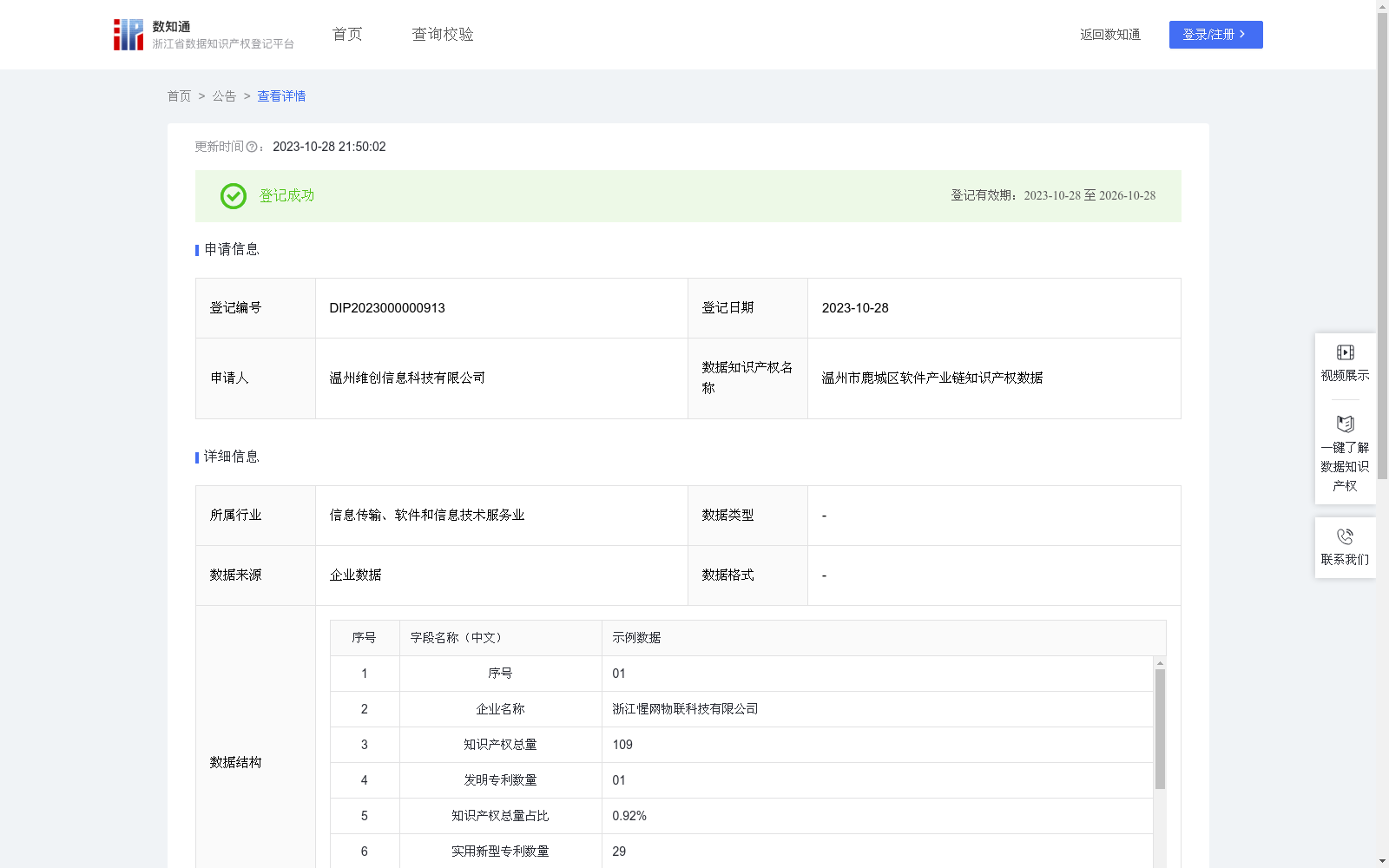
温州市鹿城区软件产业链知识产权数据
收藏资源简介:
通过采集温州市鹿城区软件产业链部分企业,对各企业拥有的法律状态为有效的知识产权数量进行统计,将部分数量相加即为各企业知识产权总量,计算各个企业各类知识产权数量占该企业知识产权总量的百分比,以帮助温州市鹿城区软件产业链企业进行知识产权战略制定。温州市鹿城区软件产业链知识产权数据算法规则包括以下步骤:1、数据采集:查找及筛选该辖区内的软件产业链企业,通过国家知识产权局及第三方知识产权数据库,对各企业的知识产权总量、发明专利数量、实用新型专利数量、外观设计专利数量、商标数量及软件著作权数量进行采集;2、数据处理:对采集到的数据分别计算各类知识产权数量占知识产权总量的占比,发明专利占知识产权总量的占比=发明专利数量/知识产权总量,实用新型专利占知识产权总量的占比=实用新型专利数量/知识产权总量,外观设计专利占知识产权总量的占比=外观设计专利数量/知识产权总量,商标占知识产权总量的占比=商标数量/知识产权总量,软件著作权占知识产权总量的占比=软件著作权数量/知识产权总量;3、经过统计、筛选得到各企业发明专利数量、实用新型专利数量、外观设计专利数量、商标数量及软件著作权数量合理比例范围,4、数据应用:根据各类知识产权的比例范围,结合各知识产权的申请客体属性为企业提供研发方向,为软件产业链企业在知识产权布局上提出合理建议。
This dataset is developed by sampling partial enterprises within the software industry chain of Lucheng District, Wenzhou City. Specifically, we first count the quantity of valid intellectual property (IP) held by each enterprise, sum the quantities of valid IPs to calculate the total IP volume of each enterprise, then compute the percentage of each category of IP quantity relative to the enterprise's total IP volume, to assist enterprises in the Lucheng District software industry chain in formulating their intellectual property strategies. The algorithmic rules for the intellectual property data of the Lucheng District software industry chain are as follows: 1. Data Collection: Identify and screen enterprises in the local software industry chain. Collect the total IP volume, number of invention patents, utility model patents, design patents, trademarks, and software copyrights of each enterprise through the National Intellectual Property Administration and third-party IP databases. 2. Data Processing: Calculate the proportion of each category of IP quantity relative to the total IP volume for the collected data individually. The specific calculation formulas are: - Proportion of invention patents = Number of invention patents / Total IP volume - Proportion of utility model patents = Number of utility model patents / Total IP volume - Proportion of design patents = Number of design patents / Total IP volume - Proportion of trademarks = Number of trademarks / Total IP volume - Proportion of software copyrights = Number of software copyrights / Total IP volume 3. Obtain the reasonable proportion ranges for the quantity of each IP category (invention patents, utility model patents, design patents, trademarks, and software copyrights) of each enterprise via statistics and screening. 4. Data Application: Provide targeted R&D directions for enterprises based on the proportion ranges of each IP category and the attributes of the protected subjects of each type of intellectual property, and put forward rational suggestions for intellectual property layout for enterprises in the software industry chain.