
Database of fraction unbound in plasma (fu) measurements
收藏DataCite Commons2024-03-01 更新2024-07-13 收录
下载链接:
https://figshare.manchester.ac.uk/articles/dataset/Database_of_fraction_unbound_in_plasma_fu_measurements/25243138
下载链接
链接失效反馈官方服务:
资源简介:
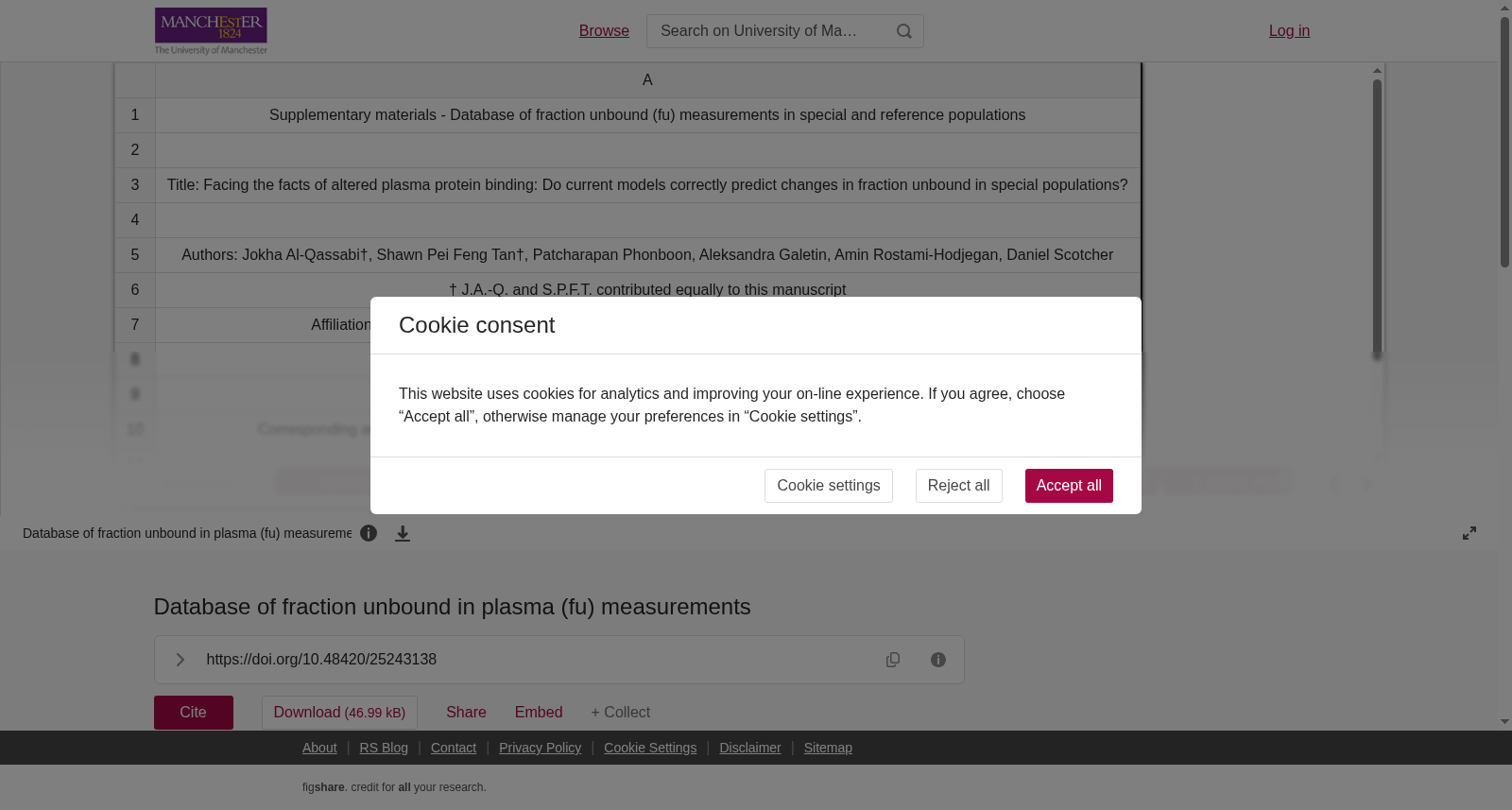
A database of fraction unbound in plasma (fu) measurements collated from literature sources in reference and special populations.The data was collected and is reported as supplementary material for the manuscript "<b>Facing the facts of altered plasma protein binding: Do current models correctly predict changes in fraction unbound in special populations?</b>" published in Journal of Pharmaceutical SciencesDOI: 10.1016/j.xphs.2024.02.024<b>Authors:</b> Jokha Al-Qassabi<sup>†,a,b</sup> , Shawn Pei Feng Tan<sup>†,a</sup> , Patcharapan Phonboon<sup>a</sup> , Aleksandra Galetin<sup>a</sup> , Amin Rostami-Hodjegan<sup>a,c</sup> , Daniel Scotcher<sup>a</sup> <sup>†</sup> <i>J.A.-Q. and S.P.F.T. contributed equally to this manuscript </i><b>Affiliations:</b> <sup>a</sup> Centre for Applied Pharmacokinetic Research, University of Manchester, Manchester, UK;<sup> b</sup> Current affiliation: University of Technology and Applied Sciences, Oman; <sup>c</sup> Simcyp Division, Certara UK Limited, Sheffield, UK<b>Abstract:</b>Accounting for variability in plasma protein binding of drugs is an essential input to physiologically-based pharmacokinetic (PBPK) models of special populations. Prediction of fraction unbound in plasma (fu) in such populations typically considers changes in plasma protein concentration while assuming that the binding affinity remains unchanged. A good correlation between predicted vs observed fu data reported for various drugs in a given special population is often used as a justification for such predictive methods. However, none of these analyses evaluated the prediction of the fold-change in fu in special populations relative to the reference population. This would be a more appropriate assessment of the predictivity, analogous to drug-drug interactions. In this study, predictive performance of the single protein binding was assessed by predicting fu for alpha-1-acid glycoprotein and albumin bound drugs in hepatic impairment, renal impairment, paediatric, elderly, patients with inflammatory disease, and in different ethnic groups for a dataset of >200 drugs. For albumin models, the concordance correlation coefficients for predicted fu were >0.90 for 16 out of 17 populations with sub-groups, indicating strong agreement between predicted and observed values. In contrast, concordance correlation coefficients for predicted fold-change in fu for the same dataset were <0.38 for all populations and sub-groups. Trends were similar for alpha-1-acid glycoprotein models. Accordingly, the predictions of fu solely based on changes in protein concentrations in plasma cannot explain the observed values in some special populations. We recommend further consideration of the impact of changes in special populations to endogenous substances that competitively bind to plasma proteins, and changes in albumin structure due to posttranslational modifications. PBPK models of special populations for highly bound drugs should preferably use measured fu data to ensure reliable prediction of drug exposure or compare predicted unbound drug exposure between populations knowing that these will not be sensitive to changes in fu.
本数据集为血浆游离药物分数(fraction unbound in plasma, fu)测量数据库,其数据整理自参考人群与特殊人群的文献来源。本数据集作为发表于《Journal of Pharmaceutical Sciences》(DOI: 10.1016/j.xphs.2024.02.024)的论文**《直面血浆蛋白结合改变的真相:当前模型能否准确预测特殊人群的血浆游离药物分数变化?》**的补充材料发布,相关数据已完成收集整理。
**作者:** Jokha Al-Qassabi<sup>†,a,b</sup>、Shawn Pei Feng Tan<sup>†,a</sup>、Patcharapan Phonboon<sup>a</sup>、Aleksandra Galetin<sup>a</sup>、Amin Rostami-Hodjegan<sup>a,c</sup>、Daniel Scotcher<sup>a</sup><sup>†</sup> <i>注:J.A.-Q.与S.P.F.T.对本论文贡献等同</i>
**作者单位:** <sup>a</sup> 英国曼彻斯特大学应用药代动力学研究中心;<sup>b</sup> 现任职单位:阿曼理工与应用科学大学;<sup>c</sup> 英国谢菲尔德Certara UK Limited公司Simcyp事业部
**摘要:** 药物血浆蛋白结合的变异性分析是构建特殊人群生理药代动力学(physiologically-based pharmacokinetic, PBPK)模型的核心输入参数之一。针对此类人群的血浆游离药物分数(fu)预测,通常仅考虑血浆蛋白浓度的变化,同时假设药物与蛋白的结合亲和力保持不变。现有研究常以特定特殊人群中不同药物的预测fu值与实测值间的良好相关性,作为此类预测方法的合理性依据。然而,现有相关分析均未评估特殊人群相对于参考人群的fu倍数变化预测效果——该评估方式与药物-药物相互作用的预测性评价思路更为契合,是更为合理的预测性能考察维度。本研究针对包含200余种药物的数据集,通过预测肝损伤、肾损伤、儿科、老年、炎症性疾病患者及不同种族人群中与α1-酸性糖蛋白、白蛋白结合的药物的fu值,评估了单一蛋白结合模型的预测性能。针对白蛋白结合模型,在17个带亚组的人群中,有16个人群的预测fu值的一致性相关系数大于0.90,表明预测值与实测值间具有高度一致性。与之相反,同一数据集的fu倍数变化预测值的一致性相关系数在所有人群及亚组中均小于0.38。α1-酸性糖蛋白结合模型也呈现出相似的趋势。因此,仅基于血浆蛋白浓度变化的fu预测方法,无法解释部分特殊人群中的实测fu值。我们建议进一步研究特殊人群内源性物质变化对血浆蛋白结合的竞争性影响,以及翻译后修饰导致的白蛋白结构改变。针对高结合率药物的特殊人群生理药代动力学(PBPK)模型,建议优先采用实测fu数据以确保药物暴露量预测的可靠性;若需比较不同人群的游离药物暴露量,则应知晓此类比较不受fu变化的影响。
创建时间:
2024-02-21
搜集汇总
数据集介绍
以上内容由遇见数据集搜集并总结生成


