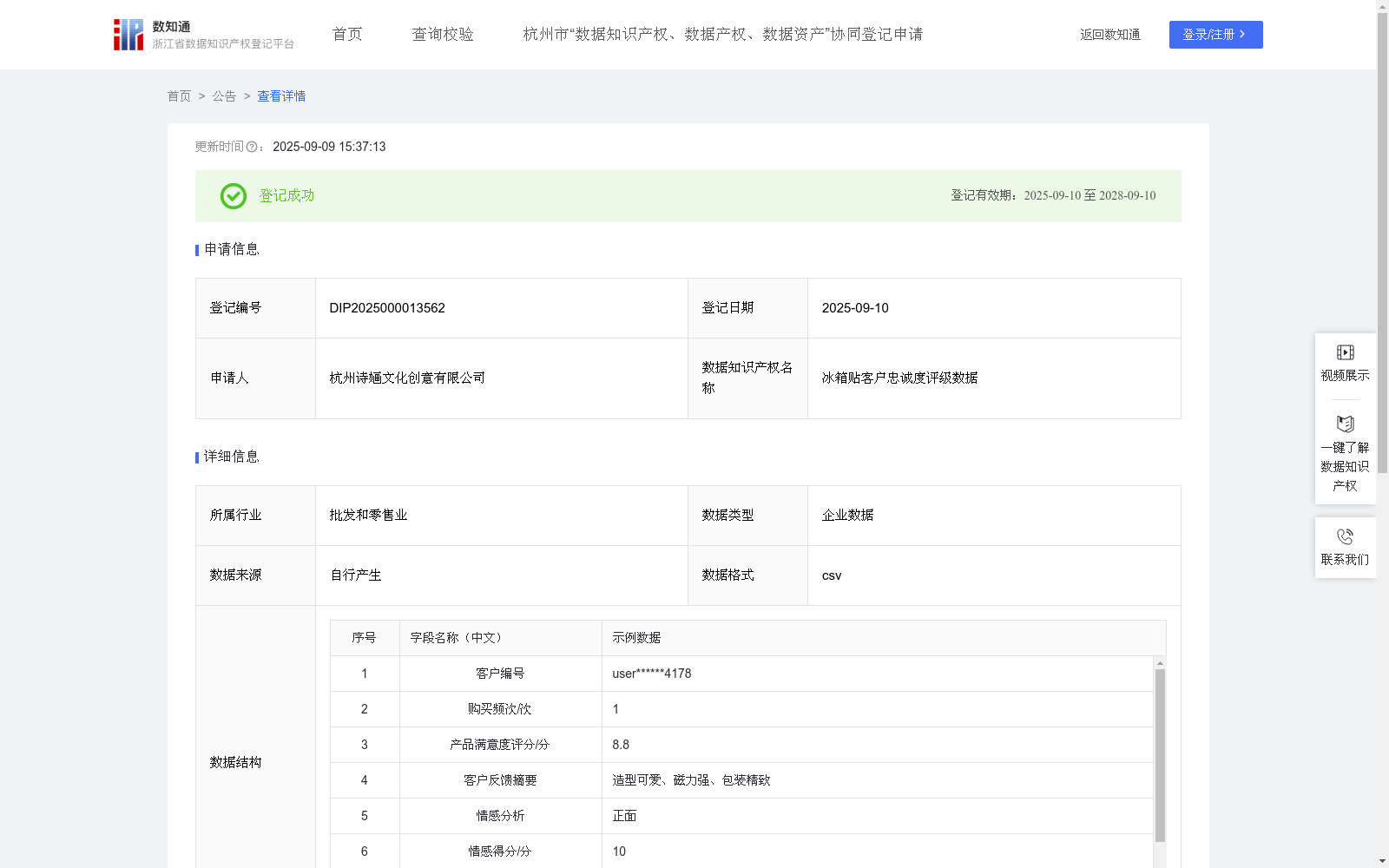
冰箱贴客户忠诚度评级数据
收藏资源简介:
本数据通过对冰箱贴消费者的购买行为与互动反馈进行综合评级,反映客户在重复购买、主题偏好延续及品牌关注方面的表现情况。该评级有助于企业识别用户对系列化、主题化产品的持续兴趣程度,了解不同群体的使用黏性特征。对于文创品牌商、文旅合作单位及线上销售平台而言,此类数据可作为观察用户参与深度的参考,辅助优化产品线布局与用户沟通方式。同时,该评级也为相关服务方了解消费持续性提供支持,增强对用户行为趋势的整体认知。1.数据收集和预处理:从公司内部订单管理系统中收集客户编号、购买频次、产品满意度评分、客户反馈摘要。通过数据清洗去除无效或错误记录,确保数据质量。 2.计算购买频次得分:根据行业经验划分以下得分区间,将每个客户购买频次映射到相应得分区间。1次:2分;2次:4分;3次:6分;4次:8分;5次及以上:10分 。 3.情感分析:使用情感分析模型(基于机器学习的文本分类模型)对客户反馈摘要进行情感分析,输出为正面、中性或负面。 4.情感得分转换:将情感分析转换为定量得分:正面得10分,中性得6分,负面得2分 。 5.权重分配:根据影响程度研讨确定满意度评分、购买频次和情感得分的权重,满意度评分70%,购买频次20%,情感得分10% 。 6.客户忠诚度评分计算:客户忠诚度评分=(服务满意度评分×0.7)+(购买频次得分×0.2)+(情感得分×0.1) 。 7.客户忠诚度评级:研讨设定以下评级得分,给出客户忠诚度评级 A级(高忠诚度):9分及以上; B级(中高忠诚度):8分(含)~9分(不含); C级(中等忠诚度):6分(含)~8分(不含); D级(低忠诚度):6分以下。
This dataset comprehensively rates the purchase behavior and interactive feedback of fridge magnet consumers, reflecting customers' performance in repeat purchases, consistency of theme preferences, and brand attention. Such ratings help enterprises identify the degree of users' sustained interest in serialized and themed products, and understand the user stickiness characteristics of different groups. For cultural and creative brand operators, cultural tourism cooperation partners, and online sales platforms, this type of data can serve as a reference for observing the depth of user participation, assisting in optimizing product line layout and user communication methods. Additionally, this rating provides support for relevant service parties to understand consumption continuity and enhances the overall awareness of user behavior trends. 1. Data Collection and Preprocessing: Collect customer ID, purchase frequency, product satisfaction score, and customer feedback summaries from the company's internal order management system. Perform data cleaning to remove invalid or erroneous records and ensure data quality. 2. Purchase Frequency Score Calculation: Divide into the following score intervals based on industry experience, and map each customer's purchase frequency to the corresponding score interval: 1 purchase: 2 points; 2 purchases: 4 points; 3 purchases: 6 points; 4 purchases: 8 points; 5 or more purchases: 10 points. 3. Sentiment Analysis: Use a sentiment analysis model (machine learning-based text classification model) to conduct sentiment analysis on customer feedback summaries, outputting positive, neutral, or negative results. 4. Sentiment Score Conversion: Convert sentiment analysis results into quantitative scores: positive gets 10 points, neutral gets 6 points, negative gets 2 points. 5. Weight Allocation: Determine the weights of satisfaction score, purchase frequency score, and sentiment score through discussion based on impact degree: satisfaction score accounts for 70%, purchase frequency score 20%, and sentiment score 10%. 6. Customer Loyalty Score Calculation: Customer Loyalty Score = (Service Satisfaction Score × 0.7) + (Purchase Frequency Score × 0.2) + (Sentiment Score × 0.1). 7. Customer Loyalty Rating: Set the following rating score ranges through discussion to assign customer loyalty ratings: Level A (High Loyalty): 9 points and above; Level B (Medium-High Loyalty): 8 (inclusive) to 9 (exclusive) points; Level C (Medium Loyalty): 6 (inclusive) to 8 (exclusive) points; Level D (Low Loyalty): below 6 points.