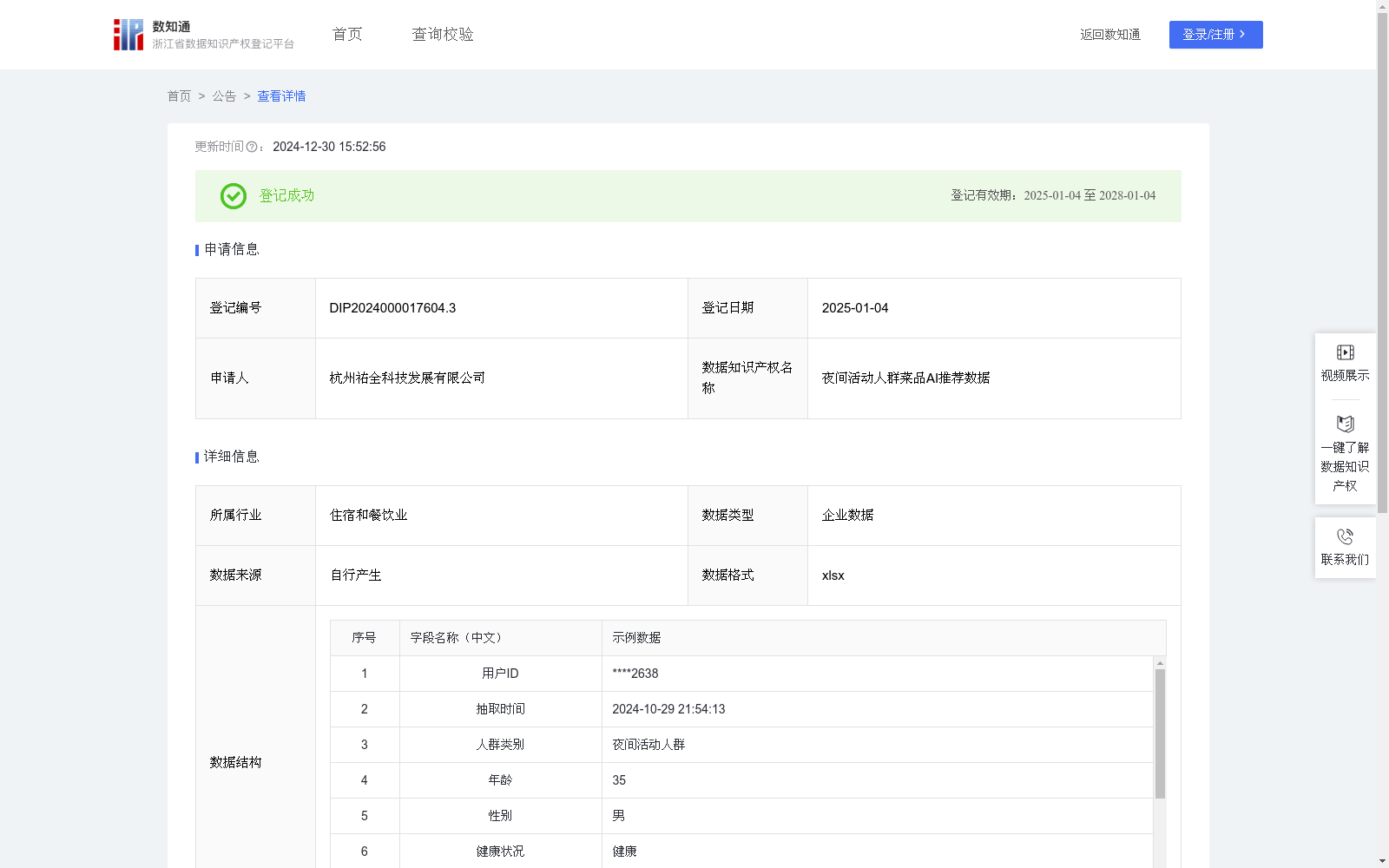
夜间活动人群菜品AI推荐数据
收藏资源简介:
夜间活动人群菜品AI推荐数据的应用场景主要体现在为夜间活动者、个人健康顾问以及餐饮服务商提供智能化、精准化的菜品推荐服务。通过分析夜间活动人群的基本信息和饮食习惯,AI模型能够为每位夜间活动者推荐符合其能量需求和健康考量的菜品,有助于丰富夜间活动者的就餐选择。对于个人健康顾问而言,通过本数据可以更好地了解夜间活动者的饮食习惯和营养摄入情况,从而提供更科学的饮食建议。餐饮服务商也能通过这些数据来调整菜单,确保菜品的多样性和营养均衡,满足不同夜间活动者的需求。1.数据收集和预处理:(1)从公司订单系统抽取用户ID、抽取时间、人群类别、年龄、性别、健康状况、饮食习惯。(2)通过数据清洗去除无效或错误记录,确保数据质量。 2.特征生成:根据人群类别、年龄、性别、健康状况、饮食习惯,使用Feature-engine工具进行特征转换,生成特征标签。 3.实时预测:运用经公司自行训练和部署的基于深度交叉网络(DCN)深度学习架构的夜间活动人群菜品智能推荐模型,根据生成的特征标签,对菜品进行实时预测和推荐。 4.结果解释:利用SHAP方法对推荐菜品进行解释,确保结构对用户的可理解性和可解释性。 5.评价优化:收集用户对推荐菜品的反馈,利用反馈数据对模型进行进一步的迭代和优化。
The application scenarios of the AI-powered dish recommendation dataset for night-active populations mainly focus on providing intelligent and precise dish recommendation services for night-active individuals, personal health consultants, and catering service providers. By analyzing the basic information and dietary habits of night-active groups, the AI model can recommend dishes that meet each user's energy needs and health considerations, which helps enrich the dining choices of night-active individuals. For personal health consultants, this dataset allows them to better understand the dietary habits and nutritional intake of night-active people, thereby providing more scientific dietary advice. Catering service providers can also use this data to adjust their menus, ensuring dish diversity and nutritional balance to meet the needs of different night-active users. 1. Data Collection and Preprocessing: (1) Extract user ID, extraction time, population category, age, gender, health status, and dietary habits from the company's order system. (2) Conduct data cleaning to remove invalid or erroneous records to ensure data quality. 2. Feature Generation: Generate feature labels by performing feature transformation using the Feature-engine tool based on population category, age, gender, health status, and dietary habits. 3. Real-time Prediction: Utilize the intelligent dish recommendation model for night-active populations, which is independently trained and deployed by the company and based on the Deep & Cross Network (DCN) deep learning architecture, to conduct real-time dish prediction and recommendation based on the generated feature labels. 4. Result Explanation: Explain the recommended dishes using the SHAP method to ensure the understandability and interpretability of the results for users. 5. Evaluation and Optimization: Collect user feedback on the recommended dishes, and use the feedback data to further iterate and optimize the model.